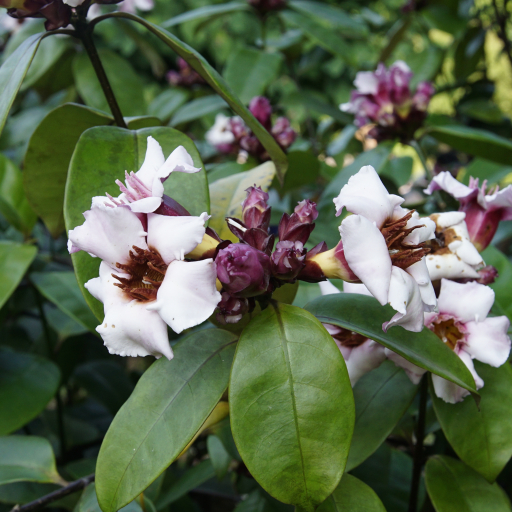
Plant Overview
Often called the Climbing Oleander or Rose Allamanda, Strophanthus gratus is a tropical masterpiece that bridges the gap between a sturdy shrub and a graceful vine. Native to the lush forests of West Africa, it captivates gardeners with its intoxicating rose-like fragrance and elegant, waxy blooms. Despite its delicate appearance, this plant holds a powerful chemical secret within its sap that has shaped both tribal history and modern medicine.
🔍 How to Identify
- 🌸 The Blooms: Large, funnel-shaped flowers that appear in clusters at the ends of branches. They are typically white or pale pink with a distinct, fleshy "corona" (a crown-like ring) in the center that looks like small, purple-tinged teeth.
- 🍃 The Foliage: Thick, leathery, and glossy evergreen leaves. They grow in opposite pairs and have a deep, polished green hue that provides a dramatic backdrop for the lighter flowers.
- 🪜 Growth Habit: This is a "scandent" shrub, meaning it can grow as a mounding bush or, if given a trellis, will use its woody stems to scramble upward of 25 feet.
🏡 In Your Garden
- ☁️ Atmospheric Needs: This plant is a true tropical; it craves high humidity and warmth. If you live in a drier climate, it will appreciate regular misting or being placed near a water feature to prevent its buds from dropping prematurely.
- ✂️ Pruning & Support: Because it is a vigorous grower, it needs a "firm hand." Pruning after the flowering season helps maintain a compact, bushy shape if you don't have the space for a massive vine. Be sure to provide a sturdy structure, as the woody stems can become quite heavy over time.
⚠️ Safety & Toxicity
- 🚫 Status: Extremely Dangerous / Highly Toxic.
- 💔 The Risk: Every part of this plant—especially the seeds and sap—contains G-strophanthin (Ouabain), a potent cardiac glycoside. If ingested, it can cause severe heart palpitations or even cardiac arrest.
- 🧤 Pet & Child Safety: It is not recommended for households with curious pets or small children. Even the milky sap can cause intense skin irritation or "burning" sensations. Always wear gloves and eye protection when pruning.
✨ Fun Fact
🏹 The Arrow Poison: For centuries, various African tribes used the seeds of Strophanthus gratus to create lethal arrow poisons for hunting big game. Paradoxically, the very same toxin was later refined by scientists into a medicine used to treat congestive heart failure!

Detailed Care Instructions
To grow Strophanthus Gratus, also known as the climbing oleander, you can follow these steps:
- Climate: Make sure you live in a suitable climate for this plant. Strophanthus Gratus thrives in warm tropical regions with temperatures between 65-85°F (18-29°C). It prefers a humid environment but can tolerate some drier conditions.
- Soil: Use well-draining soil with a pH range of 6.0-7.5. Prepare a pot or choose a planting spot with sandy loam soil enriched with organic matter.
- Propagation: You can propagate Strophanthus Gratus through seeds or cuttings. If using seeds, soak them in water for 24 hours before planting. Sow the seeds about 1/4 inch deep in the soil, keep them moist, and provide indirect sunlight. Germination can take a few weeks. If using cuttings, take a 4-6 inch long cutting from a healthy plant and plant it in well-draining soil. Keep the soil moist until the roots develop.
- Planting: Choose a location that offers partial shade or filtered sunlight. Dig a hole slightly larger than the root ball of your plant. Place the plant in the hole and backfill with soil, slightly firming it around the base. Water thoroughly after planting.
- Watering: Strophanthus Gratus prefers evenly moist soil but does not like to be waterlogged. Water regularly, allowing the top few inches of soil to dry out between waterings. Adjust watering frequency based on the environmental conditions and the moisture needs of the plant.
- Fertilization: Apply a balanced, water-soluble fertilizer every 2-4 weeks during the growing season. Follow the instructions on the fertilizer packaging for the correct application rate. Avoid excessive fertilization, as it can negatively impact the plant's health.
- Pruning: Pruning is essential to keep the plant shape and promote better flowering. After the blooming season, trim back any dead, damaged, or overgrown branches. You can also lightly prune to control the plant's size and shape.
- Support: As a climbing plant, Strophanthus Gratus requires support to grow vertically. Install trellises or a sturdy frame for it to latch onto and climb. Monitor the growth and guide the plant on the support structure as needed.
- Pests and diseases: Keep an eye out for pests like aphids, spider mites, and mealybugs. Treat infestations promptly with insecticidal soap or other appropriate pesticides. Also, ensure good airflow around the plant to prevent fungal diseases.
- Winter care: If you live in a region with cold winters, consider growing Strophanthus Gratus as a potted plant so you can bring it indoors during the colder months. Place the plant in a sunny location and reduce watering during winter dormancy.
Remember to research and follow any local regulations regarding the cultivation of Strophanthus Gratus, as it is considered toxic to humans and animals if ingested. Handle the plant with gloves and avoid contact with sap or any other plant parts.

Place in a bright room that is sun drenched almost all day. Or directly in a south-facing window.

To water this plant, it is important to allow the soil to dry out slightly between waterings. This can be tested by sticking your finger into the soil up to the first knuckle and feeling for moisture. If the soil feels dry, it is time to water. Water the plant thoroughly, allowing water to run out of the drainage holes in the bottom of the pot. Do not let the plant sit in standing water as this can lead to root rot. This plant prefers well-draining soil and does not tolerate waterlogged conditions. In periods of hot weather or if the plant is in a warmer, drier environment, it may require more frequent watering.
To fertilize this plant, use a balanced fertilizer with equal amounts of nitrogen, phosphorus, and potassium. Apply the fertilizer once a month during the growing season, starting in the spring and ending in the fall. Dilute the fertilizer with water according to the instructions on the package and apply it directly onto the soil around the base of the plant. Avoid getting the fertilizer on the leaves as this can cause leaf burn. Water the plant deeply after fertilizing to help the nutrients reach the roots.
The ideal soil for the Strophanthus Gratus plant should be well-draining with good water retention properties. It should be slightly acidic, with a pH range of 5.5 to 6.5. The soil should also be rich in nutrients, including nitrogen, phosphorus, and potassium, to support healthy growth and blooming. Organic matter such as compost or peat should be added to improve the soil's fertility and structure. Additionally, the soil should be free of any contaminants or toxins that can harm the plant's delicate roots.
Propagation of this plant can be done through seeds, stem cuttings, and layering. For seeds, they should be harvested when they are ripe and sown immediately after collection. To improve germination rates, seeds can be soaked in warm water for 24 hours before planting. Cuttings should be taken from the tip of healthy stems and treated with rooting hormone before being placed in a well-draining soil mixture. Layering involves bending a low-lying stem to the ground and securing it with a stake or rock. A wound is made on the stem where it touches the soil, and it is covered with soil. After roots have formed, the stem can be cut and transplanted.








