Plant Overview
Commonly known as a "tree-hugging" parasite, Struthanthus orbicularis is a fascinating hemiparasitic shrub native to the tropical forests of Central and South America. Often referred to by the dramatic nickname "Matapalo" (Tree Killer) in Spanish-speaking regions, it lives its entire life high in the canopy. While it creates its own energy through photosynthesis, it is a master thief that "borrows" water and minerals from its host tree to survive.
🔍 How to Identify
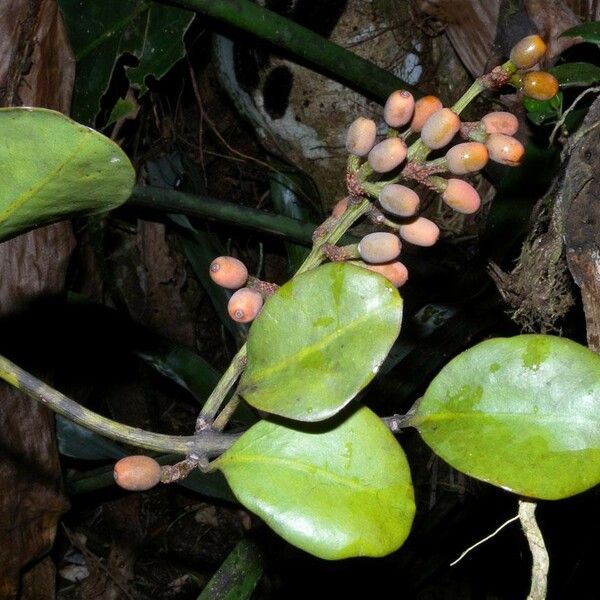
- 🟢 Orbicular Leaves: As the name suggests, the leaves are nearly perfectly round, thick, and leathery, providing a distinct look compared to the thinner leaves of many host trees.
- 🌿 Woody Attachment: Unlike vines that just wrap around a trunk, this plant emerges directly from the branches of another tree, forming a woody, tangled clump.
- 🌸 Small Flowers: It produces clusters of tiny, inconspicuous greenish-white or yellow flowers that are often hidden among the foliage.
- 🍒 Sticky Berries: After flowering, it produces small, fleshy berries that are highly attractive to tropical birds.
🏡 Habitat & Ecology
- 🌳 The Hemiparasite Lifestyle: This plant doesn't need soil. It uses specialized roots called haustoria to pierce the bark of a host tree and tap into its vascular system. It is technically a "partial" parasite because its green leaves still perform photosynthesis.
- 🐦 Avian Architects: Its survival depends on birds. The seeds are covered in a sticky substance called viscin. When a bird eats the berry and later wipes its beak or "deposits" the seed on a branch, the seed glues itself to the bark and begins to grow.
- 📉 Host Impact: In a garden setting, it is often viewed as a pest. While a single plant rarely kills a healthy tree, a heavy infestation can "strangle" a host by stealing too many nutrients and causing branch dieback.
⚠️ Safety & Toxicity
- 🐾 Toxic if Ingested: Like many members of the mistletoe family, the berries and leaves contain compounds that are toxic to humans and pets.
- 🤢 Symptoms: Ingestion can lead to stomach pain, vomiting, and diarrhea. Keep these berries out of reach of curious toddlers and pets, as the bright colors can be tempting.
✨ Fun Fact
The genus name Struthanthus is derived from the Greek words struthos (sparrow) and anthos (flower), a nod to the small birds that are almost always found fluttering around these plants in the wild!

Detailed Care Instructions








