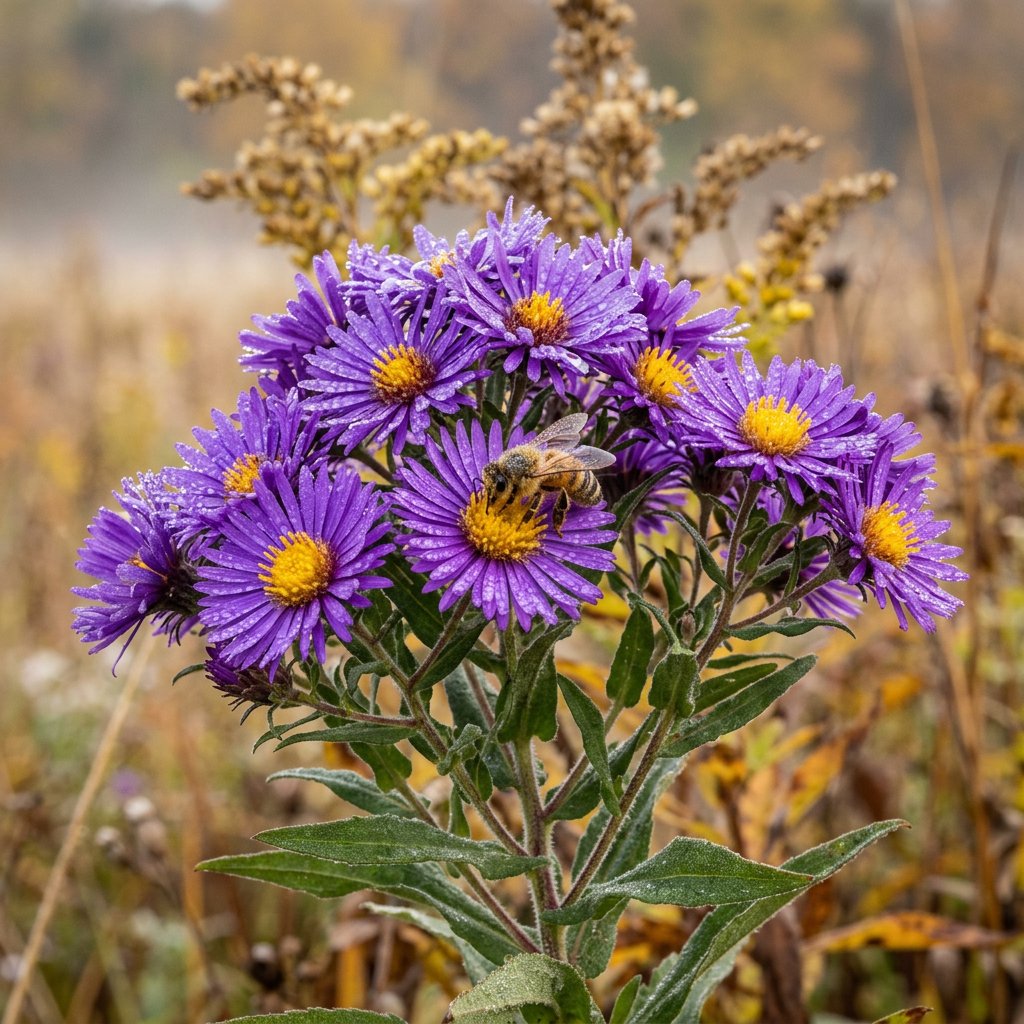
Plant Overview
Often called the "New England Aster" or the "Michaelmas Daisy," this plant is the grand finale of the North American growing season. While other garden favorites begin to wither in the autumn chill, this hardy perennial erupts into a spectacular firework display of violet and gold. It is a legendary cornerstone of the fall landscape, beloved by both gardeners and migrating butterflies alike.
🔍 How to Identify
- 🌸 The Blooms: Features dense clusters of daisy-like flowers, typically deep purple or vivid pink, with a bright yellow center that matures into a reddish-purple hue.
- 🌿 Clasping Leaves: The lance-shaped, olive-green leaves are unique because they "clasp" the stem, meaning the base of the leaf wraps partially around the stalk without a petiole (leaf-stem).
- 📏 Sturdy Texture: The entire plant is covered in fine, bristly hairs, giving the stems and leaves a rough, sandpaper-like feel that helps distinguish it from the smoother New York Aster.
🏡 In Your Garden
- 🦋 Pollinator Banquet: This is a vital "fueling station" for Monarch butterflies. Because it blooms late (August to October), it provides the high-energy nectar necessary for their long migration to Mexico.
- ✂️ The "Chelsea Chop": To prevent the plant from becoming too tall and floppy, gardeners often pinch back the stems by half in early June. This encourages a bushier, more compact shape with even more flower heads.
- 💧 Mildew Mindfulness: While tough, it appreciates good air circulation. It prefers moist, well-drained soil; if the soil stays too dry, the lower leaves may turn brown and drop off, a look often called "ugly legs" which can be hidden by planting shorter perennials in front.
⚠️ Safety & Toxicity
- ✅ Status: Non-toxic and generally safe.
- 🐾 Details: New England Asters are considered safe for cats, dogs, and horses. They are also non-toxic to humans. In fact, various parts of the plant were historically used in indigenous medicine to treat respiratory issues, though today it is strictly an ornamental favorite.
✨ Fun Fact
The name Aster comes from the Ancient Greek word for "star," referring to the star-like shape of the flower head. According to legend, asters were created from the tears of the Greek goddess Astraea, who wept when she looked at the earth and saw no stars; where her tears hit the ground, these "star flowers" bloomed.

Detailed Care Instructions
To grow Symphyotrichum Novae-angliae, also known as New England aster, follow these steps:
- Location: Choose a sunny location for planting the New England aster. It prefers full sun but can tolerate partial shade.
- Soil: The plant prefers well-draining soil that is rich in organic matter. Prepare the soil by adding compost or aged manure to improve its fertility and drainage.
- Planting: Dig a hole that is slightly larger than the root ball of the plant. Place the plant in the hole, ensuring that the crown is level with the soil surface. Backfill the hole with soil and gently firm it around the plant's roots. Water the plant deeply after planting.
- Watering: Water the plant regularly, especially during dry spells. Aim to keep the soil consistently moist but not waterlogged. Avoid overhead watering to prevent foliage diseases.
- Mulching: Apply a layer of organic mulch, such as wood chips or straw, around the base of the plant. Mulch helps retain soil moisture, suppresses weed growth, and regulates soil temperature.
- Fertilizing: Fertilize the New England aster in spring with a balanced, slow-release fertilizer. Follow the instructions on the fertilizer packaging for dosage and application methods. Avoid over-fertilization, as it can lead to leggy growth and reduced flowering.
- Pruning: After the flowering season, you can cut back the plant to maintain its shape and encourage bushier growth. Prune the plant to about 6-8 inches above the ground. This will also help prevent the plant from becoming too tall and floppy.
- Dividing: Every few years, when the plant becomes crowded or starts to die out in the center, consider dividing it. Dig up the plant in early spring or fall, separate the clumps into smaller sections, and replant them.
- Pest and disease control: New England asters are generally hardy plants but can sometimes suffer from powdery mildew or aphid infestations. Monitor the plant regularly and take appropriate measures to control pests and diseases, such as using insecticidal soap or fungicides if necessary.
- Support: Depending on the variety and your desired aesthetic, you may need to provide support to the plant with stakes or cages to prevent flopping over, especially in windy areas.
By following these steps and providing proper care, your Symphyotrichum Novae-angliae plant should grow healthy and produce beautiful flowers.

Place in a bright room that is sun drenched almost all day. Or directly in a south-facing window.

Symphyotrichum Novae-angliae plants should be watered deeply and infrequently to encourage deep root growth. A good rule of thumb is to water thoroughly once a week or when the top inch of soil feels dry to the touch. Be sure to water at the base of the plant rather than overhead to avoid wetting the leaves, which can lead to fungal diseases. It is also recommended to water in the morning to allow the foliage to dry before nightfall. Overwatering can cause root rot, so it's important to make sure the soil is well-draining. A layer of mulch can help retain moisture and regulate soil temperature.
To properly fertilize this plant, you should first prepare the soil with compost or organic matter. Use a balanced fertilizer with equal parts nitrogen, phosphorus, and potassium. Apply the fertilizer in early spring, just as new growth begins. Avoid fertilizing after mid-summer as this can promote new growth that will not have sufficient time to harden off before winter. Water the plant well after fertilizing to ensure the nutrients penetrate the soil.
Symphyotrichum Novae-angliae plant is a member of the Asteraceae family and requires a well-draining soil that is rich in organic matter. The soil should have a pH between 6.0 and 7.5. It should contain a good balance of nutrients such as nitrogen, phosphorus, and potassium. The soil should be loose enough to allow air and water to flow easily, but not so loose that it dries out quickly. A mixture of garden soil, sand, and compost can be used to create the ideal soil for the Symphyotrichum Novae-angliae plant. Additionally, the plant prefers full sun to partial shade and requires regular watering to thrive.
Symphyotrichum Novae-angliae plant can be propagated through several methods, including division and taking stem cuttings.
To propagate through division, carefully dig up the entire plant and separate it into smaller sections, making sure each section has a healthy root system. Replant the divided sections in well-draining soil and water thoroughly.
To propagate through stem cuttings, take a cutting from the plant in the spring or early summer. Cut a 4-6 inch stem from the plant and remove the bottom leaves. Dip the cut end of the stem in a rooting hormone and plant in a pot filled with well-draining soil. Keep the soil moist and place the pot in an area with bright, indirect sunlight. After a few weeks, new growth should appear and the plant can be transplanted into the ground.
Common pests of the new england aster include Spider mites, larvae. Make a habit of checking your new england aster frequently for pests so that any infestations can be caught and managed early.








