Plant Overview
Commonly known as "Knitbone," "Boneset," or "Bruisewort," Comfrey is a legendary staple of the traditional apothecary garden. This hardy perennial is a powerhouse in the permaculture world, acting as a "living fertilizer" that mines nutrients from deep underground. While its history is rooted in ancient medicine, modern gardeners prize it most for its incredible ability to rejuvenate tired soil.
🔍 How to Identify
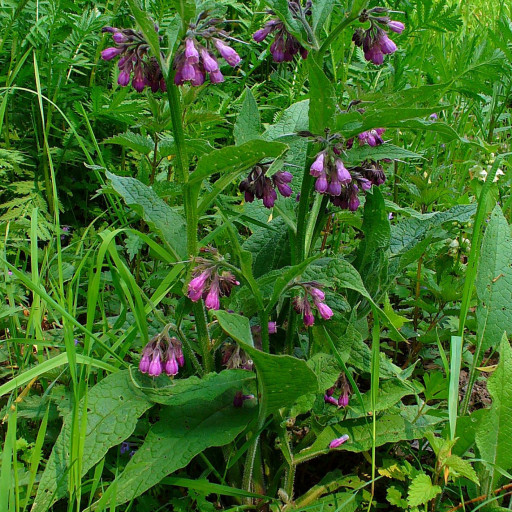
- 🍃 Large, Hairy Leaves: The foliage is broad, lance-shaped, and covered in stiff, bristly hairs that feel rough—and sometimes prickly—to the touch.
- 🔔 Drooping Bell Flowers: Clusters of tubular, bell-shaped flowers emerge in nodding coils. They typically range in color from creamy white and pale pink to a vibrant, deep purple.
- 🌿 Robust Stature: It grows in dense, upright clumps that can reach up to 3 feet in height, featuring thick, "winged" stems that give the plant a sturdy, architectural look.
🏡 In Your Garden
- 🧪 The Dynamic Accumulator: Comfrey is famous for its massive taproot, which can reach depths of 6 to 10 feet. It pulls minerals like potassium, calcium, and magnesium from the subsoil into its leaves, making it an elite choice for "chop-and-drop" mulching or making "comfrey tea" fertilizer.
- 🌱 Permanent Placement: Choose your spot wisely! Because of that deep taproot, Comfrey is notoriously difficult to remove. Even a tiny fragment of root left in the soil will sprout into a new plant, meaning it is effectively a permanent resident once planted.
⚠️ Safety & Toxicity
- 🚫 Internal Warning: While historically used in teas, Comfrey contains pyrrolizidine alkaloids which are toxic to the liver. Modern herbalists and health organizations strongly advise against ingesting any part of the plant.
- 🐾 Pets & Livestock: Keep a close eye on grazing pets. While many animals avoid the prickly leaves, ingestion can lead to cumulative liver damage over time.
- 🧤 Skin Irritation: The stiff hairs on the stems and leaves can cause "contact dermatitis" (an itchy red rash) for those with sensitive skin. It is highly recommended to wear gloves when harvesting or pruning.
✨ Fun Fact
- 🦴 The nickname "Knitbone" comes from the plant’s high concentration of allantoin, a compound that promotes cell proliferation. In ancient times, poultices made of mashed comfrey leaves were wrapped around broken limbs to help speed up the healing of bones and connective tissue!

Detailed Care Instructions
| Color | Violet, Pink, Or Creamy Yellow |
| Soil Ph | 6.0-7.0 |
| Humidity | Normal |
| Lighting | Part Sun |
| Toxicity | Poisonous |
| Soil Type | Medium Moisture, Rich, Well-Drained Soil |
| Bloom Time | Late Spring |
| Difficulty | Medium |
| Plant Type | Herbaceous Perennial |
| Hibernation | Cold Period |
| Mature Size | 1 To 3 Feet, Similar Spread |
| Native Area | Europe And Asia |
| Sun Exposure | Full Sun To Part Shade |
| Hardiness Zones | 3-9 |
To grow Symphytum Officinale, commonly known as comfrey, you can follow the steps below:
- Choose a suitable location: Comfrey prefers full sun to partial shade. Ensure that the soil is fertile, well-draining, and rich in organic matter.
- Prepare the soil: Before planting, loosen the soil with a garden fork or tiller. Remove any large rocks, debris, or weeds.
- Obtain comfrey plants: You can purchase comfrey plants from a garden center or online nursery. Alternatively, you can start growing them from seeds or root divisions.
- Planting: Dig a hole that is large enough to accommodate the root ball of the comfrey plant. Space multiple plants about 3 feet apart. Gently place the plant in the hole and backfill with soil, ensuring that the crown of the plant sits at soil level.
- Watering: Give the newly planted comfrey plants a thorough watering. After that, water deeply once a week, especially during dry periods. Comfrey is relatively drought-tolerant but benefits from consistent moisture.
- Mulching: Apply a layer of organic mulch around the base of the comfrey plants to help conserve moisture, suppress weeds, and provide additional nutrients as it breaks down.
- Fertilization: Comfrey is a nutrient accumulator and does not require regular fertilization. However, you can add compost or well-rotted manure around the plants in spring or fall to provide extra nutrients.
- Pruning: Trim the plants back to the desired height in early spring or after flowering to promote bushier growth. Regular pruning can prevent them from becoming lanky.
- Harvesting: You can start harvesting comfrey leaves when the plants are established, usually after the first year. Harvest the leaves by cutting them near the base of the plant. Use the leaves for making compost, mulch, or herbal preparations.
- Controlling spread: Comfrey can be a vigorous spreader, so consider installing a root barrier around the planting area to constrain its growth if desired.
Remember to check if comfrey is legal to grow in your area, as it is prohibited or restricted in some places due to its potential invasive nature.

Place in a bright room that is sun drenched almost all day. Or directly in a south-facing window.

Symphytum Officinale is a plant that requires a consistent and thorough watering schedule to thrive. It should be watered frequently, but not excessively, as too much water can lead to root rot. The soil around the plant should be kept moist, but not waterlogged.
When watering, it's best to water the plant at the base rather than from above, as it can cause damage to the leaves and flowers. Watering early in the morning or late in the evening is also beneficial, as it helps to prevent evaporation and allows the roots to absorb the water more effectively.
If the plant is in a container, it's important to ensure that there is proper drainage so that excess water can escape. This can be achieved by placing stones or gravel at the bottom of the pot and creating a layer of soil above it.
In general, the best way to determine when to water Symphytum Officinale is to check the soil regularly. If it feels moist to the touch, there's no need to water. If it feels dry, it's time to water. Over time, you'll become familiar with the specific watering needs of your plant and can adjust accordingly.
To fertilize the plant, use a balanced fertilizer with equal amounts of nitrogen, phosphorus, and potassium. Apply the fertilizer every two weeks during the growing season, and reduce the frequency to once a month in the winter. Mix the fertilizer with water at a ratio of 1 tablespoon per gallon of water. Apply the mixture to the soil at the base of the plant using a watering can or hose. Be careful not to get the fertilizer on the foliage as it can cause damage.
The plant in question prefers to grow in a soil that is rich in organic matter and has a slightly acidic pH level. A well-draining soil is also important, as the plant does not like to have its roots sitting in water. It is recommended to mix the soil with a good quality compost to provide the necessary nutrients. Additionally, adding some perlite or sand to the soil can improve drainage and prevent waterlogging. The ideal soil for this plant should feel moist but not soggy to the touch.
To propagate the plant in question, you can divide the root system in late summer or early autumn. Carefully dig up the plant and separate the root system into smaller sections, ensuring that each section has plenty of roots and leaves. Replant the sections in well-draining soil, making sure they are kept well-watered until they establish themselves. Alternatively, you can take stem cuttings in the spring or early summer. Choose a healthy stem with several leaves and cut it just below a node. Remove any lower leaves and dip the cut end in rooting hormone before planting it in a pot filled with moist potting soil. Cover the pot with plastic and place it in a bright, but not direct, light until the cutting has rooted. Once rooted, the new plant can be transplanted into the garden or a larger pot.








