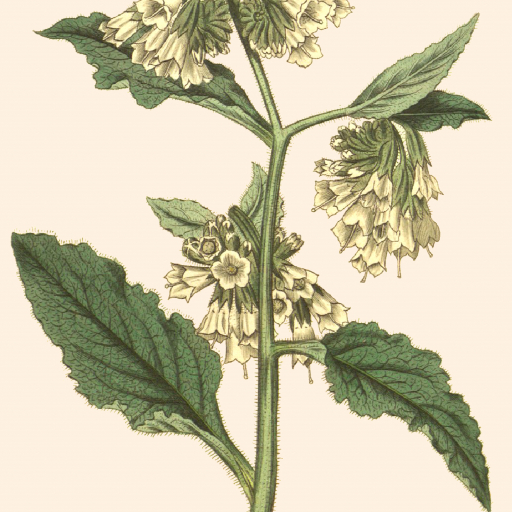
Plant Overview
Known as the White Comfrey, this elegant perennial is like a breath of fresh air for the shadowy corners of a garden. Originating from the rolling landscapes of Turkey and the Caucasus, it has long been a staple in European woodland gardens for its early spring blooms and rugged reliability. It is the "resilient romantic" of the plant world, thriving in the dappled light where more delicate species might falter.
🔍 How to Identify
- 🔔 The Flowers: Drooping clusters of pure white, bell-shaped blossoms that emerge in mid-to-late spring. Unlike its purple cousins, these flowers maintain a crisp, snowy appearance.
- 🍃 Leaf Texture: Broad, lance-shaped leaves that are covered in fine, bristly hairs. This gives the foliage a slightly rough, sandpaper-like feel when touched.
- 🌱 Growth Habit: A clump-forming plant that grows in lush mounds. It typically reaches about 1.5 to 2 feet in height, creating a dense canopy of green.
🏡 In Your Garden
- 🌳 The Shade Champion: This plant is a "problem solver" for dry shade. It is exceptionally talented at growing under the thirsty roots of large trees where other plants often starve for moisture.
- 🐝 Pollinator Magnet: Even though the flowers look modest to us, bees find them irresistible. It is one of the earliest sources of high-quality nectar for bumblebees waking up from winter.
- 🏃 Space Management: While beautiful, it spreads via underground rhizomes. It is best used as a groundcover in larger areas rather than in a tiny, curated flower bed where it might crowd out smaller neighbors.
⚠️ Safety & Toxicity
- 🚫 Ingestion Hazard: Like all members of the Comfrey family, Symphytum orientale contains pyrrolizidine alkaloids. These compounds are toxic to the liver if eaten by humans or pets.
- 🐕 Pet Safety: Keep this plant away from dogs or livestock who might be tempted to graze. The bristly hairs usually deter them, but "curious nibblers" are still at risk.
- 🧤 Skin Irritation: The stiff hairs on the leaves can cause "contact dermatitis" (an itchy red rash) on sensitive skin. It is always wise to wear gloves when dividing or pruning this plant.
✨ Fun Fact
The genus name Symphytum comes from the Greek word symphyo, which means "to grow together." In ancient folklore, comfrey was so highly regarded for its healing properties that it was believed even boiling two pieces of meat with comfrey root would cause them to fuse back together!

Detailed Care Instructions
To grow Symphytum Orientale plant, follow these steps:
- Purchase seeds or divisions of Symphytum Orientale from a reputable nursery or online retailer.
- Choose a suitable location with partial shade or full sun. The plant prefers moist, fertile soil.
- Prepare the soil by removing any weeds, rocks, or debris. Loosen the soil and add organic matter like compost or well-rotted manure to improve its fertility.
- Sow the seeds in early spring or early fall, as they need a period of cold stratification to germinate. If using divisions, plant them at the same depth they were grown previously.
- Water the seeds or divisions thoroughly after planting to settle the soil and ensure moisture contact with the plant roots.
- Keep the soil evenly moist but not waterlogged during the growing season. Symphytum Orientale is a moisture-loving plant and may not tolerate drought well.
- Apply a slow-release balanced fertilizer or compost annually to provide essential nutrients for plant growth.
- Mulch around the plant to retain moisture, suppress weed growth, and protect the roots from temperature extremes.
- Monitor the plant regularly for pests and diseases. Common pests include slugs, snails, and aphids. Take appropriate measures if infestation occurs.
- During the winter, cover the plant with a layer of mulch or move it to a protected location to protect it from frost or extreme cold temperatures.
- Divide the plant every few years to maintain its vigor and prevent overcrowding. This can be done in early spring or fall by carefully lifting the plant and separating it into smaller clumps before replanting.
- Enjoy the beautiful flowers of Symphytum Orientale throughout the growing season. Deadhead the faded flowers to encourage continuous blooming.
Remember to check the specific care instructions provided with the plant or consult a local gardening expert for any additional tips or advice tailored to your specific location and climate.

Place in a window with dappled sun or a spot in the middle of a room. Or directly in a window facing west or east.

Symphytum Oriental is a plant that requires regular watering to ensure its optimal growth and health. When watering, it is important to avoid overwatering or underwatering, as both can be detrimental to the plant's health.
To properly water Symphytum Oriental, first, check the soil moisture level by sticking your finger into the soil up to the first knuckle. If the soil feels dry, it's time to water the plant. If it's still moist, wait a day or two before checking again.
When watering, use a watering can or hose to apply water directly to the soil around the plant's base. Avoid getting the leaves wet, as this can lead to fungal growth and disease. A slow, deep watering is recommended to ensure the soil is fully saturated, but without causing waterlogging.
Water the plant once or twice a week, depending on the weather conditions and humidity level. In hot weather or dry climates, more frequent watering may be required.
Overall, the key to watering Symphytum Oriental is to keep the soil consistently moist, but not soggy, and to avoid letting the plant dry out completely. With proper watering, this beautiful plant will thrive and bring you years of enjoyment.
To fertilize this plant, mix a balanced fertilizer with equal amounts of nitrogen, phosphorus, and potassium. Use a dilution ratio of 1:2, meaning 1 part fertilizer to 2 parts water. Apply the fertilizer solution once a month during the growing season, taking care not to over-fertilize. Water the plant well after fertilizing to avoid burning the roots.
Symphytum Orientale prefers a moist and well-draining soil with a neutral to slightly alkaline pH level. The ideal soil for this plant is a loamy soil that is rich in organic matter, such as compost or well-rotted manure, which will help retain moisture and provide nutrients. It is important to avoid using heavy clay soils or soils that are too sandy, as they may not provide the necessary moisture and nutrients for the plant to thrive. When planting this plant, it is recommended to mix the soil with some organic matter and also some sand to improve drainage. Additionally, it is important to ensure that the soil has good aeration to promote root growth and prevent waterlogging. Overall, the soil should be fertile, rich in organic matter, well-draining, and have a neutral to slightly alkaline pH level to promote healthy growth of the Symphytum Orientale plant.
Symphytum Orientale is a perennial plant that can be propagated in a number of ways. One method is through division, where the plant is dug up and then separated into smaller sections, each with its own root system. These smaller sections can then be replanted and will develop into new plants. Another way to propagate the Symphytum Orientale plant is by taking cuttings from the stem of an existing plant. The stem is cut just below a leaf node and then placed in water or soil to develop roots. Once the roots have formed, the cutting can be planted in a pot or in the ground to grow into a new plant. Finally, it is also possible to propagate the Symphytum Orientale plant through seed. The seeds can be harvested from the plant and then planted in soil or a seed-starting mix. With proper care, the seeds will germinate and grow into new plants.








