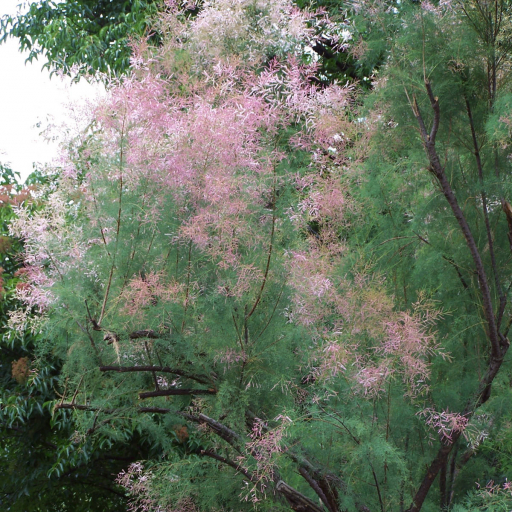
Plant Overview
Often called the Saltcedar or Pink Cascade, Tamarix ramosissima is a master of disguise. While it looks like a soft, feathery cloud of pink cotton candy when in bloom, this Eurasian native is actually one of the toughest "thirsty survivors" in the botanical world. It is celebrated by some for its ornamental beauty and despised by others for its aggressive ability to dominate riverbanks and desert wetlands.
🔍 How to Identify
- 🌸 The Bloom: Look for dense, slender plumes (racemes) of tiny, five-petaled flowers that range from pale pink to deep rose, appearing from late spring through late summer.
- 🌿 The Foliage: The leaves are minute and scale-like, overlapping each other much like a juniper or cedar. They are a soft bluish-green and feel almost like delicate lace to the touch.
- 🪵 The Bark: Young stems are smooth and distinctively reddish-brown, providing a beautiful winter contrast, while older trunks become thick, furrowed, and dark gray.
🏡 In Your Garden
- 🧂 The Salt Secret: This plant has specialized glands that "sweat" salt. It absorbs saline water from deep underground and excretes the salt through its leaves, which eventually falls to the ground, preventing many other competing plants from growing nearby.
- 💧 Water Thief: Be cautious where you plant it; it has a massive taproot that can reach deep water tables. In many parts of the Western US, it is considered a noxious weed because it "guzzles" water and dries up small streams or ponds.
- ✂️ Pruning Needs: If kept as an ornamental, it requires hard pruning in early spring. Because it flowers on new wood, cutting it back significantly will encourage those iconic long, flowing "cascades" of pink.
⚠️ Safety & Toxicity
- 🟢 Status: Generally non-toxic.
- ✋ Details: Tamarix ramosissima is not known to be poisonous to humans, dogs, or cats. However, the fine, needle-like foliage can cause minor skin irritation or scratches if you are moving through a dense thicket without protection. The real "danger" is ecological—it can significantly alter the soil chemistry in your yard.
✨ Fun Fact
A single mature Saltcedar can produce up to 500,000 tiny seeds every year. These seeds are so light they can travel for miles on the wind or float down rivers to start an entirely new colony.

Detailed Care Instructions
| Humidity | Normal |
| Lighting | Full Sun |
| Toxicity | Poisonous |
| Difficulty | Easy |
| Hibernation | Cold Period |
| Hardiness Zones | 3 - 8 |
To grow Tamarix ramosissima (Tamarisk) plants, follow these steps:
- Choose the right location: Tamarisk plants are adaptable to a wide range of conditions but prefer full sun and well-draining soil. They can tolerate salty environments and are often grown near coastal areas.
- Preparing the soil: Tamarisks can grow in poor soil but will appreciate loose, sandy, or loamy soil. If your soil is heavy or compacted, consider adding organic matter such as compost to improve drainage.
- Planting: Dig a hole that is large enough to accommodate the plant's root ball. Place the plant in the hole, making sure it is at the same depth as it was in its container. Backfill the hole with soil, firming it gently around the roots. Water thoroughly after planting.
- Watering: Tamarisk plants are drought-tolerant once established, but it is important to water regularly during the first year to help them establish deep roots. Afterward, they will only need occasional watering during extended periods of drought.
- Mulching: Apply a layer of organic mulch around the base of the plant to help retain moisture, suppress weeds, and moderate soil temperature.
- Pruning: Tamarisk plants are fast-growing and may require pruning to maintain their shape and size. It is best to prune either in late winter or early spring before new growth resumes.
- Fertilizing: Tamarisks generally do not require much fertilization. However, you can apply a balanced slow-release fertilizer in spring to promote healthy growth.
- Pests and diseases: Tamarisks are generally resistant to pests and diseases. However, occasional infestations of aphids or scale insects may occur. Monitor the plants regularly and treat with insecticidal soap if necessary.
With proper care and maintenance, Tamarix ramosissima plants should grow well and provide beautiful foliage and flowers.

Place in a bright room that is sun drenched almost all day. Or directly in a south-facing window.

Tamarix Ramosissima plant prefers a moist soil but can tolerate some dryness. When watering, it is recommended to give the plant a deep watering once a week or when the top inch of soil feels dry. Avoid overwatering as it can result in root rot. The best time to water is in the morning to allow the plant to absorb moisture throughout the day. That being said, watering needs may vary depending on the climate, soil type, and location of the plant. It is important to observe the plant and adjust watering accordingly.
To fertilize this particular plant, use a balanced fertilizer with equal amounts of nitrogen, phosphorus, and potassium. Use the fertilizer once every two weeks during the growing season. Apply the fertilizer around the base of the plant and then water it thoroughly. During the winter months, reduce the frequency of fertilizing to once a month. Be careful not to over fertilize as this can damage the plant.
The recommended soil type for Tamarix Ramosissima plant is a well-draining, sandy or loamy soil with a slightly acidic to neutral pH level. It should also be rich in organic matter and nutrients to support optimal growth and health. It is best to avoid heavy clay soils, as they can become waterlogged and lead to root rot. Additionally, the soil should be kept consistently moist but not waterlogged, as the plant can tolerate some drought but not excessive moisture. It is also recommended to fertilize regularly with a balanced, slow-release fertilizer to ensure adequate nutrient uptake. Overall, a well-draining, nutrient-rich soil is essential for the successful growth and development of Tamarix Ramosissima plant.
Tamarix ramosissima can be propagated through several methods such as seed germination, cutting, layering, and root division.
Seed Germination:
Collect the seeds in late summer or early fall and sow them in a seedbed containing well-drained soil. The optimum temperature for seed germination is around 68-77°F. Water the seeds regularly to keep the soil moist, and within 2-4 weeks, the seeds should start to germinate.
Cutting:
Take cuttings from the plant in May or June when the growth is vigorous. Cut a stem from the plant about 6-8 inches long, remove the bottom leaves, and dip the cut end of the stem in rooting hormone powder. Plant the stem in a pot filled with well-draining soil, and keep it moist. The stem should root within four to six weeks, and after that, it can be transferred to the ground.
Layering:
In the spring season, select a healthy, low-growing branch of the plant close to the ground. Scratch the bark of the branch near the middle part to a one-inch depth. Cover the scar with soil and keep it moist. The layer should root within six to eight weeks, and then it can be separated from the parent plant and planted in new soil.
Root Division:
This method should be done during early spring or late fall. Dig out the entire plant, remove the soil from around the roots, and separate the plant into sections with a sharp knife. Each section should have at least one active root system and stem. The sections can be planted separately in the soil and watered adequately.
Common pests of the tamarisk include Mealybugs, spider mites. Make a habit of checking your tamarisk frequently for pests so that any infestations can be caught and managed early.








