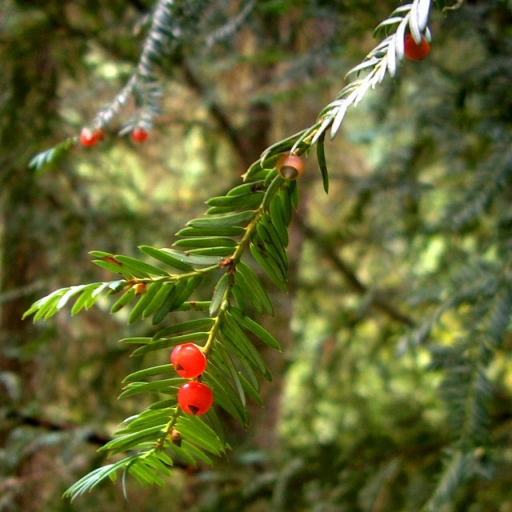
Plant Overview
Known as the "Tree of Life" in some circles and the "Bow Wood" in others, the Pacific Yew is a patient resident of the Pacific Northwest’s ancient forests. Unlike its towering evergreen cousins, this tree is a slow-growing master of the understory, often hiding in the shadows of giants like the Douglas Fir. It carries a heavy legacy, bridging the gap between ancient archery and modern life-saving medicine.
🔍 How to Identify
- 🌲 The Foliage: Look for flat, needle-like leaves that are dark green on top and paler underneath. They are arranged in a spiral but often twist to appear as if they are growing in two flat rows.
- 🍎 The "Berries": Instead of a woody cone, it produces a single seed partially enclosed in a bright red, fleshy, cup-shaped "fruit" called an aril, which looks like a soft jewel hanging from the branch.
- 🍂 The Bark: The bark is exceptionally thin and papery, often appearing in shades of reddish-purple or brown. It flakes away in thin scales to reveal smooth, younger bark underneath.
🏡 In Your Garden
- ☁️ Shade Specialist: This is one of the few conifers that truly thrives in deep shade. If you have a dark corner of your garden where nothing else grows, the Pacific Yew will be perfectly at home.
- 💧 Moisture Balance: It prefers the cool, damp conditions of a coastal forest. While it is hardy, it hates "wet feet" (waterlogged roots) and won't tolerate extreme drought well, preferring consistent, moderate moisture.
⚠️ Safety & Toxicity
- 🚫 High Toxicity Warning: Almost every part of this plant—including the bark, needles, and seeds—is highly toxic to humans, dogs, cats, and horses.
- 💀 Cardiac Risk: The plant contains taxine alkaloids, which can cause severe heart rhythm issues if ingested. While the red fleshy part of the "berry" is technically non-toxic, the hard seed inside is deadly. It is best treated as a "hands-off" plant for households with curious pets or children.
✨ Fun Fact
For decades, the Pacific Yew was the primary source of Taxol, one of the most effective chemotherapy drugs ever discovered. Because the tree grows so slowly, it takes the bark of approximately three mature trees to treat a single patient, leading scientists to eventually find more sustainable ways to synthesize the medicine!

Detailed Care Instructions
| Humidity | Dry |
| Lighting | Part Sun |
| Toxicity | Poisonous |
| Difficulty | Medium |
| Hardiness Zones | 5 - 9 |
To grow Taxus brevifolia (Pacific yew) plants, follow these steps:
- Planting: Choose a suitable location with well-drained soil and partial shade or dappled sunlight. The soil should be slightly acidic with a pH range of 6.0-6.5. Dig a hole slightly larger than the root ball of the plant.
- Transplanting: Purchase a young Taxus brevifolia plant from a reputable nursery or use seeds obtained from the cones of mature plants. Transplant the plant in spring or early fall.
- Soil Preparation: Prepare the soil by adding organic matter, such as compost or aged manure, to improve drainage and fertility. Mix the organic matter with the topsoil.
- Planting Technique: Place the root ball into the hole, ensuring that the top of the root ball is level with or slightly above the surrounding soil. Backfill the hole with the soil mixture, gently firming it around the plant.
- Watering: Water the plant thoroughly after planting to settle the soil and remove air pockets. Afterward, water regularly to keep the soil consistently moist but not overly saturated. Reduce watering during the winter months.
- Mulching: Apply a layer of organic mulch, such as wood chips or shredded bark, around the base of the plant. Mulch helps retain moisture, suppresses weeds, and moderates soil temperature.
- Pruning: Prune Taxus brevifolia plants in late winter or early spring to maintain their desired shape and size. Remove any dead, damaged, or crowded branches. Avoid heavy pruning as it may harm the plant.
- Fertilizing: Apply a slow-release fertilizer specifically formulated for evergreen trees or shrubs in early spring. Follow the manufacturer's instructions for proper application rates.
- Pests and Diseases: Monitor the plant regularly for pests like aphids, spider mites, or scale insects. These can be controlled using organic insecticidal soaps or horticultural oils. Watch for signs of fungal diseases, such as root rot or needle blight, and take prompt action if necessary.
- Wildlife Considerations: Taxus brevifolia plants produce bright red berries, which are an important food source for birds and small mammals. If desired, allow some berries to mature and spread the seeds naturally.
Remember that Taxus brevifolia is a slow-growing plant, so be patient and provide the necessary care to ensure its healthy growth.

Place in a window with dappled sun or a spot in the middle of a room. Or directly in a window facing west or east.

The plant in question is a type of evergreen shrub commonly found in North America. It prefers to grow in well-drained soil that is slightly acidic, and it can tolerate a range of soil types, including sandy, loamy, and clay soils. When watering this plant, it is important to avoid over-watering, as this can lead to root rot and other problems. Instead, it is best to water deeply but infrequently, allowing the soil to dry out slightly between waterings. During periods of extended drought or hot weather, the plant may require supplemental watering to stay healthy. It is also important to provide the plant with adequate drainage and to avoid standing water, as this can also lead to root rot and other issues. Overall, the key to keeping this plant healthy and thriving is to provide it with consistent, appropriate levels of moisture and to monitor it closely for signs of stress or damage.
The recommended fertilizer for this plant is a slow-release, granular, acidic fertilizer with a balanced ratio of nitrogen, phosphorus, and potassium. Fertilize once in the spring and once in the fall, using a rate of 1 pound of fertilizer per 100 square feet of area, applied evenly around the root zone. Keep the fertilizer at least 6 inches away from the trunk and water immediately after application. Avoid over-fertilization, which can cause excessive growth and reduce the plant's hardiness.
The recommended soil for planting Taxus Brevifolia should be well-drained, slightly acidic, and rich in organic matter. The soil needs to be fertile and not excessively moist or dry. In order to ensure optimal growth and development, the soil should be prepared by digging down to a depth of at least 12 inches and adding compost or other organic matter, such as leaf mold or peat moss. The plant prefers slightly acidic soil with a pH range of 5.5 to 6.5. The soil should be well-aerated to promote healthy root growth, and should be mulched with a layer of organic mulch to help keep the soil moist and cool. It is also important to avoid planting the Taxus Brevifolia in areas with high water tables or where the soil remains wet for extended periods of time.
To propagate a certain plant species, the first step is to prepare cuttings from a mature and healthy plant. The cuttings should be taken in the spring or early summer when the plant is actively growing. It is important to use sharp pruners to avoid damaging the plant tissue.
The cuttings should be at least 4 inches long and should have several sets of healthy, green leaves. Remove the lower leaves from the stem and dip the cut end in rooting hormone powder to help stimulate root growth.
Prepare a potting mix made of equal parts perlite and peat moss. Moisten the mix and fill a small container with it. Use a pencil to make a planting hole in the center of the mix.
Carefully insert the cutting into the hole, making sure that the stripped area of the stem is buried in the mix. Firmly press the mix around the stem to eliminate any air pockets.
Cover the container with a clear plastic bag to provide humidity and maintain moisture. Place the container in a well-lit area, but avoid direct sunlight. Keep the rooting mix moist by misting the cutting or watering from the bottom.
After a few weeks, the cutting should develop roots and start to grow new leaves. Once the roots are well-established, the new plant can be transplanted into a larger container or planted outdoors in a suitable location.








