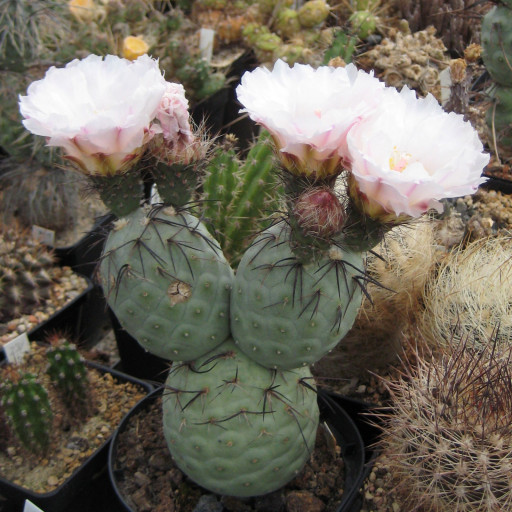
Plant Overview
Often called the "Living Sculpture," Tephrocactus geometricus is one of the most sought-after cacti for collectors worldwide. Hailing from the high-altitude deserts of Argentina, it looks less like a plant and more like a carefully stacked pile of blue-grey marbles or a piece of modernist geometry. Its uncanny, spherical growth makes it a standout "statement plant" for any sunny windowsill.
🔍 How to Identify
- ⚽ The Segments: The plant is made of perfectly globose (round) segments called cladodes that stack on top of one another as the plant matures.
- 📐 Geometric Skin: The surface is divided into small, flat tubercles that create a precise, mesh-like pattern across the skin, giving it its "geometric" name.
- 🎨 Color Palette: The skin ranges from a dusty blue-grey to a deep smoky purple, especially when the plant is exposed to bright, direct sunlight.
🏡 In Your Garden
- 🏜️ The Taproot Trap: This cactus develops a massive, fleshy taproot underground. Because of this, it requires extremely gritty, porous soil; if the soil stays damp for too long, the taproot will rot before you even notice the top is in trouble.
- ☀️ Sun-Kissed Stress: To achieve those iconic purple hues, the plant needs "stress" from high light levels. In low light, it will turn a dull green and the new segments will grow elongated (etiolated) rather than perfectly round.
- 💧 Winter Rest: During the cold months, this plant goes into deep dormancy. It should be kept almost entirely dry from late autumn to early spring to mimic its high-altitude Andean habitat.
⚠️ Safety & Toxicity
- 🌵 Low Risk: Tephrocactus geometricus is generally considered non-toxic to humans and common household pets.
- 🤏 Hidden Spines: While many specimens appear "spineless," they often possess glochids—tiny, hair-like barbed bristles—at the top of the segments. These can easily lodge in the skin and cause irritation, so use tongs or thick gloves when repotting.
✨ Fun Fact
In its native habitat in the Puna region of Argentina, Tephrocactus geometricus grows at altitudes of up to 3,000 meters. Because of this extreme environment, it is incredibly cold-hardy and can survive temperatures well below freezing, provided its soil is bone-dry!

Detailed Care Instructions
| Color | Green With White/Silver Stems |
| Soil Ph | 6.1-7.8 |
| Humidity | Dry |
| Lighting | Full Sun |
| Toxicity | Non-Toxic |
| Soil Type | Well-Drained Soil Mixture |
| Bloom Time | Spring |
| Difficulty | Easy |
| Plant Type | Cactus |
| Mature Size | Up To 6 In. Tall |
| Native Area | Argentina |
| Sun Exposure | Full Sun |
| Hardiness Zones | 8-10 |
To grow a Tephrocactus Geometricus plant, you can follow these steps:
- Start by selecting a healthy and mature Tephrocactus Geometricus plant. You can either purchase one from a nursery or acquire a cutting from an existing plant.
- Choose a suitable container with drainage holes. The container should be slightly larger than the plant's root ball.
- Prepare a well-draining potting mix. A cactus or succulent mix is ideal. You can also make your own mix by combining equal parts of regular potting soil, coarse sand, and perlite or pumice.
- Fill the container with the potting mix, leaving about an inch of space at the top.
- Carefully remove the Tephrocactus Geometricus plant from its current pot or container. Gently loosen the surrounding soil and carefully untangle any tangled roots, if necessary.
- Place the plant in the center of the new container and backfill with the potting mix. Avoid burying the stem too deeply as it may cause rotting.
- Pat the soil gently to settle it and remove any air pockets. Take care not to compact the soil too tightly.
- Water the plant thoroughly, allowing the water to run through the drainage holes. Ensure the potting mix is evenly moist but not waterlogged.
- Place the container in a location with bright, indirect sunlight. Tephrocactus Geometricus plants prefer around 4 to 6 hours of sunlight per day.
- Water the plant sparingly, allowing the soil to dry out between waterings. Overwatering can lead to root rot. It is better to underwater than overwater.
- During the growing season, which is typically spring and summer, you can fertilize the Tephrocactus Geometricus plant with a diluted cactus fertilizer every 4-6 weeks.
- Tephrocactus Geometricus plants are generally hardy and can withstand temperature fluctuations. However, they prefer temperatures between 65°F to 80°F (18°C to 27°C). Protect them from frost or extreme cold.
- Occasionally, you may notice small offsets or "pups" growing from the base of the plant. These can be carefully detached and potted separately to propagate new Tephrocactus Geometricus plants.
With regular care and attention to its water and light requirements, your Tephrocactus Geometricus plant should thrive and grow well.

Place in a bright room that is sun drenched almost all day. Or directly in a south-facing window.

To water this plant, it is important to first take a few things into consideration. The plant prefers well-draining soil, so it is important to allow the soil to dry out slightly between watering. Over-watering can lead to root rot and other complications. When watering, it is best to use room temperature water and to water the soil around the base of the plant rather than directly on top of the plant itself. Watering should be done only when the soil has completely dried out, which can vary depending on the individual environmental conditions the plant is in. It is also important to ensure that the drainage system in the pot is working properly to prevent water from building up in the bottom of the pot.
To fertilize this plant, use a balanced fertilizer with equal amounts of nitrogen, phosphorus, and potassium. Apply the fertilizer during the growing season, which is typically spring and summer, every two to three weeks. Be sure to follow the manufacturer's instructions for the amount of fertilizer to use. During the winter months, do not fertilize the plant as it is dormant. Water the plant thoroughly before and after fertilizing to avoid burning the roots.
For optimal growth, Tephrocactus Geometricus requires a well-draining soil mixture that is slightly acidic and rich in nutrients. A mixture of sand, perlite, and cactus soil is recommended to ensure proper drainage and prevent water retention, which could lead to root rot. The soil should be slightly moist, but not consistently wet, as overwatering can also harm the plant. In addition, adding a slow-release fertilizer to the soil can provide the necessary nutrients for growth and encourage flowering.
To propagate this plant, start by selecting a healthy, mature stem. Using a sharp, clean knife or pair of scissors, cut the stem at a point just below a node. Allow the cut end to dry and callus over for a few days.
Next, prepare a potting mix of well-draining cactus soil, sand, and perlite. Moisten the soil lightly and create a planting hole in the center.
Dip the cut end of the stem in rooting hormone powder, shaking off any excess. Insert the stem into the planting hole and gently press the soil around it. Water the soil lightly, being careful not to disturb the cutting.
Place the pot in a bright, warm location with indirect sunlight, such as a south-facing window. Keep the soil lightly moist but not wet, misting with water occasionally if necessary.
Within a few weeks, roots should begin to form from the cut end of the stem. Once the plant has developed a strong root system, it can be transplanted into a slightly larger pot or planted in the ground.
Propagation can also be done by division, where the plant is carefully separated into smaller sections and replanted. This method is best done in the spring or early summer when the plant is actively growing.
Common pests of the opuntia geometricus include Scale insect, mealybugs, spider mites. Make a habit of checking your opuntia geometricus frequently for pests so that any infestations can be caught and managed early.








