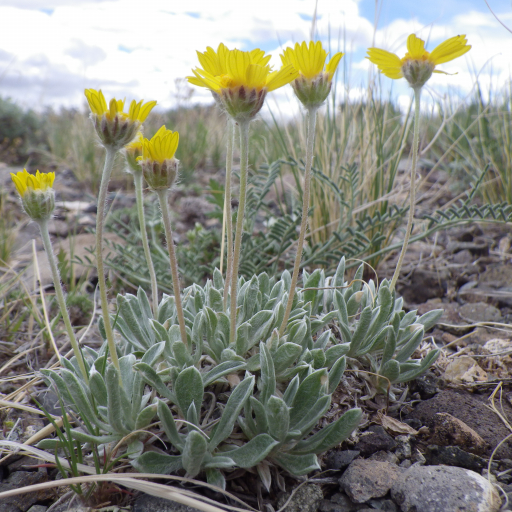
Plant Overview
Often called the Angelita Daisy or Stemless Four-nerve Daisy, this little golden gem is a champion of the American West. It is the kind of plant that thrives where others give up—shining brightly in sun-scorched plains and rocky mountain slopes. Despite its delicate, "button-like" appearance, it is a tough-as-nails perennial that provides a long-lasting splash of sunshine from early spring through the heat of summer.
🔍 How to Identify
- 🌼 Toothed Blooms: The bright yellow ray petals are unique because they have three distinct tiny "teeth" or notches at the very tips.
- 🌿 Silvery Foliage: The leaves form a dense, low-growing tuft. They are narrow, grayish-green, and often covered in fine hairs that give the plant a soft, silvery sheen.
- 🧶 The "Four-Nerve" Clue: If you flip a flower over and look closely at the petals, you will see four distinct veins (nerves) running down the length of each one.
- 📏 Acaulis Form: The name acaulis means "stemless." While the flowers sit on tall, leafless stalks, the foliage stays clamped tightly to the ground in a tidy mound.
🏡 In Your Garden
- 🏜️ Drainage is Vital: Being a desert native, this plant is an expert at handling drought but will quickly rot if left in soggy soil. It thrives in rock gardens, sandy patches, or gravelly borders.
- ☀️ Sun Seeker: This daisy is a literal sun-worshipper. To keep it from getting leggy or "stretching," place it in the brightest spot in your yard where it can soak up at least 6 to 8 hours of direct light.
- 🐝 Pollinator Magnet: While it's low-maintenance for you, it's high-value for local wildlife. It’s a frequent stop for native bees and small butterflies seeking nectar in arid climates.
⚠️ Safety & Toxicity
- 🐾 Pet Friendly: Great news for pet owners! Tetraneuris acaulis is generally considered non-toxic to dogs, cats, and horses.
- 👶 Family Safe: It is a safe, non-irritating plant for children’s gardens, as it lacks thorns, prickles, or toxic sap.
✨ Fun Fact
The "Four-nerve" daisy is a botanical timekeeper! In its native habitat, the flowers are known to "track" the sun across the sky during the day, a phenomenon called heliotropism, ensuring they catch every available ray of light.

Detailed Care Instructions
To grow a Tetraneuris Acaulis plant, also known as the "Four-Nerve Daisy," follow these steps:
- Choose the right location: Tetraneuris Acaulis prefers full sun to partial shade. Ensure that the chosen spot receives at least 6-8 hours of direct sunlight per day.
- Prepare the soil: The plant thrives in well-draining soil. Mix organic matter like compost or aged manure into the soil to improve its fertility and drainage. Tetraneuris Acaulis can tolerate a range of soil types but prefers slightly acidic to neutral soil.
- Planting: The optimal time to plant Tetraneuris Acaulis is in spring or early summer. Dig a hole that is slightly larger than the root ball of the plant. Place the plant in the hole, ensuring that the top of the root ball is level with the soil surface. Gently fill the hole with soil and tamp it down to remove any air pockets.
- Watering: Water the plant thoroughly after planting and keep the soil consistently moist but not waterlogged. Once the plant is established, it is drought-tolerant and can survive with minimal watering. However, occasional deep watering during prolonged dry spells will promote healthy growth and blooming.
- Fertilizing: Tetraneuris Acaulis does not require frequent fertilization. Adding a slow-release fertilizer once a year in early spring can provide the necessary nutrients for healthy growth. Follow the package instructions for proper dosage.
- Pruning: The plant produces basal rosettes of leaves and can grow up to 6-8 inches tall with yellow daisy-like flowers. Deadheading, or removing spent blooms, will encourage continuous flowering. In late fall or early spring, you can cut back the plant to promote fresh growth.
- Maintenance and care: Tetraneuris Acaulis generally has minimal pest or disease problems. Monitor the plant for any signs of pests like aphids or powdery mildew. If necessary, treat the plant with approved pest or disease control methods.
With proper care and suitable growing conditions, your Tetraneuris Acaulis plant should flourish and provide beautiful blooms throughout the growing season.
The recommended way of watering this particular plant is by gently and thoroughly soaking the soil around its base until the entire rootball is saturated. It is important to avoid getting water on the leaves or flowers as this can cause them to rot or develop water spots. The plant should be watered deeply but not too frequently as it prefers well-draining soil and can be susceptible to root rot if kept in soggy conditions. To determine when to water, it is advisable to check the top inch of soil for dryness and then water as needed. In general, this plant can tolerate periods of drought but will perform best with regular, consistent watering.
To fertilize this plant, use a balanced fertilizer with equal parts nitrogen, phosphorus, and potassium. Apply the fertilizer once a month during the growing season, which is typically from spring to early fall. Be sure to water the plant thoroughly before and after fertilizing to avoid fertilizer burn. Avoid over-fertilizing, as this can lead to root burn and damage to the plant. Instead, use a slow-release fertilizer to ensure a steady release of nutrients over time.
Tetraneuris Acaulis is a type of plant that is sensitive to the quality of soil in which it is grown. It requires a well-draining soil that is loose and fertile. The ideal soil for Tetraneuris Acaulis should be rich in organic matter, and have a pH range of 6.0-7.5. The soil also needs to have good water retention capabilities, without becoming overly waterlogged. One option for soil is to use a potting mix that is designed specifically for flowering plants, as it will contain the necessary nutrients and additives to support healthy growth. Another option is to create a soil mixture by combining equal parts of sand, perlite, and peat moss, along with a small amount of compost or fertilizer. Regardless of the method chosen, it is important to ensure that the soil is kept moist but never overly wet, as too much water can cause rotting and other issues with the plant's roots.
Tetraneuris acaulis can be propagated through both seeds and division.
Seeds:
- Collect the seeds from the plant in the fall after the flowers have faded and dried out.
- Store the seeds in a cool, dry place until ready to plant.
- Prepare a seedbed by loosening the soil and removing any debris or weeds.
- Sow the seeds thinly and cover them with a thin layer of soil.
- Water the seedbed gently and keep it moist until the seeds germinate and establish themselves.
Division: - Wait until the plant is mature and has multiple rosettes of leaves.
- Dig up the plant carefully, trying to avoid damaging the roots.
- Gently separate the rosettes, taking care not to damage the roots or leaves.
- Replant the rosettes in their new location, spacing them at least six inches apart.
- Water the newly planted rosettes deeply to help them establish in their new location.
Both of these propagation methods should be done in the spring or early fall, when the weather is mild and there is enough moisture for the plants to establish themselves.








