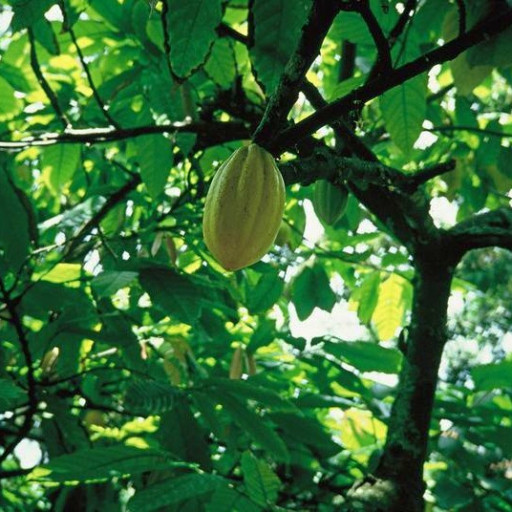
Plant Overview
Known globally as the source of chocolate, Theobroma cacao translates literally to "Food of the Gods." Native to the deep rainforests of Central and South America, this tree was so revered by the Mayans and Aztecs that its beans were used as currency. Today, it is a prized specimen for collectors who want to bring a piece of tropical history into their conservatory or greenhouse.
🔍 How to Identify
- 🍃 Large, Glossy Leaves: The foliage is striking, with long, leathery, oblong leaves that can reach up to 12 inches in length. New growth often emerges in a beautiful bronze or reddish hue before turning deep green.
- 🌸 Cauliflory (Trunk Flowers): One of the most unique traits is that tiny, star-shaped white or pink flowers grow directly out of the main trunk and older branches rather than at the tips of stems.
- 🏈 Football-Shaped Pods: The fruit is a large, leathery pod with deep ridges. Depending on the variety, these pods can range in color from bright yellow and orange to deep crimson or purple as they ripen.
🏡 In Your Garden
- ☁️ The Humidity Diva: Because it originates in the Amazonian understory, this plant craves high humidity (above 70%) and consistent warmth. In a home setting, it thrives best in a heated greenhouse or a very bright bathroom with a humidifier.
- ☂️ Filtered Sunlight: Unlike many tropical fruits, Cacao hates direct, scorching sun. It prefers "dappled" light, mimicking the canopy of taller trees that would naturally protect it in the wild.
- 💧 Sensitive Roots: It requires rich, organic soil that stays moist but never soggy. It has a sensitive taproot, so it generally dislikes being moved or repotted frequently once established.
⚠️ Safety & Toxicity
- 🐾 High Risk for Pets: While the fruit pulp is safe for humans, the seeds (cocoa beans) contain high concentrations of theobromine. This compound is highly toxic to dogs, cats, and horses, affecting their heart and central nervous system.
- 👶 Child Safety: The raw pods are generally not a temptation for children, but the processed beans or dark chocolate should be kept away from curious toddlers due to the caffeine and theobromine content.
✨ Fun Fact
Chocolate doesn’t owe its existence to bees! Because Cacao flowers are so tiny and complex, they cannot be pollinated by traditional honeybees. Instead, they rely on microscopic "biting midges"—tiny flies no bigger than a pinhead—to do the heavy lifting of pollination.

Detailed Care Instructions
| Color | Pink |
| Soil Ph | Acidic, Neutral, Alkaline |
| Lighting | Full Sun |
| Soil Type | Loamy, Moist, Well-Drained |
| Bloom Time | Seasonal |
| Plant Type | Tree |
| Mature Size | 20–30 Ft. Tall And Wide |
| Native Area | Central America, South America |
| Sun Exposure | Full, Partial Sun |
| Hardiness Zones | 11-12 |
To grow Theobroma cacao, also known as the cacao plant, you can follow these steps:
- Climate and Environment: Cacao plants thrive in warm, tropical climates with temperatures ranging from 20-30°C (68-86°F) and high humidity. They require well-drained soil that is rich in organic matter.
- Seed Selection: Obtain cacao seeds or pods from a reputable source. Make sure the seeds are fresh, free from diseases, and have not been exposed to extreme temperatures or moisture.
- Germination: The cacao seeds have a hard outer shell, so it is recommended to soak the seeds in warm water for 24-48 hours to soften the shell. Change the water every 12 hours. Alternatively, you can lightly scratch the seed coat on one side with a knife to help it germinate.
- Container Preparation: Use a well-draining pot or container with drainage holes to prevent waterlogging. Fill the container with a mixture of fertile soil, compost, and organic matter.
- Planting: Plant the softened/cracked seeds vertically in the soil, pointy end down, at a depth of about 2 inches. Keep the soil moist, but avoid overwatering to prevent rotting.
- Light and Shade: Place the container in a location with filtered sunlight or partial shade, as direct sunlight can scorch the young plants. Indoor growers can provide artificial shade using shade cloth.
- Watering and Humidity: Keep the soil consistently moist, but not waterlogged. Use a spray bottle to mist the leaves with water regularly to maintain humidity levels.
- Nutrient Requirements: Cacao plants benefit from regular feeding. Use a balanced, slow-release fertilizer according to the manufacturer's instructions. Apply the fertilizer every 2-3 months during the growing season.
- Pruning: As the cacao plant grows, prune it to create a strong central stem and encourage branching. Removing lower branches helps to improve air circulation and reduce the risk of fungal diseases.
- Pollination: Cacao plants require a specific midge insect for pollination. In a non-native environment, creating conditions suitable for midges might be challenging. However, hand-pollination can be attempted by gently transferring pollen from one flower to another using a small brush or cotton swab.
- Harvesting: Cacao plants typically start producing fruit after 3-5 years. The fruit pods turn from green to yellow or orange when they are ripe. Harvest the pods by cutting them from the tree using a sharp knife or secateurs.
Growing Theobroma cacao requires patience and care as it is a tropical plant with specific requirements. It may take several years before you see fruit production, but the process can be rewarding.

Place in a bright room that is sun drenched almost all day. Or directly in a south-facing window.

The Theobroma Cacao plant should be watered regularly to keep the soil moist, but not waterlogged. Watering frequency will depend on factors such as the plant's location, the temperature and humidity of the environment, and the size and age of the plant. The best way to determine when to water is to check the soil with your finger or a moisture probe. Water deeply until the water starts to drain out of the bottom of the pot or soil. Avoid watering the leaves or flowers of the plant, as this can cause fungal diseases and damage. Use filtered or distilled water if possible to avoid chlorine and mineral buildup in the soil. During the winter months, reduce watering frequency and allow the soil to dry out slightly between waterings.
The best time to fertilize this plant is during the growing season, which typically falls between April and September. It's recommended to use a balanced fertilizer with equal parts nitrogen, phosphorus, and potassium. Apply the fertilizer every two to three weeks, but make sure to not over-fertilize as it can harm the plant. Always water the plant before fertilizing and avoid getting the fertilizer on the leaves or stems.
The soil that is best suited for Theobroma Cacao plant should be well-draining and loamy, with a pH level of 6.0-7.5. It should also be rich in organic matter and nutrients. A mixture of peat moss, compost, and sand can be used to create an ideal soil mix for this plant. Additionally, the soil should be kept moist but not waterlogged, and should provide adequate aeration for the plant's roots. Avoid using soils that are high in clay, as they can cause drainage issues and root rot.
Theobroma Cacao can be propagated through various vegetative methods including stem cuttings, air layering, and grafting.
To propagate through stem cuttings, select a healthy stem that is about 6-8 inches long and has at least 2-3 leaves. Make a clean cut below a node and remove the lower leaves. Dip the base of the cutting in rooting hormone and plant it in a well-draining potting mix. Water the cutting regularly and place it in a warm and humid environment. It should develop roots within a few weeks.
Air layering involves making a small cut on a healthy stem, dusting the area with rooting hormone, and wrapping it in moist sphagnum moss. Cover the moss with plastic wrap and secure it with a rubber band. After about 4-8 weeks, roots should form and you can cut the stem below the roots.
Grafting is another method of propagation where a stem from a desired cultivar is joined onto a rootstock that is hardier or more disease-resistant. It involves making a clean cut on a healthy rootstock and a cultivar stem, and joining them together with grafting tape or wax. The grafted plant should be kept in a warm and humid environment until it establishes.
Common pests of the cocoa tree include Scale insect, mealybugs, spider mites, thrips, whiteflies. Make a habit of checking your cocoa tree frequently for pests so that any infestations can be caught and managed early.








