Plant Overview
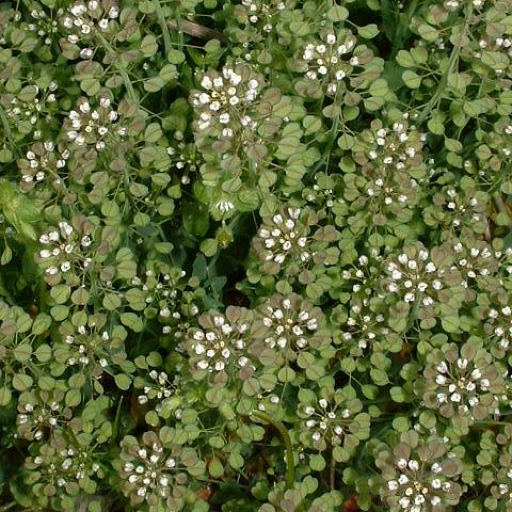
Commonly known as the Perfoliate Pennycress, this dainty member of the mustard family is a master of the "hug." Its name comes from the unique way its leaves appear to be pierced by the stem, wrapping around it in a tight, green embrace. Often found in limestone-rich grasslands or along quiet roadsides, it is one of the first subtle signs that spring has truly arrived.
🔍 How to Identify
- 🍃 The Stem-Hugging Leaves: The most distinct feature is the "perfoliate" leaves—they have no stalks and actually clasp the stem entirely at the base, making it look as though the stem is growing directly through the center of the leaf.
- 🌸 Tiny White Clusters: At the top of the plant, you'll find clusters of very small, four-petaled white flowers. These are classic "cruciform" flowers, a signature of the Brassicaceae family.
- 💚 Heart-Shaped Seed Pods: After the flowers fade, the plant produces flat, notched, heart-shaped seed pods (silicles). These look like tiny green purses or "pennies," giving the plant its common name.
🏡 In Your Garden
- 🌱 The Pioneer Spirit: This plant thrives in "disturbed" soil. If you have a gravelly patch, a rock garden, or a spot with thin, lime-rich soil where nothing else grows, the Pennycress will likely feel right at home.
- ⏳ A Fleeting Presence: It is a winter annual, meaning it germinates in the fall or winter, blooms in early spring, and disappears by mid-summer. It doesn't compete well with larger, aggressive perennials, so it usually sticks to the edges and bare spots.
⚠️ Safety & Toxicity
- ✅ Low Risk: Perfoliate Pennycress is generally considered non-toxic to humans, cats, and dogs. It lacks the dangerous alkaloids found in many other wild species.
- 🚜 Soil Quality Matters: Because it belongs to a family of "accumulators," it can pull minerals and heavy metals from the soil. If your garden soil is contaminated, the plant may store those substances in its leaves, so it's best not to let curious pets graze on it in industrial areas.
✨ Fun Fact
[🧪] Environmental Cleaner: Scientists study species in the Thlaspi group because they are "hyperaccumulators." They have the incredible ability to suck heavy metals like zinc and cadmium out of polluted soil and store them in their tissues without dying, acting as a natural vacuum for the earth!

Detailed Care Instructions
To water this plant, you should ensure that the soil is moist but not waterlogged. Test the soil with your finger or a moisture meter before watering. If the top inch of soil feels dry, it is time to water. Use a watering can or hose to water at the base of the plant, taking care not to wet the leaves or stems. Water in the morning to allow the foliage to dry before cooler evening temperatures set in. During hot and dry periods, you may need to water more frequently. Be sure to also check the plant's specific water requirements and adjust your watering frequency accordingly.
The soil that is most suitable for Thlaspi perfoliatum is one that is well-draining and rich in organic matter. It should have a pH level between 5.5 and 7.0. It is important to note that this plant does not tolerate standing water, so the soil must drain well.
To create the ideal soil mix for Thlaspi perfoliatum, you can start by mixing equal parts of high-quality potting soil, perlite, and compost or aged manure. This will provide the necessary nutrients and drainage that the plant needs to thrive.
If you are planting Thlaspi perfoliatum in a garden bed, it is also a good idea to work in some organic matter such as compost or well-rotted manure into the existing soil. This will help to improve drainage, fertility, and overall soil health.
Overall, the ideal soil for Thlaspi perfoliatum is one that is well-draining, rich in nutrients, and has a slightly acidic to neutral pH level. By providing the right soil conditions, you can help ensure that this plant grows and flourishes.








