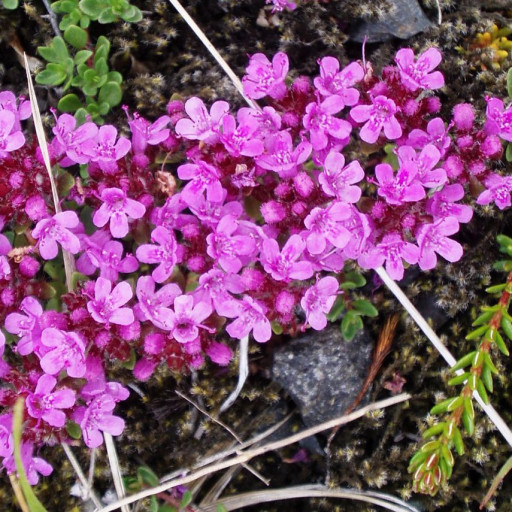
Plant Overview
Often called "Mother of Thyme" or the "Magic Carpet," Thymus praecox is the gardener's secret weapon for turning dull pathways into aromatic runways. This low-profile perennial creates a dense, velvety mat that releases a refreshing herbal scent every time it is stepped upon. In medieval lore, patches of this wild thyme were said to be the preferred dancing floors for woodland fairies.
🔍 How to Identify
- 🌿 Growth Habit: It forms a dense, ground-hugging cushion that rarely exceeds 3 inches in height, spreading outward like a slow-moving green tide rather than growing upward.
- 🍃 The Foliage: The leaves are incredibly small, oval-shaped, and slightly hairy. They are evergreen in most climates, providing a dark green texture even in the dead of winter.
- 🌸 The Bloom: During early summer, the green mat disappears under a sea of tiny, tubular flowers that range from deep magenta to pale lavender, attracting a frenzy of pollinators.
🏡 In Your Garden
- 🪨 The Drainage Rule: While it is a hardy survivor, its biggest enemy is "wet feet." It evolved in rocky, Mediterranean-style soils, so it requires a gritty or sandy spot. If planted in heavy clay, it will likely rot during a rainy winter.
- 👣 The Step-able Factor: This plant is one of the few that actually enjoys a bit of "abuse." It is categorized as "step-able," meaning its woody stems can handle occasional foot traffic between paving stones without being crushed.
⚠️ Safety & Toxicity
- 🐾 Pet & Child Friendly: Thymus praecox is considered non-toxic to dogs, cats, and horses. It is a fantastic alternative to grass for homeowners who want a pet-safe, low-maintenance lawn.
- 🐝 Bee Magnet Alert: While the plant itself is safe, it is so rich in nectar that it will be covered in bees during the summer. If you or your children are allergic to stings, avoid walking through it barefoot during the blooming season.
✨ Fun Fact
🧚 Fairy Folklore: According to ancient English legend, planting a bed of Creeping Thyme in a corner of your garden provides a place for fairies to sleep. It was a common 17th-century belief that a soup made from this thyme would allow a human to actually see the "hidden folk."

Detailed Care Instructions
| Humidity | Dry |
| Lighting | Full Sun |
| Difficulty | Medium |
| Hardiness Zones | 4 - 9 |
To grow Thymus praecox or creeping thyme, you can follow these steps:
- Location: Choose a sunny location for your Thymus praecox plant. It thrives best in full sun but can tolerate partial shade.
- Soil: Thyme prefers well-draining soil that doesn't retain excess moisture. Ensure the soil is fertile and loamy with a pH level between 6.0 and 8.0.
- Planting: Dig a small hole, slightly larger than the root ball of the Thymus praecox plant. Place the plant in the hole and backfill with soil. Gently pat down the soil around the plant.
- Watering: Thyme plants have low water requirements. Water it regularly until it establishes roots, usually during the first growing season. After that, water only when the soil is dry to touch.
- Mulching: Apply a layer of organic mulch around the plants to retain moisture and suppress weed growth.
- Pruning: Prune the plant regularly to encourage compact growth and prevent it from becoming woody. Cut back about one-third of the plant's growth in early spring.
- Fertilizer: Thyme is not a heavy feeder. However, you can apply a slow-release balanced fertilizer in early spring to promote healthy growth.
- Propagation: Thyme can be propagated by division or by taking stem cuttings. Divide the plant in spring or take stem cuttings during summer. Plant the divisions or cuttings in well-draining soil and water thoroughly until they establish roots.
- Pests and diseases: Thyme plants are generally resistant to pests and diseases. However, keep an eye out for common garden pests like aphids, spider mites, or thrips. Treat any infestations promptly.
- Winter care: Thyme is a hardy plant that can tolerate cold temperatures. It usually goes dormant in winter. However, in regions with severe winters, cover the plant with a layer of mulch or burlap to protect it from freezing temperatures.
By following these steps, you can successfully grow Thymus praecox and enjoy its aromatic foliage and delicate flowers.

Place in a bright room that is sun drenched almost all day. Or directly in a south-facing window.

To water this plant, make sure to observe its soil moisture level. It needs to be well-drained but not too dry. Water the plant consistently and deeply, but not excessively as it can lead to root rot. The best time to water is early in the morning or late afternoon to avoid direct sun exposure. Use tepid water and avoid getting water on the leaves, as it can cause scorching and fungal growth. Lastly, reduce watering in the winter months to prevent waterlogged soil.
For optimal growth, plant Thymus Praecox in well-draining soil with a pH between 6.0 and 8.0. After the plant has established, work a balanced fertilizer into the top inch of soil around the plant. Fertilize again every four to six weeks during the growing season. Use a fertilizer with a balanced N-P-K ratio, such as 10-10-10. Avoid over-fertilizing, as it can lead to weak growth and reduced flavor.
To provide ideal growing conditions for Thymus Praecox plant, it is recommended to use a well-draining, nutrient-rich soil that is slightly alkaline in nature. The soil should be moderately fertile, with a pH level between 6.5 and 8.5. Mix the soil with organic matter like compost or peat moss to improve its fertility and texture. The plant prefers a soil that is slightly loamy with a good amount of sand. Avoid using heavy clay soils that hold moisture, as it can cause root rot. Make sure the soil is moist but not waterlogged. Regular watering is necessary during the growing season to keep the soil evenly moist. Soil that is too wet can lead to fungal diseases. The container or planting bed for the Thymus Praecox plant should be placed in a sunny location with well-draining soil to promote optimal growth.
Thymus praecox can be propagated through division or stem cuttings.
For division, the plant should be dug up and gently separated into smaller sections, making sure each section has some roots attached. These smaller sections can then be replanted in their desired location and watered regularly until they establish themselves.
For stem cuttings, select a healthy stem with no flowers or buds. Cut the stem about 3-4 inches from the tip and remove the lower leaves. Dip the cut end in rooting hormone and plant it in well-draining soil. Keep the soil moist and place the cutting in a shady area until roots have formed, then gradually move it to a sunnier location.
Common pests of the mother of thyme include Spider mites, fungus gnats, aphids, thrips, whiteflies. Make a habit of checking your mother of thyme frequently for pests so that any infestations can be caught and managed early.








