Plant Overview
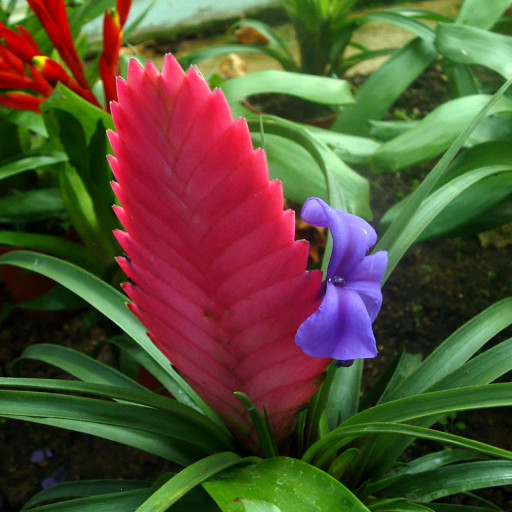
Often called the "Pink Quill," this Ecuadorian beauty is one of the most recognizable bromeliads in the world. It looks like a tropical treasure with its neon-pink paddle and tiny, ink-blue flowers that peek out like hidden gems. Unlike many of its air-plant cousins, it is surprisingly adaptable, comfortably thriving both mounted on wood or nestled in a pot of well-draining soil.
🔍 How to Identify
- 🌸 The "Quill": A large, flattened, paddle-shaped spike (bract) made of overlapping bright pink or fuchsia scales.
- 🌿 Foliage: Thin, arching, dark green leaves that grow in a dense, fountain-like rosette, often appearing grass-like.
- 💜 The Flowers: Small, three-petaled flowers of a deep violet or royal blue color that emerge one by one from the edges of the pink quill.
🏡 In Your Garden
- ☁️ Epiphytic Nature: In the wild, it grows on tree branches rather than in the ground. Because of this, it hates "wet feet"—if you pot it, use a chunky orchid mix or bark to ensure the roots can breathe.
- 💧 Misting Over Watering: While it has roots, it is a master at absorbing moisture from the air. It appreciates frequent misting on its leaves, which helps it maintain its vibrant pink color and prevents the tips of the leaves from turning brown.
⚠️ Safety & Toxicity
- ✅ Non-Toxic: The Pink Quill is considered safe and non-toxic for both cats and dogs.
- 👶 Child Safe: It is safe for households with children, though the thin leaves can be somewhat sharp-edged, so it is best kept on a high shelf out of reach of tiny hands.
✨ Fun Fact
The Pink Quill is a "monocarpic" plant, meaning the main rosette will only bloom once in its lifetime. However, as the flower spike fades, the plant focuses its energy on producing small clones called "pups" at its base, which you can eventually separate to grow entirely new plants!

Detailed Care Instructions
| Color | Blue, Purple |
| Lighting | Full Sun |
| Plant Type | Perennial, Succulent |
| Mature Size | Up To 10 In. Tall |
| Native Area | South America |
| Sun Exposure | Partial Shade |
| Hardiness Zones | 11 And Above |
To grow a Tillandsia Cyanea plant successfully, you should follow these steps:
- Lighting: Place your Tillandsia Cyanea plant in bright, indirect sunlight. Avoid exposing it to direct sunlight, as it can scorch the leaves.
- Temperature: This plant thrives in temperatures between 60-80°F (15-27°C). Make sure to protect it from extreme cold or heat.
- Watering: Mist the plant two to three times a week, ensuring the leaves are thoroughly wetted. Alternatively, you can submerge the plant in water for 10-15 minutes once a week, allowing it to drain fully before returning it to its display. Reduce the frequency during the winter months when the plant requires less hydration.
- Humidity: Tillandsia Cyanea plants appreciate high humidity levels. If the air in your home is dry, you can use a humidifier or place a tray filled with water near the plant to increase moisture in the surroundings.
- Fertilization: Feed the plant every two to three weeks during the growing season with a diluted, balanced houseplant fertilizer. Follow the instructions on the fertilizer packaging for proper dosage.
- Air circulation: Good air circulation is essential for Tillandsia Cyanea plants to thrive. Make sure there is sufficient airflow in the room where you keep the plant, avoiding stagnant conditions.
- Potting: Tillandsia Cyanea plants are epiphytic, which means they don't require soil. You can mount them on a piece of driftwood, cork, or any other decorative surface. You may also place them in a pot with well-draining soil and incorporate some orchid bark or sphagnum moss to enhance drainage.
- Pruning: Trim off any dead or brown leaves to maintain the plant's appearance and health. Be careful not to damage the healthy parts while pruning.
- Repotting: Repotting is not typically required for Tillandsia Cyanea plants. However, if the roots are overcrowded or the plant is outgrowing its current container, you can gently remove it from its current placement and transplant it into a new pot or mounting surface.
By following these care instructions, you can effectively grow and maintain a healthy Tillandsia Cyanea plant in your home.

Place in a window with dappled sun or a spot in the middle of a room. Or directly in a window facing west or east.

To water this type of plant, it is important to avoid getting the leaves wet and instead focus on watering the roots. Water should be applied once a week by submerging the root ball in a container of water for about 15-20 minutes. After soaking, allow the excess water to drain completely before returning the plant to its location. It is important to avoid overwatering, as this can lead to root rot. Keep the plant in a location with bright, filtered light and avoid direct sunlight.
To fertilize the plant, mix a general-purpose liquid fertilizer with water at half-strength. Mist the leaves of the plant with the mixture once a month during growing season. Avoid getting the fertilizer on the plant's flower spikes.
Tillandsia Cyanea plant prefers a well-draining and nutrient-rich soil that is not too dense or compact. The soil should be a mix of organic matter, such as peat moss or coconut coir, and inorganic components like perlite or vermiculite. This combination helps to provide good air circulation around the roots, preventing waterlogging and root rot. The ideal soil for this plant should have a pH level between 5.5 to 7.5, which is slightly acidic to neutral. It's important to ensure that the soil is moist but not waterlogged, as overwatering can cause the plant to decay. Therefore, it's recommended to use a high-quality soil mix specifically designed for epiphytic plants or air plants, which provides the necessary drainage, moisture retention, and nutrient supply required for the Tillandsia Cyanea plant to thrive.
Tillandsia Cyanea is a type of plant that can be propagated by using offsets. Start by carefully removing the offsets from the mother plant using a sharp, sterile knife. Ensure that each offset has enough roots to survive on its own.
Place the offsets in a well-draining potting mix, or simply wrap their roots in a damp sphagnum moss. It is important not to bury the base of the offset in the soil as this can cause rot.
Once the offsets are planted, place them in a bright, indirect light and mist them regularly with water or use a fine spray bottle to water them lightly.
It is important to avoid overwatering, which can cause the offsets to rot. Instead, aim to keep the soil moist but not saturated, and allow it to dry out slightly before watering again.
The offsets should begin to develop their own roots within a few weeks to a couple of months, at which point they can be transplanted into their own pots. With proper care, the newly propagated Tillandsia Cyanea plants should continue to grow and thrive.
Common pests of the pink quill include Scale insect, mealybugs, spider mites. Make a habit of checking your pink quill frequently for pests so that any infestations can be caught and managed early.








