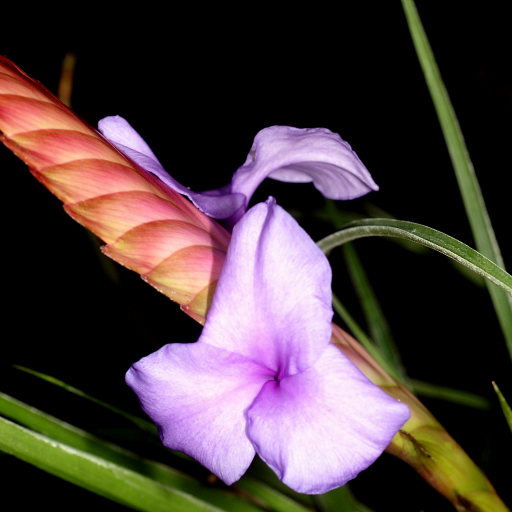
Plant Overview
Often hailed as the "Jewel of the Highlands," Tillandsia guatemalensis is a show-stopping air plant that hails from the misty cloud forests of Central America. Unlike its tiny, silver cousins often found in glass terrariums, this species is a lush, green giant that adds a prehistoric, tropical flair to any room. In its native Guatemala, it is deeply woven into local culture, frequently used to decorate churches and altars during traditional festivals.
🔍 How to Identify
- 🍃 Soft Rosette: It forms a large, symmetrical funnel of wide, flexible leaves that are a vibrant mossy green, lacking the heavy "fuzz" (trichomes) seen on desert air plants.
- 🌸 The Inflorescence: When it blooms, it produces a spectacular, multi-branched flower spike that ranges from deep rose-pink to cardinal red.
- 🟣 Bicolor Flowers: Nestled within the red bracts are tubular, violet or royal blue flowers that provide a stunning color contrast.
- 📐 Substantial Scale: This isn't a "pocket plant"; a mature specimen can reach over a foot in diameter, making it a true focal point.
🏡 In Your Garden
- ☁️ Cloud Forest Vibes: Because it originates from high-altitude forests, this plant craves high humidity and cooler temperatures than most Tillandsias. It doesn't just like a misting; it thrives when kept in a "steamy" environment like a bright bathroom.
- 🌬️ Air Circulation is Key: While it loves moisture, it hates stagnant air. If the base of the plant stays wet without airflow, it can succumb to rot quickly. Think of it as a plant that likes to "shower and then blow-dry."
- 💡 Light Sensitivity: Its soft green leaves are prone to sunburn. It prefers bright, filtered light—think of the dappled sun through a forest canopy rather than the harsh glare of a south-facing window.
⚠️ Safety & Toxicity
- ✅ Pet Safe: Like almost all members of the Bromeliad family, Tillandsia guatemalensis is non-toxic to cats, dogs, and humans.
- 🛡️ Fragility Alert: While not poisonous, the leaves are quite supple and can be easily snapped by curious pets or toddlers. It is best displayed hanging or mounted high on a wall to protect its delicate form.
✨ Fun Fact
In Guatemala, this plant is a star of the "Semana Santa" (Holy Week) celebrations. Its massive, colorful red spikes are harvested to create "Alfombras"—intricate, aromatic carpets made of flowers and sawdust that line the streets for religious processions.

Detailed Care Instructions
To grow Tillandsia guatemalensis, also known as the Guatemalan air plant, you can follow these steps:
- Watering: Tillandsias are epiphytic plants that extract nutrients and moisture from the air. They do not require soil, but they do need regular misting or soaking. Fill a bowl with filtered or rainwater and submerge your Tillandsia guatemalensis for about 10-15 minutes every week or two. After soaking, let the plant drain and return it to its display area.
- Light: Place your Tillandsia guatemalensis in a bright area, receiving indirect sunlight. They can tolerate a few hours of direct sunlight each day but excessive exposure can cause their leaves to burn or become scorched. A south, east, or west facing window is ideal.
- Air circulation: Good air circulation is essential for the health of air plants. They thrive in areas with good air movement, so ensure that there is natural or artificial airflow in the vicinity of the plant. This can be done by using a fan or positioning them in spaces where there is constant air movement.
- Temperature: Tillandsias prefer temperatures between 50°F to 90°F (10°C to 32°C). They are more tolerant of higher temperatures than lower ones. Avoid exposing them to extreme temperature fluctuations or below-freezing temperatures.
- Fertilization: Once a month during the growing season, you can provide some additional nutrients to your Tillandsia guatemalensis by misting them with a diluted epiphytic orchid fertilizer. Follow the package instructions for ratios and dilution amounts.
- Display: Tillandsia guatemalensis can be displayed in various ways. They can be mounted on driftwood, hung in a wire or glass terrarium, or placed in decorative containers such as seashells or vases. Ensure that the chosen display method provides good air circulation and does not trap water, as this can lead to rot.
Following these care instructions, you should be able to grow and maintain a healthy Tillandsia guatemalensis plant.

Place in a window with dappled sun or a spot in the middle of a room. Or directly in a window facing west or east.

Tillandsia Guatemalensis belongs to the family Bromeliaceae and is an epiphytic air plant native to Guatemala and other Central American countries. Its unique growth habit allows it to grow without soil and obtain nutrients and moisture from the air.
To water Tillandsia Guatemalensis, it is important to mimic its natural habitat and provide adequate moisture without overwatering. Here are some guidelines to follow:
1. Misting: Fill a spray bottle with filtered, non-chlorinated water. Mist the plant thoroughly, ensuring that water reaches both the leaves and the central rosette. Mist until the leaves appear uniformly wet.
2. Soaking: Alternatively, you can soak the plant in a bowl of water for about 20-30 minutes. Fill a bowl or basin with room temperature filtered water and submerge the plant completely. This method allows the plant to absorb water through its leaves and the central rosette. After soaking, remove the plant from the water and gently shake off excess moisture.
3. Drying: After watering, it's crucial to allow the plant to dry properly. Tillandsias are susceptible to rotting if they remain wet for too long. Place the plant in a well-ventilated area with good air circulation. Avoid placing it in direct sunlight or in very humid conditions.
4. Frequency: The watering frequency can vary depending on the environment and humidity levels. Generally, watering once or twice a week should be sufficient. However, hot and dry conditions may require more frequent watering, while cooler and more humid environments may require less.
5. Adjusting watering schedule: You can observe the plant's appearance to determine when it needs water. When Tillandsia Guatemalensis is adequately hydrated, the leaves appear plump and have a greenish hue. As it dries out, the leaves may curl slightly and appear slightly grayish. This is a natural adaptation to prevent excessive water loss.
Remember, it is essential not to overwater Tillandsia Guatemalensis, as it can lead to root rot and ultimately kill the plant. Additionally, using filtered or rainwater is recommended to avoid the negative effects of chlorine and other impurities found in tap water.
By following these guidelines and understanding the specific needs of Tillandsia Guatemalensis, you can ensure that your plant thrives and remains healthy.
To fertilize Tillandsia Guatemalensis, follow these instructions:
- Dilute a balanced, water-soluble fertilizer specifically for Tillandsias or bromeliads. Use about ¼ of the recommended strength to avoid over-fertilizing.
- Fill a spray bottle or a basin with the diluted fertilizer solution. If using a spray bottle, adjust the nozzle to a fine mist setting.
- Mist the foliage of the Tillandsia Guatemalensis plant with the diluted fertilizer solution. Ensure the leaves are thoroughly coated but avoid excessive saturation.
- Alternatively, you can also submerge the plant in the diluted fertilizer solution for 10-15 minutes instead of misting.
- Apply the fertilizer once every month during the growing season, which usually encompasses spring and summer. Reduce or stop fertilizing during the dormant period in fall and winter.
- After fertilizing, carefully rinse off any excess fertilizer from the leaves with water. Excess fertilizer buildup can harm the plant.
Note: Tillandsia Guatemalensis is an epiphytic plant that primarily absorbs nutrients through its leaves. Therefore, foliar fertilization, like misting or submerging, is the most effective way to provide nutrients to the plant.
Tillandsia Guatemalensis is a plant that thrives in a specific type of soil to ensure its optimal growth and health. Here are some details about the soil that is recommended for Tillandsia Guatemalensis:
- Well-Draining Soil: Tillandsia Guatemalensis prefers soil that is well-draining so that excess water can quickly pass through and not sit around the roots. This helps to prevent root rot and fungal diseases.
- Air Circulation: The ideal soil for Tillandsia Guatemalensis promotes air circulation around its roots. This is crucial as the plant primarily obtains nutrients and moisture through its leaves rather than its roots.
- Porous Mix: It is best to use a soil mix that is lightweight and porous, allowing air to circulate freely around the roots. This can be achieved by incorporating materials such as orchid bark, coconut coir, or pumice in the soil mix.
- Organic Matter: Tillandsia Guatemalensis benefits from soil that contains some organic matter, which helps in retaining moisture while allowing proper aeration and nutrient availability. Adding a small amount of well-rotted compost or leaf mold to the soil can be beneficial.
- pH Level: The ideal pH level for Tillandsia Guatemalensis is slightly acidic to neutral, ranging between 5.5 to 7.0. Ensuring the soil pH remains within this range helps the plant to efficiently absorb essential nutrients from the soil.
- Nutrient Content: While Tillandsia Guatemalensis can obtain nutrients primarily from the air and rainfall, a soil mix that contains some slow-release organic or balanced fertilizer can provide additional nutrients for healthy growth. However, it is important to avoid excessive fertilization as this can damage the plant.
Remember, apart from the soil, Tillandsia Guatemalensis requires indirect or filtered sunlight, water misting or occasional soaking, and proper air circulation to thrive.
To propagate Tillandsia Guatemalensis, follow these steps:
- Prepare the mother plant: Choose a mature and healthy Tillandsia Guatemalensis plant to use as the mother plant for propagation. Ensure that it is well-established and free from any diseases or pests.
- Identify the offsets: Inspect the base of the mother plant for the presence of offsets, also known as pups. Offsets are small plants that grow from the base of the mother plant and can be separated to propagate new individual plants.
- Remove the offsets: Gently and carefully separate the offsets from the mother plant. Use your hands or a clean, sharp knife to detach them. Ensure that each offset has its own set of roots.
- Allow offsets to dry: Place the separated offsets in a well-ventilated area, away from direct sunlight, and allow them to dry for a few hours or up to a day. This step helps to prevent rotting and infection during the rooting process.
- Rooting the offsets: Prepare a suitable medium for rooting, such as a mixture of well-draining soil and orchid bark or sphagnum moss. Insert the base of each offset into the rooting medium, ensuring it comes into contact with the medium and has good support.
- Provide appropriate conditions: After rooting, place the newly propagated offsets in a warm and bright location, with indirect sunlight. Avoid exposing them to harsh sunlight or extreme temperatures, as it can cause damage.
- Mist or soak the offsets: Tillandsia Guatemalensis is an air plant that absorbs moisture through its leaves. To provide ample hydration during the early stages of propagation, mist the offsets daily or soak them in water for 10-15 minutes every week. Ensure they drain well after soaking to prevent waterlogged roots.
- Monitor growth: Regularly check the offsets for signs of growth. Over time, you will observe new roots emerging and the development of new leaves from the center of the plant.
- Transplanting: When the offsets have grown to a suitable size and have established healthy roots, they can be transplanted into individual pots or attached to a suitable substrate, such as cork bark or driftwood. Use a specialized glue or tie them securely to the substrate, allowing the roots to anchor and establish themselves.
- Care for the new plants: As the new plants continue to grow, provide them with the same care and conditions as a mature Tillandsia Guatemalensis plant. This includes indirect bright light, occasional misting or soaking, and a well-ventilated environment to prevent rotting.
By following these steps, you can successfully propagate Tillandsia Guatemalensis and create new plants from the offsets of the mother plant.
Common pests of the pink quill include Scale insect, mealybugs, spider mites. Make a habit of checking your pink quill frequently for pests so that any infestations can be caught and managed early.








