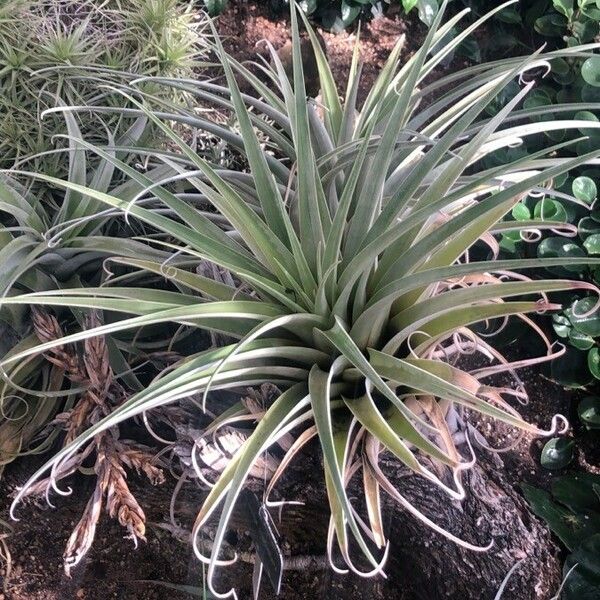
Plant Overview
Known as the "Rose-Scaped Air Plant," Tillandsia roseoscapa is a rare and majestic inhabitant of the vertical limestone cliffs in Puebla, Mexico. Unlike the delicate, wispy air plants many are used to, this species is a "xeric" powerhouse, built to withstand intense sun and dry winds. It is highly prized by collectors for its architectural symmetry and the stunning, rose-colored floral spike that gives it its name.
🔍 How to Identify
- ❄️ Frosty Foliage: The leaves are thick, stiff, and covered in a dense layer of silver-white scales called trichomes, giving the plant a metallic, frosted appearance.
- 📏 Stiff Rosette: It grows in a very symmetrical, star-shaped rosette. Because the leaves are so rigid, the plant feels almost like it is made of soft plastic or wood rather than living tissue.
- 🌸 The Rose Scape: When it blooms, it produces a long, thick flower stalk (scape) that is a brilliant, dusty rose pink, which eventually sprouts small, tubular flowers.
🏡 In Your Garden
- ☀️ The Sunscreen Effect: Those silver scales aren't just for looks—they act as a biological sunscreen. This plant requires very bright, indirect light (or even some direct morning sun) to maintain its color and health.
- 🌬️ Cliff-Side Cues: In the wild, it lives on wind-swept cliffs. In your home, air circulation is its best friend. It is prone to rot if water gets trapped in its base, so always ensure it dries out completely within a few hours of watering.
- 💧 Less is More: Because it is a succulent-style air plant, it stores more water than its green-leaved cousins. It prefers a good dunking or heavy misting followed by a "shake" to remove excess water, rather than constant humidity.
⚠️ Safety & Toxicity
- ✅ Safe for All: Like the vast majority of the Tillandsia genus, roseoscapa is non-toxic to humans, cats, and dogs.
- 🌵 Mechanical Warning: While not poisonous, the leaves are very stiff and can have slightly pointed tips. Place it somewhere it won't be accidentally bumped, as the leaves can be brittle and the tips can be poky.
✨ Fun Fact
Tillandsia roseoscapa is a "Lithophyte," a word that literally translates to "stone-dweller." While most air plants grow on trees (epiphytes), this species prefers to cling directly to bare rock faces, absorbing every drop of dew that rolls down the stone!

Detailed Care Instructions
To grow Tillandsia Roseoscapa, also known as Pink Quill, follow these steps:
- Light: Choose a location that offers bright, indirect light. Avoid direct sunlight, as it can scorch the plant. A north or east-facing window is ideal.
- Air circulation: Tillandsia Roseoscapa is an epiphytic plant that naturally grows on tree branches, so it requires good air circulation. Place it in an area with adequate air flow, or use a fan if necessary.
- Water: Tillandsias are air plants and do not rely on soil for nutrients. Instead, they absorb moisture through their leaves. Mist your Tillandsia Roseoscapa with water 2-3 times per week, ensuring the leaves are thoroughly wetted. Alternatively, you can dunk the plant in water for 10-15 minutes once a week.
- Humidity: As Tillandsias are native to tropical areas, they prefer humidity. If your home is dry, you can increase humidity levels around the plant by placing it on a humidity tray filled with water or using a humidifier.
- Fertilizer: Feed your Tillandsia Roseoscapa monthly with a water-soluble bromeliad or orchid fertilizer, diluted to half strength. Mist the leaves with the diluted fertilizer or soak the plant in the mixture for 15-20 minutes.
- Temperature: Tillandsia Roseoscapa prefers temperatures between 60-80°F (15-27°C). Avoid exposing it to extreme cold or heat.
- Air drying: After watering, ensure the plant's leaves dry completely within a few hours to prevent rot and fungal issues.
- Display: You can grow Tillandsia Roseoscapa in various ways. Mount it onto driftwood, cork bark, or other decorative surfaces, or place it in a well-draining pot filled with orchid or bromeliad mix. Ensure that the plant's roots are not buried in the soil.
- Maintenance: Regularly remove any dead or yellowing leaves to maintain the plant's health and appearance.
By following these guidelines, you should be able to grow Tillandsia Roseoscapa successfully. Remember to observe your plant and adjust care as needed since growing conditions may vary.

Place in a window with dappled sun or a spot in the middle of a room. Or directly in a window facing west or east.

Tillandsia Roseoscapa is an epiphytic plant which means that they grow on trees, rocks, and other surfaces without soil. The leaves of the plant absorb moisture and nutrients from the air. Hence, it is crucial to water them properly to maintain its health.
Here is a step-by-step guide on how to water a Tillandsia Roseoscapa plant:
1. Check the plant's condition: Check the plant regularly to determine whether it needs water. Healthy plants will have green leaves, while unhealthy plants will have brown or yellow leaves.
2. Soak the plant: Fill a container with room temperature or lukewarm water and fully immerse the plant in it. Leave the plant in the water for approximately 30 minutes. This will give the plant sufficient time to absorb moisture and nutrients.
3. Shake off excess water: Remove the plant from the water and gently shake off excess water. Hold the plant upside down to ensure all the trapped water flows out from its leaves.
4. Air dry the plant: After removing the excess water, place the plant in a well-ventilated area away from direct sunlight. Make sure the plant is fully dry before putting it back to its original position.
Make sure not to overwater the plant as it can damage the plant's health in the long run. The ideal practice is to water the plant once or twice a week, depending on the environmental condition.
The Tillandsia Roseoscapa plant should be fertilized once a month by mixing a water-soluble fertilizer with water in a spray bottle, according to the package instructions. The plant should be misted lightly with the fertilizer solution, taking care to avoid saturating the plant. Fertilize the plant during the growing season (spring and summer) and reduce the frequency or stop fertilizing during the winter dormancy period. Ensure the plant is well-watered before fertilizing to prevent fertilizer burn.
The recommended soil for Tillandsia Roseoscapa plant is a loose, well-draining mix that is specifically formulated for air plants. The soil should be free of any large pieces, such as twigs or rocks that could damage the plant. The ideal soil should have a neutral pH level, high porosity, and be able to retain some moisture without becoming waterlogged. Using a commercial air plant soil mixture or a homemade blend of equal parts fine sand, peat, and coarse bark is suitable for this type of plant. The soil should not be packed too tightly around the roots, as Tillandsia Roseoscapa roots require air circulation to thrive. It is important to avoid using fertilizers on these plants, as their delicate root systems can be easily damaged.
Due to the lack of common names, here is a detailed guide on how to propagate Tillandsia Rosaescapa:
- First, locate the offsets on the base of the parent plant. These are small pups that have grown from the base of the main plant.
- Carefully remove the offsets from the parent plant by gently twisting them downward and away from the stem.
- Once the offsets are removed, allow them to dry out in a shaded, well-ventilated area for a day or two. This will prevent rotting and promote healthy growth.
- After the offsets are dry, place them in a suitable growing medium such as sphagnum moss, peat moss, or a well-draining soil mix.
- Mist the growing medium and the offsets with water, and then place them in a bright, filtered light area, avoiding direct sunlight.
- Continue to mist the offsets every few days to keep the growing medium moist but not soaking wet.
- Over time, the offsets should root and start to develop new leaves. At this point, they can be planted individually in their own containers or left to continue growing alongside the parent plant.
- Keep in mind that Tillandsia Rosaescapa is an epiphytic plant, meaning it does not grow in soil in its natural habitat. Therefore, it is important to avoid overwatering and to provide plenty of air circulation when propagating and caring for this plant.
Common pests of the tillandsia roseoscapa include Mealybugs. Make a habit of checking your tillandsia roseoscapa frequently for pests so that any infestations can be caught and managed early.








