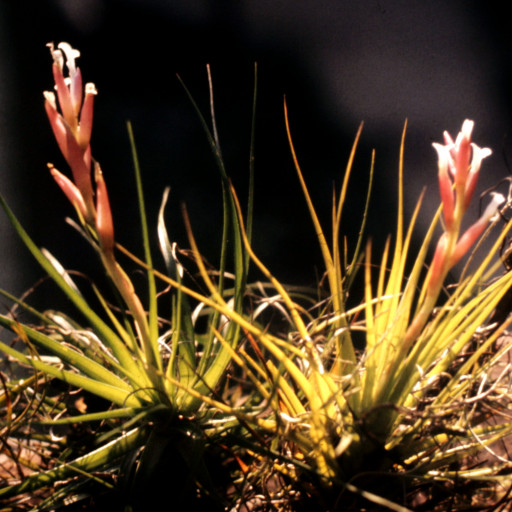
Plant Overview
Often called the Narrow-leaf Air Plant, Tillandsia tenuifolia is a resilient botanical gymnast found clinging to trees and rocks from the Caribbean down through Brazil. Unlike traditional houseplants, this "epiphyte" lives entirely without soil, using its roots merely as anchors to hold onto its perch. Its elegant, needle-like foliage and vibrant pink blooms make it a favorite for modern terrariums and minimalist home displays.
🔍 How to Identify
- 🌿 The Foliage: It features stiff, slender, silver-green leaves that curve gracefully. Over time, these plants naturally grow into impressive, spherical clusters or "clumps."
- 🌸 The Bloom Spike: When it's ready to flower, it produces a stunning pink or reddish bract that looks like a glowing matchstick.
- ✨ Small Flowers: Tucked within the pink bracts are delicate, three-petaled flowers, which are usually white or a pale, icy blue.
🏡 In Your Garden
- 💨 Airflow is Vital: Because it doesn't have soil to regulate moisture, this plant relies on constant air movement. Stagnant, humid air is its greatest enemy and can lead to crown rot.
- 🚿 The Soak and Shake: Instead of a watering can, this plant prefers a deep soak in a bowl of water for 20–30 minutes once a week. Crucially, you must shake it upside down afterward to ensure no water remains trapped in the leaf bases.
- ⛅ Sun and Color: While it thrives in bright, indirect light, giving it a bit of cool morning sun can cause the leaves to "blush," turning them a beautiful bronze or deep purple hue.
⚠️ Safety & Toxicity
- 🐾 Pet Friendly: Tillandsia tenuifolia is non-toxic to cats, dogs, and horses. It is one of the safest plants to keep in a home with curious pets.
- 🧤 Handle with Care: While not poisonous, the leaf tips are quite stiff and can be pointy. It is best to hang them or place them on shelves where they won't be accidentally bumped into.
✨ Fun Fact
The name tenuifolia literally translates from Latin to "slender leaf." In its native habitat, this plant is so hardy that it can be found growing at sea level all the way up to high-altitude forests 8,000 feet above the clouds!

Detailed Care Instructions

Place in a window with dappled sun or a spot in the middle of a room. Or directly in a window facing west or east.

The water in these plants is absorbed and evaporated form the leaves. As a result, it is recommended that the leaves be submerged in water once a week or misted on a regular basis. Submerge your plant in water in a sink or holder for 30 minutes. Then gently shake the plant tossing and turning to dry it. Place your plant on a towel for a few hours and let it sit. It will evaporate any excess water. If the plants are kept in indoor conditions, they should be hydrated on a regular basis. It's simple to keep these plants hydrated all the time, but it takes a lot of work. Watering air plants early in the morning allows them to dry out and avoids disturbing their respiration activity at night. Chlorinated water causes the tips of the leaves to brown, so avoid it.
These plants scarcely crave for fertilizers. The choice of fertilizer, on the other hand, is quite important. Misting with right fertilizers will promote blooming. Fertilizers containing urea, zinc, and copper are toxic to plants and should be avoided at all costs. Nitrogen, phosphorus, and potassium should be present in the chosen fertilizer. Once a month, apply either bromeliad fertilizer or a diluted houseplant fertilizer with a 1/4 dilution. Moreover, don't forget to water your plants after the application of fertilizer.
You may use Orchid Food for your Narrowleaf Airplant
The ideal soil for Tillandsia Tenuifolia plant should be well-draining and loose-structured. It should not hold water and should allow air circulation around the roots. A combination of fine-grain sand, fine-grained bark chips, and coarse perlite can work well as a potting mix. The soil should be slightly acidic, with a pH range of 5.5-6.5. It should also be nutrient-poor as these plants are epiphytic and obtain nutrients from the air and rain. It's important to avoid using soil that has been treated with chemicals or fertilizers.
Common pests of the narrowleaf airplant include Mealybugs. Make a habit of checking your narrowleaf airplant frequently for pests so that any infestations can be caught and managed early.








