Plant Overview
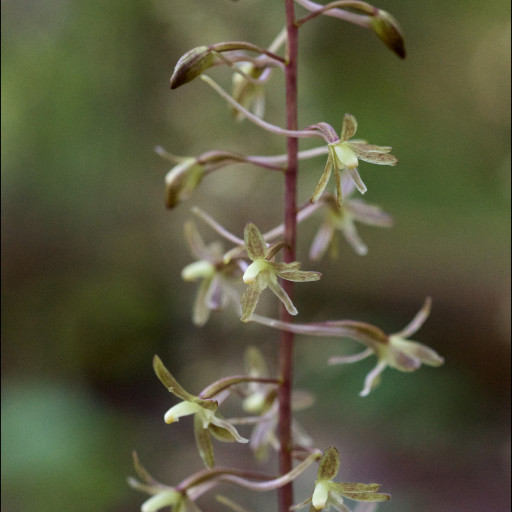
Known as the Cranefly Orchid, this elusive woodland resident is a master of the "winter-green" strategy. It is one of the few plants that performs its photosynthesis during the cold months, showing off a single, striking leaf when the rest of the forest is brown. By the time its delicate, insect-like flowers bloom in mid-summer, the leaf has completely withered away, leaving the blossoms to appear like hovering ghosts in the shadows.
🔍 How to Identify
- 🍃 The Solitary Leaf: It produces only one leaf per year. The top is a dull, pleated green, while the underside is a startling, vibrant royal purple.
- 📐 Asymmetrical Base: The leaf is famously "lopsided" or "crippled" at the base, where one side of the blade attaches to the stem lower than the other.
- 🦟 Cranefly Blossoms: In July or August, a thin, leafless brownish stalk rises 10–20 inches, sporting translucent, spindly flowers that mimic the long legs of a crane fly.
🏡 In Your Garden & Habitat
- 🌳 Woodland Specialist: This orchid is native to the organic-rich leaf litter of deciduous forests in the Eastern United States. It thrives under the canopy of Oak, Beech, and Hickory trees.
- 🍄 Fungal Partnership: Like many orchids, it is "mycorrhizal," meaning it relies on a complex relationship with soil fungi to absorb nutrients. Because of this, it rarely survives being transplanted into a standard garden bed.
- 🍂 Summer Dormancy: Don't be fooled into thinking the plant has died! It naturally goes dormant and disappears entirely during the late spring as the forest canopy closes.
⚠️ Safety & Toxicity
- 🟢 Non-Toxic: The Cranefly Orchid is not known to be poisonous to humans, cats, or dogs.
- 🛡️ Conservation Status: While not endangered everywhere, it is sensitive to habitat loss. In some states, it is a protected species. It is best enjoyed with a camera rather than a shovel.
✨ Fun Fact
The flowers are evolved with a specific "asymmetry" to match the faces of nocturnal moths. As a moth sips nectar, the flower precisely glues a pollen packet (pollinia) onto one of the moth’s compound eyes so it can be carried to the next orchid!

Detailed Care Instructions
To grow Tipularia Discolor, also known as Cranefly Orchid or Nodding Ladies' Tresses, you can follow the steps below:
- Location: Find the suitable location for the plant. Tipularia Discolor prefers partially shady to fully shaded areas. Look for an area with dappled sunlight or under the canopy of trees.
- Soil: The plant thrives in well-draining soil. Ensure the soil is rich in organic matter and slightly acidic. You can amend the soil with peat moss or compost to improve its quality.
- Planting: Plant the Tipularia Discolor tubers in the late summer to early fall, typically from October to November. Dig a hole in the prepared soil about 2 to 3 inches deep. Place the tuber in the hole horizontally, ensuring the growth bud faces up. Cover the tuber with soil and gently pat it down.
- Watering: Keep the planting area slightly moist, but avoid overwatering. Tipularia Discolor prefers moist conditions but can't tolerate excessive waterlogging. Water the plant sparingly during the growing season and decrease watering during the dormant period.
- Mulching: Apply a layer of organic mulch, such as chopped leaves or bark, around the plant. Mulching helps retain moisture in the soil, protects the tuber, and reduces weed growth.
- Fertilizer: Tipularia Discolor doesn't require much fertilization. However, you can apply a slow-release, balanced fertilizer in the early spring when the new growth appears. Follow the package instructions for application rates.
- Maintenance: Keep an eye out for any pests or diseases. Handpick any insects you see and treat any infections promptly. Remove any dead or yellowing leaves to maintain the plant's overall health.
- Dormancy: Tipularia Discolor has a dormant period during the summer months. The plant sheds its leaves during this time, so don't be alarmed. Avoid disturbing the tubers while they are dormant.
Note: Growing Tipularia Discolor from seed is challenging due to their specific germination requirements. It's generally best to obtain tubers from a reputable nursery or garden center.
By following these steps and providing the appropriate care, you can successfully grow Tipularia Discolor in your garden.

Place in a window with dappled sun or a spot in the middle of a room. Or directly in a window facing west or east.

To properly water this plant, it is important to take into consideration its specific needs. Begin by assessing the potting mix and ensuring it is not completely dry before watering. The frequency of watering will depend on the humidity, temperature, and amount of light the plant is receiving. It is important not to overwater, as this can lead to root rot. Instead, water thoroughly and allow the soil to slightly dry out in between watering. As a general rule, it is better to underwater than overwater this plant. Always use room temperature water when watering and avoid getting water on the leaves.
To fertilize this plant, use a slow-release, balanced fertilizer with equal parts nitrogen, phosphorus, and potassium. Apply the fertilizer at a rate of one tablespoon per square foot of soil in early spring, just before new growth appears. Water the area well after applying the fertilizer. Repeat once more during the growing season if desired, but do not exceed the recommended dosage.
Tipularia Discolor plant requires a well-draining soil that is rich in organic matter. The ideal soil type should be slightly acidic, with a pH of around 5.5 to 6.5. It should also be well-draining, as these plants do not tolerate wet or soggy soil. A mix of peat moss, perlite or coarse sand, and rich organic material such as compost or leaf mold can be used to create the ideal soil for this plant. It is also important to ensure that the soil is kept evenly moist, but not waterlogged, as this can lead to root rot and other problems. Overall, the soil should be loose and friable, providing ample space for the plant's roots to grow and access the nutrients they need to thrive.
Tipularia discolor can be propagated through division. This involves carefully digging up the plant and separating the rhizomes (underground stem structures) into smaller sections. Each section should have at least one healthy stem and a few small roots. These new divisions can then be replanted in a suitable habitat and cared for as usual. It is important to ensure that the soil is moist and well-draining during the establishment phase. Propagation through division is best done in the fall or early spring when the plant is dormant.








