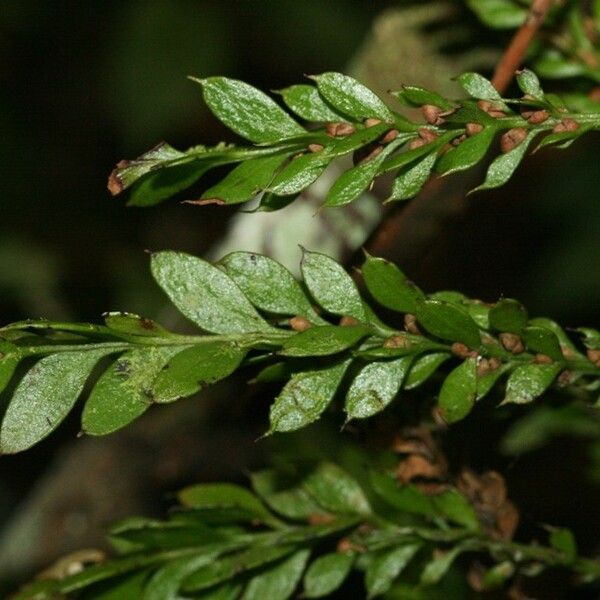
Plant Overview
Often called the Lance-leaf Fork Fern, Tmesipteris lanceolata is a living relic that looks like it stepped straight out of the Devonian period. It isn't a true fern but a "fern ally," belonging to one of the most primitive lineages of vascular plants still on Earth. You won't find this plant in a standard flower bed; it prefers to live a high-life, dangling gracefully from the trunks of tree ferns in the humid forests of New Zealand and the Pacific.
🔍 How to Identify
- 🌿 Lance-Shaped Fronds: The "leaves" (technically called microphylls) are flat, narrow, and taper to a point, resembling tiny green lance-heads.
- 🔱 Dichotomous Branching: The stems have a signature "forked" growth pattern, where a single stalk splits into two equal branches.
- 🟡 Spore Capsules: Look for small, yellow, twin-lobed capsules (synangia) tucked at the base of the leaves; these are where the plant's spores are hidden.
🏡 In Your Garden & Habitat
- ☁️ The Tree Fern Connection: In the wild, this plant is an epiphyte. It doesn't grow in soil but instead anchors its rhizomes into the soft, fibrous trunks of giant tree ferns like Dicksonia.
- 💧 Humidity Lover: It requires a very specific microclimate. Because it lacks a complex root system, it drinks primarily through the humidity in the air and the moisture held by the moss and bark of its host tree.
⚠️ Safety & Toxicity
- 🟢 Status: Non-toxic and safe.
- 🐾 Details: There are no known toxins in Tmesipteris lanceolata that pose a threat to humans, cats, or dogs. However, because they are delicate and rare in cultivation, they are best left undisturbed to play their role in their forest ecosystem.
✨ Fun Fact
Tmesipteris lanceolata is so primitive that it doesn't have true roots. Instead of a traditional root system, it relies on a prehistoric partnership with specialized fungi in its underground stems to help it "eat" nutrients from the decaying organic matter on tree trunks!

Detailed Care Instructions
To grow Tmesipteris lanceolata (Lanceolate Tmesipteris) plants, follow these steps:
- Obtain spores or young plants: Tmesipteris lanceolata plants can be grown from spores or purchased as young plants. Spores can often be found for sale online or obtained from specialized plant societies or nurseries.
- Prepare a suitable growing medium: These plants typically prefer a well-draining, moist, and acidic growing medium. Use a mix of peat moss, perlite, and sand or a commercial orchid mix to create a suitable substrate.
- Choose the right container: Select a shallow, wide container with drainage holes to hold the growing medium. This will provide ample room for the plant and allow excess water to drain, preventing waterlogged roots.
- Sow the spores or plant the young plants: If using spores, sprinkle them evenly over the prepared growing medium. Give them a light misting of water and cover the container with a clear plastic lid to create a humid environment. If using young plants, gently place them in the growing medium, making sure to cover their roots lightly.
- Create a humid environment: Tmesipteris lanceolata prefers high humidity levels. Place the container on a tray of wet pebbles or use a humidifier to maintain a humid environment around the plants. Alternatively, you can cover the container with a clear plastic bag or a cloche to increase humidity.
- Provide adequate light: Place the container in a location that receives bright, indirect light. Avoid direct sunlight, as it can scorch the delicate foliage. Supplemental fluorescent or LED grow lights can be used if natural light is insufficient.
- Maintain proper moisture levels: Keep the growing medium consistently moist but not wet. Avoid allowing the soil to dry out completely or become waterlogged. A regular misting with water or using a spray bottle can help maintain proper moisture levels.
- Fertilize sparingly: Tmesipteris lanceolata plants are generally low-maintenance and do not require frequent fertilization. If desired, use a weak, balanced liquid fertilizer diluted to half strength once or twice a year during the growing season.
- Ensure suitable temperatures: Provide temperatures between 60-70°F (15-21°C) for optimal growth. Avoid exposing the plants to extreme temperature fluctuations or drafts.
- Be patient: Tmesipteris lanceolata is a relatively slow-growing plant. It may take several months or even years for the plant to reach its full size.
By following these steps and providing the right conditions, you can successfully grow Tmesipteris lanceolata plants and enjoy their unique beauty.

Place in a window with dappled sun or a spot in the middle of a room. Or directly in a window facing west or east.

When watering this plant, take into consideration the humidity of the environment it is in. The soil should be kept consistently moist but not soggy. Water the plant deeply when the top inch of soil feels dry to the touch. It is advisable to use a watering can or a hose with a gentle spray nozzle to avoid disturbing the delicate roots. Make sure the water reaches the root zone of the plant to prevent the leaves from drying out.
Avoid getting water on the foliage as this can cause damage to the leaves. Additionally, do not let water accumulate in the saucer underneath the plant as this can lead to root rot. If the air is dry, consider misting the plant frequently to increase its humidity.
In general, the plant should be watered more frequently during the warmer months and less frequently during the cooler months. However, this can vary depending on the specific growing conditions of the plant. It is important to monitor the soil moisture levels and adjust the watering frequency accordingly.
To fertilize this plant, mix a balanced water-soluble fertilizer with water according to the recommended dosage. Apply the fertilizer to the soil around the plant, making sure not to get any on the foliage. Repeat this every four to six weeks during the growing season. Reduce fertilizer applications in the winter months.
The best soil for this plant is one that is well-draining and rich in nutrients. It should be a mixture of peat moss, sand, and loam. It should have a pH level that is slightly acidic, between 5.0 and 6.5. The soil should be kept moist but not too wet, as this can lead to root rot. Adding a slow-release fertilizer to the soil before planting will help to provide the necessary nutrients for the plant's growth.
Propagation of this plant can be done by taking spores from mature fronds and sowing them in a suitable growing medium. The spores should be collected when the fronds start turning brown. To collect them, cut off a frond and place it in a paper bag. Leave it there until the spores have fallen off, and then empty the bag. After that, sift the spores through a fine sieve to remove any debris.
The growing medium should be moist but not wet, and should contain a mixture of peat moss and perlite. Sow the spores thinly on the surface of the medium and cover with a layer of vermiculite. Then cover the container with a plastic bag to help maintain a moist environment.
Place the container in a bright location, but not in direct sunlight. Keep the soil moist by misting with water, but be careful not to overwater. The spores will germinate in several weeks, and the young plants will require warmth, moisture, and light.
As the plants grow, they will need to be transplanted into larger containers or planted outside in a suitable location. They prefer moist, well-drained soil and a shady location. With proper care, the plants will grow into mature fronds and can be used for propagation.








