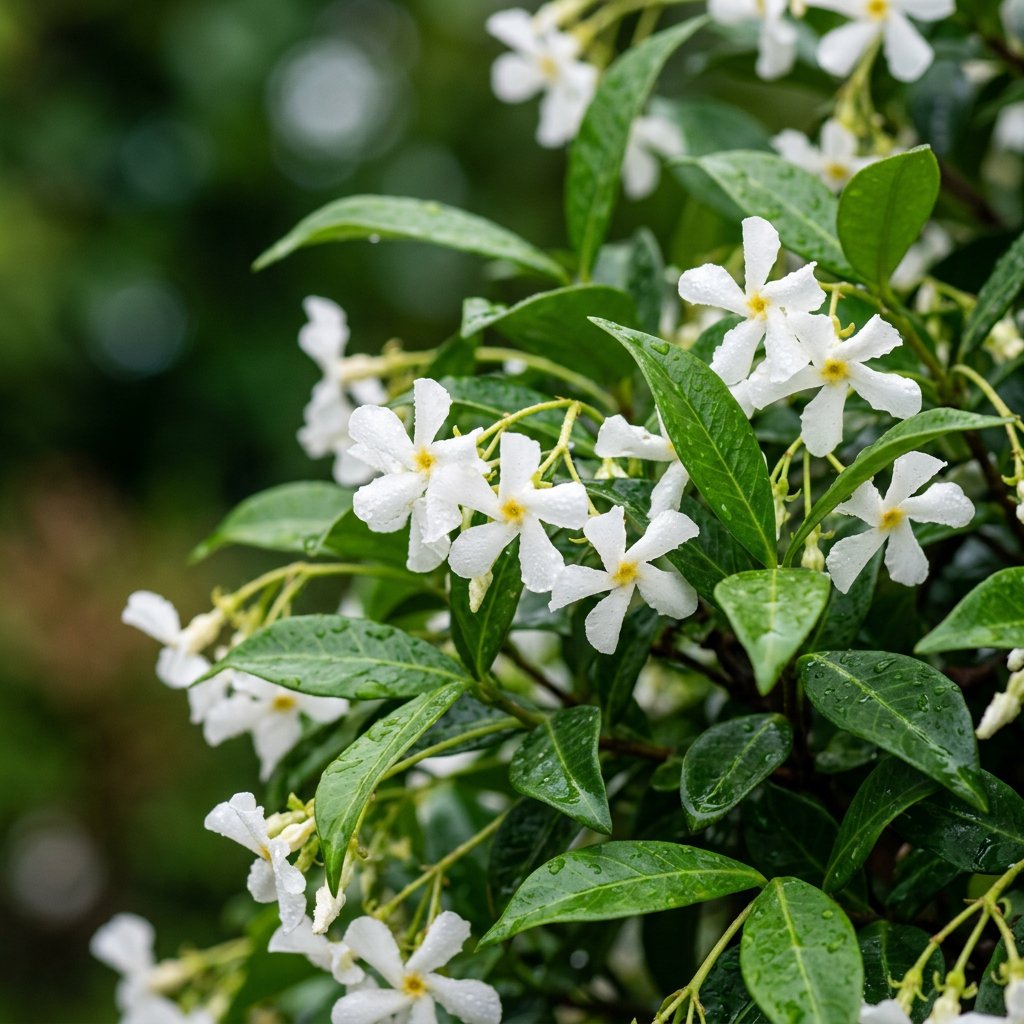
Plant Overview
Known as the Star Jasmine or "Confederate Jasmine," this evergreen climber is a sensory masterpiece for any garden. Despite its common name, it isn't a true jasmine, but its perfume is so powerful and sweet that it can fill an entire backyard on a warm summer evening. Originating from the sun-drenched forests of East and Southeast Asia, it has become a global favorite for creating "living walls" of emerald green and snowy white.
🔍 How to Identify
- 🍃 Glossy Foliage: The leaves are thick, oval-shaped, and a deep, leathery green. In colder winters, they may take on a beautiful bronze or reddish tint.
- ⭐ Pinwheel Blooms: The flowers are small, pure white, and shaped like tiny propellers or five-pointed stars, typically appearing in dense clusters.
- 🌿 Twining Stems: It doesn't use "fingers" or tendrils to climb; instead, the entire woody stem twines itself firmly around fences, trellises, or pillars.
🏡 In Your Garden
- 🧱 Versatile Architect: This plant is a master of disguise. You can train it to climb a wall for vertical interest, or let it roam horizontally to act as a thick, weed-smothering groundcover.
- ☀️ Light & Resilience: It is incredibly adaptable, thriving in full sun for maximum flowers but remaining lush and green in deep shade. It is remarkably drought-tolerant once its root system is established.
- ✂️ Pruning Patience: Because it grows vigorously, it requires pruning after the flowering season to keep it from becoming a tangled "rat's nest" of old wood.
⚠️ Safety & Toxicity
- 🥛 Irritant Sap: If you snap a stem or leaf, the plant bleeds a thick, milky white sap. This latex can cause mild skin irritation or dermatitis for those with sensitive skin.
- 🐾 Pet Safety: While generally considered non-toxic to dogs and cats by major pet registries, the sap can cause an upset stomach or drooling if your furry friends decide to use the leaves as a snack.
✨ Fun Fact
Despite being famous for its jasmine-like scent, Trachelospermum jasminoides actually belongs to the Apocynaceae family. This makes it a distant cousin of the tropical Frangipani (Plumeria) and the common Milkweed!

Detailed Care Instructions
| Humidity | Normal |
| Lighting | Full Sun |
| Difficulty | Medium |
| Hibernation | Cold Period |
| Temperature | 15°C - 35°C |
| Hardiness Zones | Min 8A |
To grow a Trachelospermum Jasminoides plant, also known as Confederate jasmine, you can follow these steps:
- Choose a suitable location: Select a spot that receives full to partial sunlight. This plant prefers well-draining soil.
- Prepare the soil: Make sure the soil is well-draining and loamy. If the soil is heavy clay or poor-draining, amend it with organic matter like compost to improve its drainage.
- Plant the vine: Dig a hole that is slightly wider and deeper than the plant's root ball. Gently remove the plant from its container, loosen the roots, and place it in the hole. Backfill the hole with soil, firming it gently around the plant.
- Water the plant: Water the plant thoroughly after planting to ensure the soil is moist. Confederate jasmine prefers consistently moist soil, but avoid overwatering, as it can lead to root rot.
- Mulch the base: Apply a layer of organic mulch, like wood chips or bark, around the base of the plant. Mulching helps retain moisture, suppresses weed growth, and insulates the roots.
- Prune regularly: Prune the plant regularly to maintain its shape and to remove dead or damaged branches. Pruning also encourages branching and promotes better flowering.
- Provide support: Confederate jasmine is a climbing vine and will benefit from some form of support, like a trellis, arbor, or fence. Install the support structure near the plant and secure the vines as needed.
- Fertilize: Feed the plant with a balanced, slow-release fertilizer in early spring. Follow the package instructions for the appropriate amount to apply.
- Monitor for pests and diseases: Keep an eye out for common pests like aphids, scales, or spider mites. Treat any infestations promptly. Also, watch for signs of diseases such as powdery mildew or leaf spot, and take appropriate action if necessary.
- Regularly water and maintain: Water the plant regularly, especially during dry periods. Maintain a consistent watering schedule, allowing the top inch of soil to dry between waterings.
With proper care and maintenance, your Trachelospermum Jasminoides plant should grow well and produce fragrant white flowers during its blooming season.

Place in a window with dappled sun or a spot in the middle of a room. Or directly in a window facing west or east.

To water this plant, one should ensure that the soil is consistently moist, but not oversaturated. It is important to water the plant deeply and thoroughly, allowing the water to penetrate the root system. This can be done by soaking the soil around the base of the plant with a watering can, hose or sprinkler system. It is recommended to water the plant regularly, especially during hot and dry weather conditions. However, over-watering should be avoided as it may lead to root rot or other fungal diseases. It is advisable to check the soil moisture level before watering to determine if the plant requires watering. The soil should not be allowed to dry out completely or become waterlogged. Overall, consistent and appropriate watering is key to maintaining the health and growth of this plant.
- Choose a balanced fertilizer with equal amounts of nitrogen, phosphorus, and potassium.
- Apply the fertilizer in early spring before new growth appears.
- Use a slow-release fertilizer to avoid over-fertilizing and burning the plant.
- Water the plant thoroughly before and after fertilizing to prevent stress.
- Repeat the fertilizing process every 6-8 weeks during the growing season.
- Avoid fertilizing during drought conditions or extreme heat to prevent plant stress.
- Apply an organic fertilizer instead of a synthetic fertilizer for a more natural approach.
The ideal soil for this particular plant should be well-draining with a pH level ranging between 6 and 7. The soil should also be rich in organic matter and nutrients to support the growth of this plant. Additionally, the soil should be loamy and contain a mix of sand, silt, and clay to ensure good drainage while retaining enough moisture for the plant to thrive. It is recommended to add perlite or sand to the potting mix to improve aeration and drainage. Avoid using heavy or compacted soil that can result in poor drainage and root rot. The soil should be slightly moist, but not waterlogged, and allowed to dry out before re-watering to prevent over-watering.
Trachelospermum Jasminoides plant can be propagated through stem cuttings. First, select stems that are at least 4-6 inches long and have a healthy appearance. Then, remove all the leaves from the bottom half of the stem, leaving only a few leaves at the top. Dip the cut end of the stem in rooting hormone powder and plant it in a pot filled with well-draining, moist soil. Water the cutting thoroughly and place it in a bright, indirect light location. Keep the soil moist but not waterlogged and mist the leaves regularly to increase humidity. After a few weeks, the cutting should start to develop roots. Once the roots have formed, the plant can be transferred to a larger container or planted directly in the garden.
Common pests of the star jasmine include Scale insect, mealybugs, spider mites, aphids, thrips. Make a habit of checking your star jasmine frequently for pests so that any infestations can be caught and managed early.








