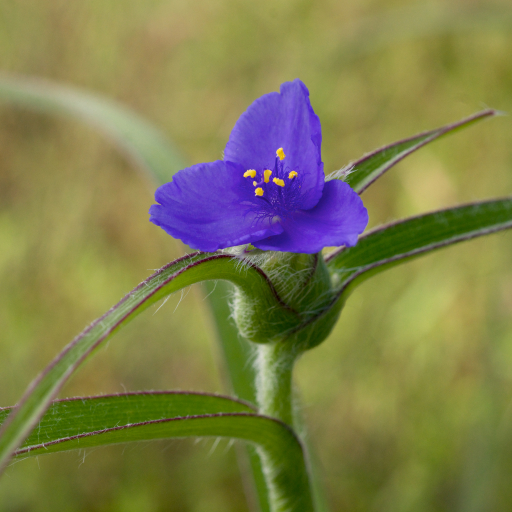
Plant Overview
Often called the Reverchon's Spiderwort, this Texas native is the rugged, "wild" cousin of the popular indoor Inch Plant. Unlike its tropical relatives that trail from hanging baskets, this species stands tall with a charming, woolly coat that helps it brave the intense heat of the American South. In the language of flowers, spiderworts are often associated with "transience" because their delicate, shimmering blooms live for only a single day.
🔍 How to Identify
- ☁️ Woolly Texture: The most striking feature is the dense covering of fine, soft hairs (pubescence) on the stems and leaves, which gives the plant a silvery, velvet-like sheen in the sunlight.
- 🌸 Vibrant Trios: It produces clusters of three-petaled flowers that range from deep violet-blue to soft lavender, accented by bright yellow, fuzzy "beards" on the stamens.
- 🍃 Lush Blades: The leaves are long, arching, and grass-like, wrapping snugly around the stem at the base to create a dense, fountain-shaped clump.
🏡 In Your Garden
- 🏖️ Sandy Soil Specialist: While many garden favorites crave rich loam, Reverchon's Spiderwort thrives in sandy, well-draining, or even rocky soils. It is a fantastic choice for "difficult" spots in a landscape where other perennials might struggle.
- 💧 Drought Resilience: Once established, this plant is remarkably water-wise. It has a deep root system that allows it to go dormant during extreme summer droughts, only to bounce back when the autumn rains arrive.
⚠️ Safety & Toxicity
- 🐾 Mildly Toxic to Pets: Like most members of the Tradescantia family, the sap contains calcium oxalate crystals. If ingested by dogs or cats, it can cause mouth irritation, drooling, or digestive upset.
- 🧤 Skin Irritation: The sticky sap and the tiny hairs on the foliage can cause a mild "itchy" rash (contact dermatitis) for people with sensitive skin. It is best to wear gloves when pruning or dividing the plant.
✨ Fun Fact
The name "Spiderwort" has a curious history. Some believe the sap, which hardens into silk-like threads when pulled apart, resembles a spider’s web. Others say the way the flower clusters hang down from the stems looks like a cluster of spiders legs!

Detailed Care Instructions
To grow Tradescantia Reverchonii (also known as Spiderwort or Purple Heart), follow these steps:
- Choose a location: Spiderwort plants prefer bright, indirect light, so place them in a spot where they can receive partial shade or filtered sunlight. Direct sunlight can scorch the leaves.
- Select the right soil: Spiderwort thrives in well-draining soil. Use a mixture of potting soil, peat moss, and perlite or sand to ensure good drainage.
- Watering: Keep the soil consistently moist but not waterlogged. Water the plant when the top inch of soil feels dry. Avoid overwatering, as it can lead to root rot.
- Fertilizing: Feed the plant with a balanced, water-soluble fertilizer once a month during the growing season (spring and summer). Follow the package instructions for the appropriate dosage.
- Propagation: Spiderwort plants are easy to propagate. You can propagate them through stem cuttings. Cut a healthy stem about four to six inches long just below a leaf node. Remove the lower leaves and place the cutting in a glass or jar of water. Make sure to change the water every few days. After a few weeks, roots should develop. Once the roots are at least an inch long, plant the cutting in a pot with well-draining soil.
- Pruning: Tradescantia Reverchonii tends to grow leggy over time. Regularly trim the stems back to keep the plant bushy and compact. You can also pinch off the tips of the stems to encourage branching.
- Winter care: Spiderwort is not frost-tolerant. If you live in a colder climate, bring the plant indoors before the first frost and place it near a sunny window. Reduce watering during the winter months, allowing the top few inches of soil to dry out between waterings.
With proper care, your Tradescantia Reverchonii plant should grow and thrive, adding beauty to your indoor or outdoor space.

Place in a bright room that is sun drenched almost all day. Or directly in a south-facing window.

To properly water this plant, you should first check the moisture level of the soil by sticking your finger about an inch deep into the soil. If it feels dry, it's time to water. Use room temperature water and pour it into the soil until it starts to come out of the drainage holes in the bottom of the pot. Be careful not to get water on the leaves as this can lead to rot and disease. Allow the soil to drain completely before placing the pot back in its saucer or decorative container. It's important not to let the plant sit in standing water as this can also lead to root rot. The frequency of watering will depend on various factors such as the size of the pot, the humidity of the environment, and the time of year. As a general rule, it's better to err on the side of under-watering than over-watering.
To fertilize this plant, use a balanced, water-soluble fertilizer diluted to half strength every two to four weeks during the growing season. Avoid over-fertilizing as it can lead to burnt roots and affect the overall health of the plant. Always water the plant thoroughly before and after applying fertilizer.
The ideal soil for the Tradescantia Reverchonii plant should be well-draining and rich in nutrients. It should have a pH level between 5.5 to 7.5. The soil should be a mixture of peat moss, perlite, and vermiculite to provide excellent drainage. The addition of compost can also help to enrich the soil. Avoid using heavy clay or sandy soils as they can retain too much or too little water, respectively, which can harm the plant's growth. The soil should be moist, but not waterlogged, and consistent watering is essential for the plant's health.
- Take stem cuttings: To propagate this plant, take stem cuttings from healthy and matured stems. Make sure each cutting has at least a few leaf nodes.
- Trim the stem cuttings: Once you have obtained stem cuttings, use clean and sharp scissors to cut them to a length of 4-6 inches.
- Remove lower leaves: Remove the lower leaves from the cuttings, leaving only a few on the upper part.
- Dip in rooting hormone: Dip the cuttings in rooting hormone powder to ensure healthy root growth.
- Plant in soil: Plant each cutting in a pot filled with moist soil. The soil should be well-draining and rich in nutrients.
- Cover with plastic: Place a plastic bag over the pot to create a humid environment, which is essential for successful propagation.
- Water regularly: Keep the soil moist and water the cuttings regularly.
- Transplant: After a few weeks, when you see new growth and roots have formed, you can transplant the cuttings into larger containers or the garden.








