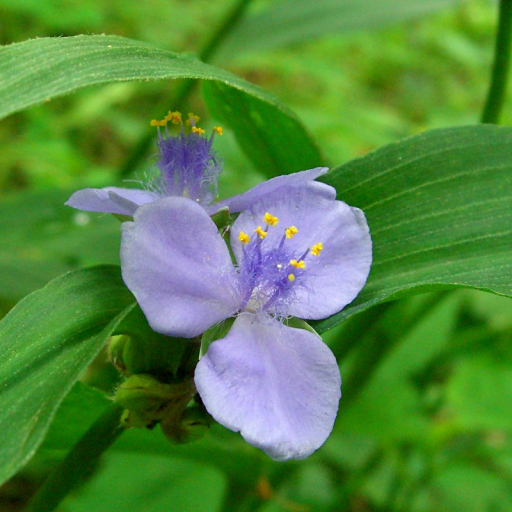
Plant Overview
Commonly known as the Zigzag Spiderwort, this native North American perennial is the architectural rebel of the woodland floor. Unlike its straight-stemmed cousins, Tradescantia subaspera earns its name from the distinct "kink" or bend its stems take at every leaf node. It is a favorite for shaded native gardens, offering a splash of deep violet-blue in the mid-summer heat when other woodland plants have finished their show.
🔍 How to Identify
- 📉 The "Zigzag" Stem: The most defining feature is the stem, which noticeably changes direction at each joint (node), creating a structural, geometric appearance.
- 🍃 Broad Leaves: The leaves are wider and more lance-shaped than most other spiderworts, often reaching up to two inches across with a deep green, slightly glossy finish.
- 💜 Three-Petaled Flowers: It produces clusters of delicate flowers with three triangular petals, usually in shades of vibrant blue or deep purple, accented by fuzzy, bright yellow stamens.
🏡 In Your Garden
- 🌑 The Shade Specialist: While many spiderworts crave the sun, the Zigzag variety is a true forest dweller. It thrives in dappled sunlight or full shade, making it the perfect solution for those tricky, dark corners of the yard where other flowers refuse to bloom.
- 💧 Thirsty & Tough: This plant loves moisture and heavy clay soils. It acts as a wonderful natural "indicator"—if its leaves start to droop or curl, it’s a sign your garden needs a deep soak. Be aware that it can be a vigorous grower; it spreads via seeds and rhizomes, so give it plenty of room to wander.
⚠️ Safety & Toxicity
- 🧪 Mildly Irritating: The Zigzag Spiderwort is generally considered non-lethal, but it does contain calcium oxalate crystals in its sap.
- 🐾 Pet & Skin Warning: Contact with the sticky sap can cause "Spiderwort dermatitis" (red, itchy skin) in sensitive individuals and pets. If your dog or cat decides to have a snack, it may cause mild stomach upset or drooling, so it is best kept in areas where curious pets don't roam.
✨ Fun Fact
The name "Spiderwort" comes from the plant's sap; when a stem is broken, the sap hardens into thin, silky threads that look remarkably like a spider's web. In centuries past, some believed this resemblance meant the plant could cure spider bites!

Detailed Care Instructions
To grow Tradescantia Subaspera, also known as the Prairie Spiderwort, follow these steps:
- Select a suitable location: Tradescantia Subaspera prefers a spot with bright, indirect sunlight. It can tolerate some shade but will thrive better with adequate lighting.
- Prepare well-draining soil: Ensure the soil is loose, fertile, and well-draining. Add compost or organic matter to improve the soil's nutrition and drainage capacity.
- Planting: Tradescantia Subaspera can be propagated from seeds or cuttings. If using seeds, sow them directly into the prepared soil, approximately 1/4 inch deep. If using cuttings, select healthy stems with several leaves and plant them about 2-3 inches deep.
- Watering: Keep the soil consistently moist but not waterlogged. Tradescantia Subaspera prefers evenly moist soil, so water it whenever the top inch of soil feels dry. Avoid overwatering or letting the plant sit in standing water, as it may cause root rot.
- Fertilization: Apply a diluted, balanced liquid fertilizer once a month during the growing season (spring and summer). Follow the manufacturer's instructions for dilution rates and application frequency.
- Pruning: To encourage bushier growth, pinch back the stems periodically. This will also prevent the plant from becoming too leggy. Remove any dead, damaged, or yellowing leaves regularly.
- Propagation: Tradescantia Subaspera can be easily propagated by division. As the plant matures and grows larger, carefully lift it from the soil, divide it into smaller sections, and replant them in separate pots or areas of the garden.
- Winter care: Tradescantia Subaspera is generally hardy in USDA zones 4-9. In colder regions, protect the plant from frost by mulching around the base during winter. If growing in containers, consider bringing them indoors or providing some winter protection.
By following these guidelines, you can successfully grow and enjoy the beauty of Tradescantia Subaspera in your garden or indoors as a houseplant.

Place in a window with dappled sun or a spot in the middle of a room. Or directly in a window facing west or east.

To water this plant, you should start by ensuring that the soil is dry to the touch. Then, gently pour water onto the soil around the base of the plant until the excess water has drained out of the bottom of the pot. Be careful not to water the leaves or stem of the plant, as this can cause damage. You should water the plant thoroughly once a week during the growing season, and decrease watering during the winter months. Additionally, the plant prefers bright, indirect sunlight and should be kept in a warm, humid environment.
To fertilize this plant, mix a slow-release fertilizer with water according to the instructions provided by the manufacturer. Apply the fertilizer to the soil evenly, making sure to avoid getting any on the leaves. Water the plant immediately after fertilizing to help the fertilizer soak into the soil. Repeat this process every 2-3 months during the growing season. Avoid fertilizing during the winter months when the plant is dormant.
The ideal soil for this plant should be well-draining, nutrient-rich, and slightly acidic with a pH range of 5.5 to 6.5. It should also have good moisture retention capabilities while still allowing excess water to drain away. A mixture of peat moss, perlite, and vermiculite in a 2:1:1 ratio is ideal. Alternatively, a soilless potting mix that contains a mix of peat moss, perlite, and sphagnum moss can also be used. It is important to avoid using heavy soil that retains too much moisture, as this can lead to root rot and other issues.
To propagate this plant, you will need a sharp pair of scissors or gardening shears, a small pot, and well-draining potting soil. Take a stem cutting from the parent plant, making sure to cut just below a node (the point where a leaf attaches to the stem). Remove the leaves from the lower half of the stem, leaving only a few at the tip. Dip the cut end into rooting hormone (optional) and plant the cutting in the potting soil, making sure the node is buried. Water the cutting thoroughly and place it in a bright, indirect light. Keep the soil moist but not waterlogged, and in a few weeks, you should see new growth emerging from the tip of the cutting, indicating that it has rooted and is ready to grow on its own.








