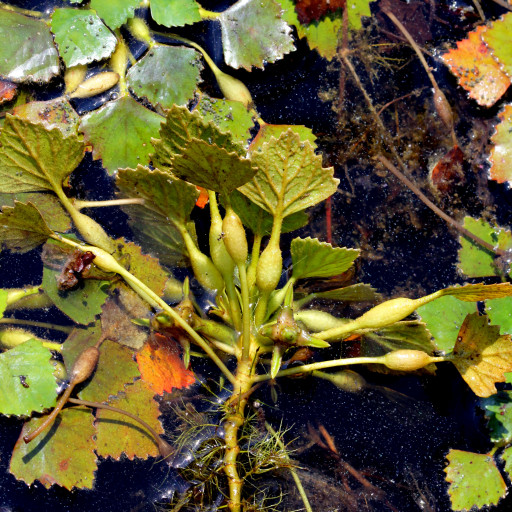
Plant Overview
Often called the "Water Caltrop," "Devil’s Pod," or "Bat Nut," Trapa natans is an aquatic plant that is as fascinating as it is controversial. While it produces a nutritious starch used in traditional Asian cuisines, it is also known as a fierce invader in North American waterways, where its dense mats can completely block out sunlight and oxygen for other aquatic life.
🔍 How to Identify
- 🍃 Floating Rosette: It features a striking, fan-like cluster of triangular leaves with "saw-tooth" edges that sit flat on the water's surface.
- 🎈 Buoyant Stems: If you lift a leaf, you’ll notice a swollen, air-filled bulb on the stem (petiole) that acts like a tiny life jacket to keep the plant afloat.
- 😈 The Seed Pod: The most iconic feature is the hard, woody fruit found underwater. It is dark, heavy, and equipped with four incredibly sharp, curved horns that resemble a bull’s head or a bat.
🏡 In Your Garden & Ecology
- 🌊 Aquatic Environment: This plant prefers slow-moving or stagnant freshwater, such as ponds or quiet river coves. It thrives in nutrient-rich mud where its long, cord-like stem can anchor deep into the sediment.
- 🚫 Invasive Nature: Before planting this in a backyard pond, check your local regulations. In many regions, it is a "prohibited" species because a single seed can produce a massive colony that chokes out native fish and prevents boating or swimming.
- 🌱 Seed Longevity: The "Devil's Pods" are survivors; they can sink to the bottom of a pond and remain viable for up to 12 years before finally sprouting.
⚠️ Safety & Toxicity
- 🥾 Physical Hazard: The dried seed pods are a major hazard for beachgoers and pets. Their spikes are strong enough to puncture thin-soled shoes or cause deep puncture wounds in paws and feet.
- 🦠 Consumption Warning: While the inner kernel is edible when cooked, never eat them raw. Raw water chestnuts can carry Fasciolopsis buski, a giant intestinal fluke (parasite) that can cause significant illness in humans and pigs.
- 🐕 Pet Safety: The plant itself isn't typically toxic to touch, but the sharp pods are a "stepping hazard" for dogs near shorelines.
✨ Fun Fact
In various cultures, the dried, bat-shaped seed pods are kept as "good luck" charms or used to ward off evil spirits. Because the word for "bat" in Chinese is a homophone for "blessing," the Bat Nut is often considered a symbol of good fortune during festivals.

Detailed Care Instructions
To grow Trapa natans, also known as water chestnut or water caltrop, you can follow these steps:
- Choose a suitable location: Trapa natans grows best in calm, shallow freshwater bodies like ponds, lakes, or slow-moving rivers. Ensure that the water is at least 6 inches (15 cm) deep and the temperature is around 68-82°F (20-28°C).
- Prepare the planting area: Clear the area of any weed or aquatic plants that may impede the growth of water chestnuts. Use a rake to remove any debris, and create a level surface for planting.
- Planting the tubers: Trapa natans reproduces through tubers, which are bulb-like structures. Obtain water chestnut tubers from a nursery, or if permitted, collect them from a natural water body. Plant the tubers in late spring or early summer when the water temperature has warmed up. Dig small holes approximately 1-2 inches deep (2.5-5 cm), place the tuber flat side down in the hole, and cover it with soil.
- Maintain water depth: Ensure that the water depth is maintained at around 6-12 inches (15-30 cm) throughout the growing season. This depth provides optimum conditions for the Trapa natans growth.
- Control weeds: Regularly check for the growth of unwanted weeds and algae. Remove them carefully to prevent competition for nutrients and space.
- Provide nutrients: If your water body lacks natural nutrients, you can add aquatic plant fertilizer tablets. These tablets deliver essential nutrients like nitrogen and phosphorus which aid in the growth of Trapa natans.
- Harvesting: Trapa natans typically matures in three to four months. Harvest the fruits when the husks turn brown and dry. Gently detach the fruit or tuber from the plant, and store them for culinary use.
Note: Before growing Trapa natans, please ensure that it is not invasive or prohibited in your area, as it can become an aggressive water weed in certain regions. Also, check local regulations and obtain necessary permissions if collecting tubers from natural water bodies.

Place in a bright room that is sun drenched almost all day. Or directly in a south-facing window.
Trapa Natans is a species of freshwater aquatic plant that typically grows in shallow ponds, lakes, and slow-moving streams. To properly water this type of plant, it is important to understand its unique characteristics and requirements.
As a general rule, Trapa Natans prefers to be grown in a stable aquatic environment with clean, clear water that is free from pollutants and debris. The water should be slightly alkaline with a pH range of 7.0 to 8.5. It is important to maintain consistent water quality and temperature, as sudden changes can stress the plant and lead to health problems.
When watering Trapa Natans, it is best to use a gentle flow of water to avoid disturbing the plant and its roots. Aquatic fertilizers can be added to the water to provide essential nutrients, but care should be taken to avoid excessive doses that can harm the plant.
Overall, regular monitoring and maintenance are key to successful Trapa Natans care. This involves checking water quality, controlling pests and diseases, and trimming the plant as needed to promote healthy growth. By providing the right conditions and care, Trapa Natans can thrive and add beauty and diversity to any aquatic landscape.
To fertilize this aquatic plant, first test the water for its nutrient levels and adjust as needed. Use a balanced fertilizer with equal parts nitrogen, phosphorus, and potassium, or a specific aquatic plant fertilizer. Apply the fertilizer directly to the soil beneath the plant's roots, being careful not to let it come into contact with the leaves or any neighboring plants. Repeat every two to four weeks during the growing season, adjusting the amount and frequency as needed based on nutrient levels and plant growth. Avoid over-fertilization, as this can harm the plant and encourage the growth of algae.
Trapa natans is an aquatic plant, therefore it requires a soil that is suitable for its growth inside water. The ideal soil for Trapa natans should have high organic content and a neutral pH level to promote healthy growth. It is recommended to use a soil that is specifically formulated for hydroponic systems or aquatic plants. This type of soil usually contains a blend of nutrient-rich components such as peat moss, perlite, vermiculite, and other trace minerals that are essential for plant growth. The soil should also be free from any contaminants or chemicals, as these can harm the plant and its roots. Additionally, the soil should have good drainage properties to allow excess water to seep away and prevent waterlogging. Overall, using a high-quality soil with proper nutrients, pH balance, and drainage properties is crucial for the healthy growth and development of Trapa natans.
Trapa Natans is a rooted aquatic plant that is often propagated through seed germination. The seeds can be collected from mature and healthy plants and sown directly into suitable aquatic soil or containers filled with water. The seedlings require warm temperature, suitable lighting, and oxygenated water to grow.
Another way to propagate Trapa Natans is through vegetative propagation, which involves taking cuttings from mature plants and replanting them in a suitable aquatic environment. The cuttings should carefully be cut off from the parent plant and replanted in an aquatic soil or container filled with water. The cuttings require proper care, including warmth, lighting, and oxygenated water, to develop roots and establish new plants.
Additionally, Trapa Natans can also be propagated through division, which involves dividing mature plants into several smaller plants. The process involves carefully separating the plant's roots and shoots and replanting them in different aquatic environments. The new plants require proper care, including warmth, suitable lighting, and oxygenated water, to develop established roots and grow healthily in the new environment.
Regardless of the propagation method used, it is essential to ensure the suitable conditions are met for the development and growth of the new plants. These include proper temperature, lighting, nutrients, and water quality, among others.








