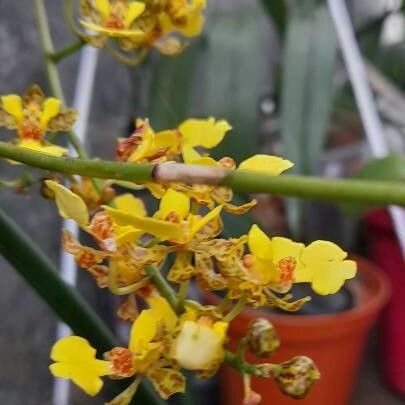
Plant Overview
Known as the Rat-tail Orchid or Cebolleta, this plant is a striking departure from the soft, broad-leaved orchids most people recognize. Its name "Cebolleta" translates to "little onion," a nod to its peculiar, succulent-like foliage that resembles green onions or chives. Native to the dry forests of Central and South America, it is a rugged survivor that trades delicate fragility for sun-loving resilience.
🔍 How to Identify
- 🍃 The "Rat-tail" Leaves: Unlike flat-leaved orchids, this species features thick, cylindrical, and pointed leaves that grow upright or arching, designed to store water during dry spells.
- 🌼 Dancing Lady Blooms: It produces long, branched sprays of bright yellow flowers. Each bloom features a large, ruffled lip and is intricately dappled with reddish-brown spots, resembling a tiny dancing figure.
- 🧶 Aerial Roots: Look for thick, silvery-white roots that often "crawl" out of the pot. In the wild, these act as anchors, gripping tightly to the bark of trees in windy environments.
🏡 In Your Garden
- ☀️ Light Lover: Because of its succulent-like leaves, this orchid craves much more light than your average Phalaenopsis. It thrives in bright, indirect sunlight and can even handle some direct morning sun, which triggers its spectacular flowering.
- 💧 Dry Roots are Happy Roots: This plant is an epiphyte that hates "wet feet." It is best grown mounted on a piece of cork or wood bark, or in a very airy, coarse bark mix. It prefers a "soak and dry" cycle, mimicking the tropical rain and subsequent wind of its natural habitat.
⚠️ Safety & Toxicity
- ✅ Status: Generally considered non-toxic to humans and common household pets.
- 🛑 Ethnobotanical Note: While not poisonous in a traditional sense, historical records suggest that certain indigenous groups used this orchid in shamanic rituals as a substitute for Peyote. It is best to keep it away from curious pets or children to avoid any potential digestive upset or unknown reactions.
✨ Fun Fact
In the 1950s, researchers discovered that Trichocentrum cebolleta was used by the Tarahumara people of Mexico as a powerful ceremonial plant. It contains compounds that were believed to induce visions, earning it the mysterious nickname "The Visionary Orchid."

Detailed Care Instructions
To grow a Trichocentrum Cebolleta plant, follow these steps:
- Choose the right location: Trichocentrum Cebolleta plants prefer bright, indirect light. Avoid placing them in direct sunlight, as it can burn the leaves. Additionally, ensure the temperature stays between 60-85°F (15-29°C).
- Select a suitable pot: Use a well-draining pot that is at least 6 inches in diameter, as Trichocentrum Cebolleta plants prefer slightly crowded conditions.
- Use the right soil: Use a well-draining orchid potting mix or a mixture of fir bark, sphagnum moss, and perlite to create an airy substrate. This will provide good airflow to the roots.
- Watering: Water your Trichocentrum Cebolleta plant regularly to keep the roots moist. During the active growing season, water it every 4-7 days and decrease watering frequency during dormant periods. Make sure the pot has drainage holes to prevent waterlogging.
- Fertilizing: Feed the plant with a balanced orchid fertilizer solution every 2-3 weeks during the growing season. Dilute the fertilizer to half strength to avoid burning the roots.
- Humidity: Trichocentrum Cebolleta plants prefer high humidity levels. Place a tray of water near the plant or use a humidifier to increase the humidity around it.
- Repotting: Repot your Trichocentrum Cebolleta plant every 2-3 years or when the roots start to outgrow the pot. Choose a slightly larger pot and replace the old substrate.
- Propagation: Trichocentrum Cebolleta plants can be propagated by dividing the pseudobulbs. Carefully separate the bulbs and plant them in separate pots using an orchid potting mix. Ensure each new division has roots attached.
- Pests and diseases: Monitor your plant regularly for signs of pests such as aphids, mealybugs, or spider mites. Treat any infestations promptly with insecticidal soap or neem oil. Also, be mindful of fungal diseases, such as root rot, and practice good hygiene by keeping the plant's environment clean and well-ventilated.
By following these steps, you can successfully grow and care for a Trichocentrum Cebolleta plant. Remember to be patient, as orchids can take time to establish and bloom.

Place in a window with dappled sun or a spot in the middle of a room. Or directly in a window facing west or east.

To water this plant, it is important to consider its specific needs. First, ensure that the soil is well-drained and not waterlogged. When watering, use room temperature water to avoid shocking the plant. Water thoroughly, allowing the water to soak through the soil and out of the drainage holes. Allow the top layer of soil to dry before watering again, as overwatering can lead to root rot. Avoid getting water on the foliage as this can cause fungal and bacterial infections. Water frequency will vary based on the plant's environment, but as a general rule, aim to keep the soil slightly moist but not wet.
To fertilize this plant, use a balanced fertilizer with equal amounts of nitrogen, phosphorus, and potassium. Apply the fertilizer every two weeks during the growing season, and reduce to once a month during the plant's dormant period. Mix the fertilizer with water according to package instructions, and apply to the soil around the base of the plant, avoiding the leaves and stems. Water the plant after fertilizing to ensure the nutrients reach the roots.
Trichocentrum Cebolleta plant prefers a well-draining soil that is rich in organic matter. It should have a pH level between 6 and 7.5, which is slightly acidic to slightly alkaline. The soil should be kept moist, but not waterlogged, as the plant is sensitive to overwatering. A mixture of peat, perlite, and bark chips is recommended for potting soil, as it provides good drainage and aeration. Additionally, the plant should be fertilized regularly with a balanced fertilizer to promote healthy growth and blooming. It is important to avoid using heavy soils or soils that do not drain well, as this can lead to root rot and other plant diseases.
Trichocentrum Cebolleta plant can be propagated by division. To do this, carefully remove the plant from its pot or growing medium. Use a sterile cutting tool to separate the plant into two or more sections, ensuring that each section has several healthy roots and a portion of the stem. Plant each division into a separate pot or growing medium. It is important to use sterile tools and to avoid damaging the roots or stems when dividing the plant to prevent potential infections. Propagation by seed is also possible, but may be a more in-depth process.








