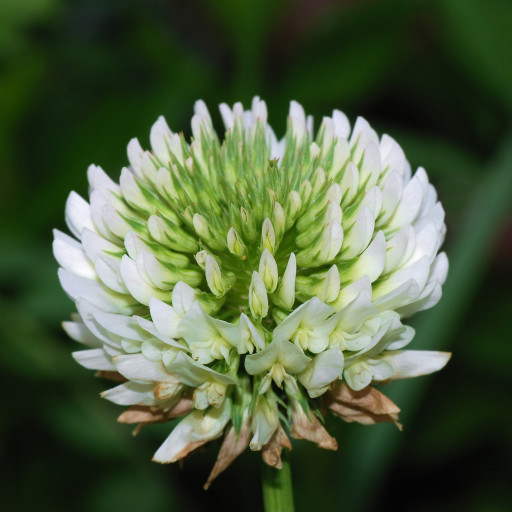
Plant Overview
Known affectionately as the "Dutch Clover" or simply "White Clover," this resilient little perennial is a staple of meadows and suburban lawns alike. While some gardeners once viewed it as a weed, it is actually a powerhouse of soil health and a legendary symbol of luck. Often associated with the Irish Shamrock, its three-heart-shaped leaves represent a persistent and cheerful presence in almost any green space.
🔍 How to Identify
- ☘️ The Foliage: Each leaf is composed of three oval leaflets, usually featuring a distinctive white or pale-green "V" or "crescent" mark called a chevron.
- ⚪ The Bloom: The flowers are round, globe-like heads made up of many tiny white tubular florets, which sometimes take on a faint pinkish tint as they age.
- 🌱 Growth Habit: It spreads via "stolons" (creeping runners) that root into the ground as they go, allowing it to form a dense, low-growing mat that survives heavy foot traffic.
🏡 In Your Garden
- 🧪 Soil Magician: White Clover is a "nitrogen fixer." It works with specialized bacteria in its roots to take nitrogen from the air and turn it into fertilizer for the soil, naturally feeding the grass around it.
- 🐝 Pollinator Magnet: It is one of the most important honey plants for bees. If you see clovers blooming in your yard, you are providing a vital "fast food stop" for local honeybees and butterflies.
- 💧 Drought Resilience: Because it has a deep root system compared to turf grass, it stays green during mid-summer droughts when the rest of the lawn might turn brown.
⚠️ Safety & Toxicity
- ✅ Status: Generally non-toxic and safe for children and common household pets.
- 🐎 Livestock Note: While humans can even use the dried flowers for tea, large-scale grazing by livestock should be monitored, as certain varieties can contain small amounts of cyanogenic glycosides if consumed in massive quantities.
- 🐝 Sting Risk: Because the flowers attract so many bees, barefoot walkers should be cautious to avoid accidental stings while the plant is in bloom.
✨ Fun Fact
Your chances of finding a "lucky" four-leaf clover on a Trifolium repens plant are approximately 1 in 5,000. This rare variation is a genetic mutation caused by environmental stressors or developmental accidents!

Detailed Care Instructions
| Color | White |
| Soil Ph | Slightly Acidic |
| Humidity | Normal |
| Invasive | Weed |
| Lighting | Full Sun |
| Soil Type | Well-Drained And Evenly Moist |
| Bloom Time | May To June |
| Difficulty | Medium |
| Plant Type | Herbaceous Perennial |
| Mature Size | 0.25 To 0.50 Feet Tall And 1 To 1.50 Feet Wide |
| Native Area | Europe |
| Temperature | 5°C - 25°C |
| Sun Exposure | Full Sun To Partial Shade |
| Hardiness Zones | 3-10 |
To grow Trifolium Repens, also known as white clover, you can follow these steps:
- Select a suitable planting location: White clover prefers full sun to partial shade. It can tolerate various soil types but thrives in well-draining soil with a slightly acidic to neutral pH level.
- Prepare the soil: Before planting, loosen the soil and remove any weeds or debris. You can also amend the soil with organic matter like compost to improve its fertility.
- Plant the seeds: White clover can be grown from seeds. Broadcast the seeds evenly over the prepared soil surface. Lightly tamp the seeds into the soil or cover them with a thin layer of soil, ensuring they are not buried too deeply.
- Water properly: Keep the soil consistently moist but avoid overwatering. Water the newly planted seeds gently to prevent them from being washed away.
- Fertilize if necessary: If your soil lacks nutrients, you can apply a balanced fertilizer following the manufacturer's instructions. Otherwise, white clover generally doesn't require additional fertilization.
- Maintain regular care: Regularly monitor the moisture level of the soil, especially during dry periods. Apply a layer of mulch around the plants to help retain moisture and suppress weed growth.
- Control weeds: White clover is a natural weed suppressant, but initially, you may need to manually remove any competing weeds. Be cautious while weeding to avoid damaging the delicate clover plants.
- Mow or trim the plants: Depending on your preference, you can mow or trim the white clover plants regularly to maintain a desired height and prevent them from becoming too invasive.
- Enjoy the benefits: White clover is known for its nitrogen-fixing properties, which can enrich the soil. It also attracts pollinators like bees and butterflies and acts as a groundcover, preventing soil erosion.
By following these steps, you should be able to successfully grow Trifolium Repens, enhancing your garden or landscape with its lush green foliage and delicate white flowers.

Place in a bright room that is sun drenched almost all day. Or directly in a south-facing window.

To water this plant, ensure that the soil is dry to the touch before watering. Water deeply, allowing the water to penetrate the soil to the roots. Avoid overwatering, as this can lead to root rot. Additionally, water the plant in the morning or evening, when the temperatures are cooler, to prevent water from evaporating too quickly.
To fertilize this plant, use a balanced fertilizer with a ratio of 10-10-10 or 20-20-20. Apply the fertilizer according to the package instructions once every four to six weeks during the growing season. Be careful not to over-fertilize, as this can damage the plant. Water the plant thoroughly before and after applying fertilizer to prevent burning the roots.
Trifolium repens, a type of plant, prefers soil that is well-draining, fertile, and has a neutral to slightly acidic pH level. The ideal soil type for Trifolium repens is loamy soil that is rich in organic matter. This plant can also tolerate slightly sandy or clay soils as long as proper drainage is ensured. It is important to avoid soils that are too compact, heavy, and poorly-draining as this can lead to root rot and poor growth. Adequate soil moisture is also important for the healthy growth of Trifolium repens.
To propagate this plant, you will need to first identify a healthy and mature specimen. Once located, carefully remove a section of the plant stem with roots attached. Plant the stem section in soil, being sure to keep it moist during the rooting process. Place the new plant in a location with bright but indirect light, and continue to water regularly. Within a few weeks, the new plant should begin to form new leaves and grow roots, indicating successful propagation.








