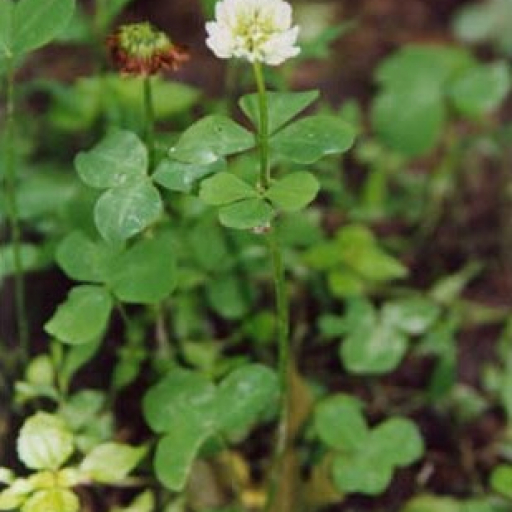
Plant Overview
Known as the Running Buffalo Clover, this rare North American native carries a history as wild as the frontier. Once thought to be extinct, it was rediscovered in the 1980s and is famous for its evolutionary bond with the American Bison. It relied on the heavy trampling and grazing of bison herds to clear away competing plants and scarify the soil, making it a true symbol of the lost tallgrass prairies.
🔍 How to Identify
- ☘️ The Foliage: Like its cousins, it features "trifoliate" leaves (three leaflets), but unlike the common White Clover, these leaves usually lack the pale, chevron-shaped "V" mark.
- 🌸 The Blooms: It produces round, white flower heads that sit atop stalks. As the flowers age, they tend to turn a soft pink or tan and droop toward the ground.
- 🏃 The Runners: Its most defining feature is its "stolons"—long, creeping stems that run along the ground and take root at the nodes, allowing the plant to "run" across the soil.
- 🌿 Smooth Stems: The stems are noticeably hairless (glabrous), which helps distinguish it from several other wild clover species that might feel fuzzy to the touch.
🏡 In Your Garden
- 🐂 Disturbance is Key: This plant is a "Goldilocks" species; it hates being crowded out by tall grass but also dies in totally bare soil. In a garden setting, it thrives where there is occasional foot traffic or light mowing that mimics the ancient bison herds.
- ⛅ Dappled Shade: Unlike many clovers that crave full sun, the Running Buffalo Clover prefers the edges of woodlands or "savanna" conditions where it gets filtered light rather than the scorching afternoon sun.
- 🌱 Conservation Note: Because it is a federally protected endangered species in many regions, it is rarely found in commercial nurseries. If you find it in the wild, it is best to leave it untouched and report the sighting to local conservationists.
⚠️ Safety & Toxicity
- ✅ Generally Safe: Most Trifolium species are considered non-toxic to humans and common household pets like dogs and cats.
- 🐾 Livestock Note: While clover is a common forage, many species contain coumarin, which can be an issue if consumed in massive quantities by livestock, though this plant is far too rare to be used as hay or pasture feed.
✨ Fun Fact
The Running Buffalo Clover didn't just survive bison trampling—it thrived on it! The seeds actually germinate better after passing through the digestive system of a large herbivore, meaning the bison were the clover's primary mode of transportation across the continent.

Detailed Care Instructions
To grow Trifolium stoloniferum, also known as strawberry clover, follow these steps:
- Choose the right location: Trifolium stoloniferum prefers well-draining soil, so select a location with good drainage. It grows best in full sun to partial shade.
- Prepare the soil: Ensure the soil is loose and rich in organic matter. If the soil is heavy clay, consider amending it with compost or perlite to improve drainage.
- Sow the seeds: Directly sow the seeds in spring or fall, when temperatures are cooler. Gently press the seeds into the soil, but don't cover them completely, as they need some light to germinate. Keep the soil consistently moist until the seeds germinate, usually within 1-2 weeks.
- Watering and maintenance: After the plants are established, water them regularly, ensuring the soil doesn't dry out completely. Strawberry clover has drought tolerance, but it thrives with adequate moisture. Weed around the plants to reduce competition.
- Fertilization: Trifolium stoloniferum doesn't require much fertilization. However, a light application of balanced organic fertilizer in early spring can promote healthy growth.
- Mowing: If you plan to cultivate a lawn with strawberry clover, mow the plants regularly on a high setting to maintain a height of around 4-6 inches (10-15 cm). This encourages spreading and thickening of the clover.
- Overwintering: If you live in a region with cold winters, Trifolium stoloniferum can survive with a deep root system. However, mulching around the plants in late autumn can help protect them from extreme temperatures.
- Propagation: If you want to expand your Trifolium stoloniferum patch, you can propagate it by division or by rooting the stolons. Simply cut a portion of the stolon (a horizontal stem) with roots attached and replant it in a new location.
By following these steps, you should be able to successfully grow Trifolium stoloniferum plants.

Place in a bright room that is sun drenched almost all day. Or directly in a south-facing window.

To properly water this plant, you should first check the moisture level of the soil to ensure it is not already too wet or too dry. If the soil feels dry to the touch, you can water it thoroughly, making sure to saturate the soil evenly. Be sure not to overwater, as this can lead to root rot.
If you are growing the plant in a container, make sure it has proper drainage holes so that excess water can escape. If the plant is grown in the ground, it may benefit from a layer of mulch around the base to help retain moisture in the soil.
It is important to water this plant regularly, especially during hot and dry weather conditions. However, you should also avoid watering it too frequently, as this can also lead to problems. Generally, watering once or twice a week is sufficient, but this can vary based on factors such as humidity, soil type, and sun exposure.
Lastly, you should avoid getting water on the leaves of the plant, as this can promote the growth of fungal diseases. Instead, water the soil at the base of the plant.
Fertilize the plant with a nitrogen-rich fertilizer in early spring, just before growth begins. Apply a light layer of the fertilizer around the base of the plant and water it in well. Avoid fertilizing after the plant has started flowering, as this may reduce flower production.
Trifolium Stoloniferum plant grows best in well-draining soil that is rich in organic matter. The soil should be mildly acidic with a pH level between 6 and 7.5. It is essential to provide the plant with a nutrient-rich soil that contains ample amounts of nitrogen, potassium, and phosphorus. Additionally, the soil should be moist but not waterlogged, so it is crucial to ensure proper drainage in the planting area. A fine-grained soil with sandy loam texture is ideal for the growth of Trifolium Stoloniferum plant. Mixing compost and organic matter in the soil can help improve soil structure and provide a healthy environment for root growth. It is recommended to loosen the soil in the planting area to a depth of at least 12 inches before planting to ensure that the roots can easily penetrate the soil.
Trifolium stoloniferum plant can be propagated by taking stem cuttings from a healthy and mature plant. Select a healthy stem and make a clean cut just below a node. Remove the leaves from the lower half of the stem and dip the cut end in rooting hormone. Plant the stem cutting in a well-draining soil mix and keep it moist but not too wet. Cover the cutting with a plastic bag or a cloche to create a humid environment. Keep the cutting in a warm and bright location but out of direct sunlight. After a few weeks, roots should begin to develop, and the plant can be gently transplanted to a larger container or soil bed.








