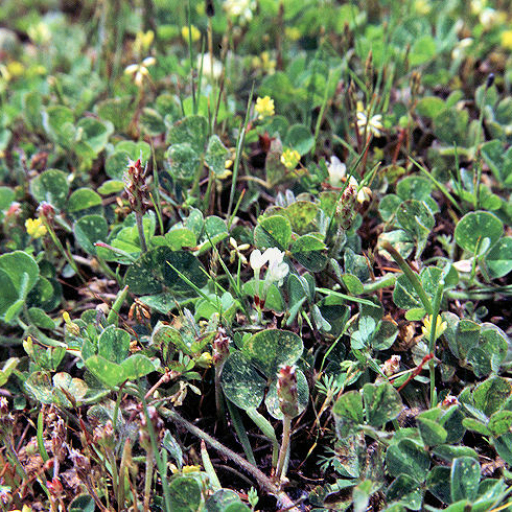
Plant Overview
Known affectionately as Subclover, Trifolium subterraneum is a clever little legume that acts as its own gardener. Unlike most plants that scatter their seeds to the wind, this Mediterranean native literally plants its own seeds into the soil after flowering. It is a powerhouse of soil health, famous for its ability to pull nitrogen from the air and store it in the ground, making it a favorite for regenerative farmers and eco-conscious gardeners alike.
🔍 How to Identify
- 🍀 The Leaf: Classic trifoliate (three-lobed) leaves, usually deep green with a faint pale "watermark" or crescent shape on each leaflet. They are often slightly hairy.
- ⚪ The Bloom: Small, creamy white or pinkish pea-like flowers that grow in clusters. They aren't as showy as Red Clover, as they quickly turn downward toward the earth.
- ⚓ The Seed Burr: After pollination, the flower head transforms into a stiff, reflexed burr. The plant then uses a "drilling" motion to push these burrs into the top layer of soil.
- 🌱 Growth Habit: A low-growing, prostrate annual that forms a dense, sprawling mat, rarely rising more than a few inches off the ground.
🏡 In Your Garden
- 🧪 Soil Superpower: Subclover is a nitrogen-fixing champion. It hosts beneficial bacteria in its roots that fertilize the soil naturally, making it an excellent "green manure" or cover crop for tired garden beds.
- 🐑 Grazing Resilience: Because it buries its seeds, it is incredibly hardy against heavy foot traffic or grazing animals. Even if the top of the plant is eaten or stepped on, the next generation is already safely tucked underground.
- 💧 Thirsty Roots: While it loves a Mediterranean climate (wet winters, dry summers), it prefers well-drained soil. It doesn't like "wet feet" and may rot if the ground stays swampy for too long.
⚠️ Safety & Toxicity
- ✅ General Status: Non-toxic to humans and common household pets like dogs and cats.
- 🐏 Livestock Note: While it is a high-quality forage plant, some older varieties contain high levels of phytoestrogens. If sheep eat too much of it exclusively, it can lead to "Clover Disease," which affects their fertility. For the average backyard, it is perfectly safe.
✨ Fun Fact
Subclover shares a rare survival strategy with the Peanut! This process is called geocarpy. By burying its seeds, the plant protects its offspring from wildfires and hungry seed-eating birds, ensuring it can reclaim its territory year after year.

Detailed Care Instructions
To grow Trifolium Subterraneum, also known as subterranean clover, you can follow these steps:
- Choose a suitable location: Subterranean clover thrives in cooler climates and prefers well-drained soil. Select a spot in your garden that receives full to partial sun.
- Prepare the soil: Prior to planting, prepare the soil by removing any rocks, weeds, or debris. Loosen the soil using a garden fork or tiller, and mix in organic matter like compost or well-rotted manure to improve fertility.
- Sow the seeds: Subterranean clover can be sown directly into the ground or started indoors and transplanted later. If sowing directly, scatter the seeds evenly over the prepared soil and gently rake them in. Aim to sow seeds in early spring or fall.
- Watering: Keep the soil consistently moist until the seeds germinate, which usually takes around 7 to 14 days. After germination, water the plants regularly, providing about 1 inch of water per week.
- Fertilization: Subterranean clover typically does not require much fertilization, as it can fix nitrogen from the air. However, if the soil is poor, you can apply a balanced, slow-release fertilizer according to the package instructions.
- Weed control: Regularly remove any weeds that may compete with the subterranean clover for nutrients and water. Mulching can help suppress weed growth.
- Disease and pest management: Subterranean clover is generally resistant to most diseases and pests. However, if you notice any issues, consult a local gardening expert or extension office for appropriate remedies.
- Harvesting: Depending on your intended use, you can harvest subterranean clover at different stages. Harvesting for fodder occurs before the flowers appear, while harvesting for seed is done when the seeds turn brown and dry. Ensure the plants are fully dry before harvesting to prevent spoilage.
Remember to check the specific requirements and recommendations for Trifolium Subterraneum in your region, as conditions can vary.

Place in a bright room that is sun drenched almost all day. Or directly in a south-facing window.

The best way to water this plant is to provide it with ample but infrequent watering. It should be watered deeply, allowing the soil to become saturated, but then allowed to dry out before being watered again. Watering should be done at the base of the plant to avoid getting the foliage wet, as this can lead to disease. It is important to pay close attention to the moisture level of the soil, as this plant is susceptible to root rot if it is over-watered. If planted in a container, be sure to have proper drainage to prevent water from sitting in the bottom of the container.
- Determine the appropriate time to fertilize: Before planting, during the growing season, and after the first harvest.
- Use a balanced fertilizer containing nitrogen, phosphorus, and potassium.
- Apply the fertilizer evenly across the planting area, using a spreader or by hand.
- Water the fertilizer in immediately after application to help it penetrate into the soil.
- Repeat fertilization every four to six weeks during the growing season, depending on the plant's growth rate and soil nutrient levels.
- Apply fertilizers carefully to avoid burning the plant's roots.
- Follow all package instructions for mixing and application.
Trifolium subterraneum plants thrive in soils with specific characteristics. The ideal soil for this plant has a relatively neutral pH, with a range of around 6.0 to 7.0. It is important that the soil is well-draining, as Trifolium subterraneum cannot tolerate waterlogged conditions. The soil should have good organic matter content and be rich in nutrients such as potassium and phosphorus. A sandy loam soil with good structure is well-suited to this plant. When planting, it is recommended to prepare the soil by removing any weeds or debris and breaking up any clumps of soil. Add compost or well-rotted manure to improve soil quality and fertility, especially if the soil is poor or compacted. Overall, the best soil for Trifolium subterraneum should be nutrient-rich, well-draining, have good structure, and be neutral in pH.
To propagate this plant, take a healthy stem cutting from the parent plant that is approximately 2-3 inches long. Trim any leaves or branches from the bottom of the cutting, leaving only a few leaves at the top. Dip the cut end of the stem into rooting hormone powder before planting it in a pot filled with well-draining soil. Water the cutting thoroughly and keep it in an area with indirect sunlight. The cutting should begin to develop roots in 2-3 weeks. Once the roots have become established, the new plant can be transplanted to its permanent location.








