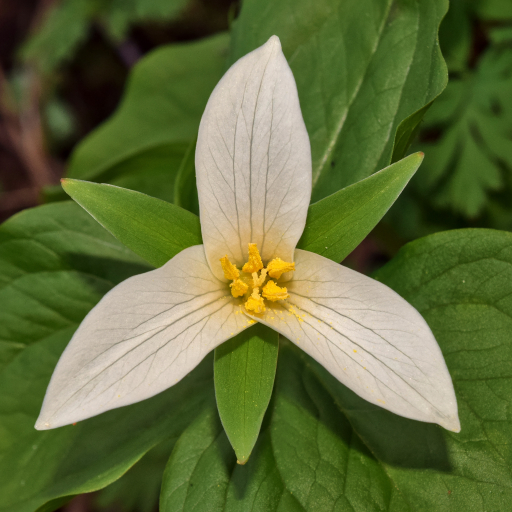
Plant Overview
Meet the Pacific Trillium, often affectionately called the "Wake Robin" because its early spring bloom is said to wake the forest after winter. Native to the damp woodlands of Western North America, this elegant perennial is a master of symmetry, famously following a "rule of three" in every part of its anatomy.
🔍 How to Identify
- 🍃 The Rule of Three: The plant features exactly three broad, heart-shaped (ovate) leaves that sit in a perfect whorl at the top of the stem.
- 🌸 Color-Changing Petals: The solitary flower starts as a brilliant, snowy white, but as it matures and is pollinated, the petals slowly "blush" into a deep rose or magenta.
- 📐 Geometric Balance: Look for three green sepals tucked behind three delicate white petals, creating a star-like appearance.
🏡 In Your Garden
- 🌲 The Shade Seeker: This plant is a true woodland spirit. It thrives in dappled sunlight and soil that is rich in organic "leaf mold," mimicking the forest floor where it naturally lives.
- 🐢 Patience is Required: Trilliums are slow-growers. A single plant can take up to seven to ten years to produce its first flower from a seed, and it deeply resents being moved due to its sensitive underground rhizomes.
- 🚫 The "No-Pick" Rule: Never pick a Trillium flower in the wild or your garden. Since the leaves provide the plant's only energy source, removing the flower and leaves usually kills the plant or prevents it from blooming again for several years.
⚠️ Safety & Toxicity
- 🐾 Mildly Toxic: The plant, particularly the root (rhizome), contains saponins. While not usually fatal, it can cause significant stomach upset, drooling, and vomiting in dogs and cats if ingested.
- 🧒 Child Safety: The berries and roots are considered inedible and can cause nausea. It is best treated as an ornamental plant to be admired rather than handled.
✨ Fun Fact
🐜 Tiny Gardeners: Pacific Trilliums rely on ants for "express delivery." Their seeds have a fatty, protein-rich attachment called an elaiosome. Ants carry the seeds back to their underground nests to feed their larvae, effectively planting the seeds in nutrient-rich soil far away from the parent plant!

Detailed Care Instructions
| Humidity | Normal |
| Lighting | Shade |
| Difficulty | Medium |
| Hibernation | Cold Period |
| Hardiness Zones | 5 - 8 |
To grow Trillium ovatum, also known as Western Trillium or Wake Robin, you can follow these steps:
- Collect seeds or purchase Trillium ovatum plants from a nursery. Collecting seeds from mature plants is the most common method for propagation.
- Prepare a suitable planting location. Trillium ovatum prefers partial to full shade, well-draining soil, and a moist environment. Clear the area of weeds and other competing plants.
- Plant the seeds or young plants in the fall or winter, as this is the natural time for Trillium ovatum to germinate. The seeds need to undergo a cold stratification process, which mimics the winter season. Keep the seeds in a moistened paper towel in the refrigerator for about 60 days before planting.
- If planting seeds, sow them directly on the soil surface or lightly cover them with a thin layer of soil. For young plants, dig a small hole and gently place the roots in the soil, making sure not to damage them.
- Water the plants regularly to maintain consistent moisture levels. Avoid over-watering, as Trillium ovatum prefers a well-drained soil and excessive moisture can lead to rot.
- Mulch around the plants with organic materials, such as leaf litter or wood chips, to help retain moisture and regulate soil temperature.
- Avoid disturbing the plants once they are established. Trillium ovatum is slow-growing and does not transplant well, so it is best to leave them undisturbed once they find their spot.
- Provide some protection from deer and other animals that may be attracted to the Trillium plants. Fencing or repellents can be used to discourage wildlife from damaging the plants.
- Be patient, as it can take several years for Trillium ovatum to reach maturity and produce its characteristic three-petaled flowers. Once established, they will continue to grow and spread through rhizomes.
By following these steps, you can successfully grow Trillium ovatum and enjoy their beautiful flowers in your garden.

Place in a window with dappled sun or a spot in the middle of a room. Or directly in a window facing west or east.

Trillium Ovatum is a perennial plant that requires an adequate amount of watering to survive. The best time to water this plant is when the top layer of soil becomes dry to the touch. It is important to not overwater the plant, as this can cause root rot.
When watering Trillium Ovatum, it is recommended to use a watering can or a gentle flow of water from a hose, to avoid disturbing the plant's roots. Water the base of the plant slowly and evenly until the soil is thoroughly saturated.
During the summer months, it is important to keep the soil consistently moist, as Trillium Ovatum prefers cooler and damper conditions. In the fall and winter months, the plant will go into dormancy and will require less watering.
It is important to monitor the weather and adjust watering accordingly, as heavy rains or drought conditions can impact the plant's water needs. Overall, providing Trillium Ovatum with consistent and appropriate watering will help it thrive and produce stunning flowers.
To fertilize this plant, it's best to use a slow-release, organic fertilizer in the spring or fall. Apply the fertilizer evenly around the base of the plant, taking care not to get any fertilizer on the leaves or stem. Water the plant well after applying fertilizer. Avoid fertilizing during the plant's dormant period.
Trillium Ovatum prefers to grow in well-draining soil that is rich in organic matter and has a slightly acidic to neutral pH. The soil should be moist, but not waterlogged, and should not dry out completely. It is also important to avoid compacted soil, as Trillium Ovatum prefers loose, airy soil to allow for root growth. A mix of organic compost, peat moss, and sand or perlite can be used to create an ideal growing environment for Trillium Ovatum. It is important to avoid using soil that is high in nitrogen, as this can cause excessive foliage growth at the expense of flowering.
Trillium ovatum is a perennial plant that can be propagated by division. Here are the steps to propagate Trillium ovatum:
- Choose a healthy parent plant with a healthy root system.
- Dig up the parent plant carefully without damaging the roots.
- Divide the parent plant into smaller sections with a sharp, clean knife or spade. Each section should have at least one healthy shoot and root system.
- Plant the divided sections in a new location that has well-draining soil, partial to full shade, and is rich in organic matter.
- Water the newly planted sections enough to ensure that the soil does not dry out completely, but do not overwater.
- Monitor the growth of the new sections, and ensure that they are thriving in their new location.
- Wait until the new sections have matured before harvesting blooms or seeds from them.
- Repeat the process every few years to keep the plants healthy and vigorous.








