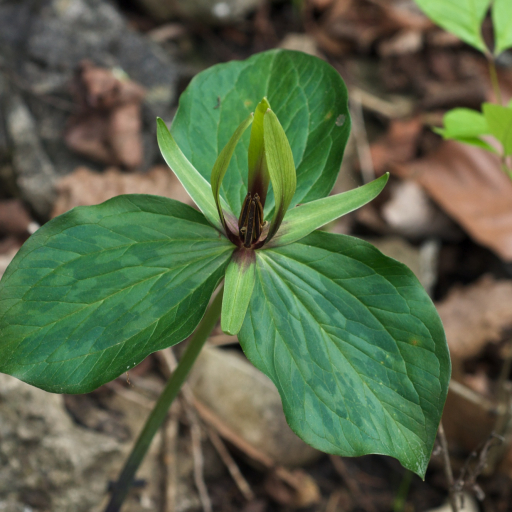
Plant Overview
Known as the "Ozark Trillium," this understated woodland beauty is a master of camouflage, blending perfectly into the dappled shadows of the American Midwest. Unlike its flashy white-petaled cousins, Trillium viridescens opts for a moody, prehistoric aesthetic with its mottled foliage and narrow, upright blooms. It is a true "spring ephemeral," appearing early in the year to soak up the sun before the forest canopy closes in.
🔍 How to Identify
- 🍃 Mottled Foliage: The plant features three large, oval leaves decorated with a stunning "camouflage" pattern of dark and light green splotches.
- 🕯️ The "Candle" Bloom: The flower consists of three narrow, lance-shaped petals that stand strictly upright, resembling a small green or maroon flame.
- 🎨 Color Gradient: While the tips of the petals are often lime green, the base near the center of the plant is typically a deep, bruised purple or maroon.
🏡 In Your Garden
- 🍂 Forest Mimicry: To keep this plant happy, you must mimic the forest floor. It thrives in "leaf mold"—the crumbly, decaying organic matter found under oak or hickory trees—and dislikes being planted in bare, manicured soil.
- ⏳ The Long Game: Trilliums are famously slow growers. If you transplant one, it may "sulk" and refuse to bloom for a season or two. This is because it possesses a deep, sensitive rhizome (underground stem) that hates being disturbed.
⚠️ Safety & Toxicity
- 🐾 Mildly Toxic: While not considered deadly, the entire plant—especially the underground rhizome—contains saponins. If ingested by curious pets or children, it can cause stomach upset, nausea, or vomiting.
- 🌿 Skin Sensitivity: Some gardeners report mild skin irritation when handling the roots directly; wearing gloves is a smart precaution.
✨ Fun Fact
🐜 The Ant Express: Trillium seeds have a tiny, fatty attachment called an elaiosome that ants find delicious. Ants carry the seeds back to their underground nests, eat the fatty snack, and discard the seed in their "trash heaps," which act as perfect, nutrient-rich nurseries for new baby Trilliums!

Detailed Care Instructions
To successfully grow Trillium viridescens, also known as green trillium, follow these guidelines:
- Location: Trillium viridescens prefers partially shaded areas where it can receive filtered sunlight. Choose a spot in your garden that offers dappled shade or morning sun with afternoon shade.
- Soil: The plant prefers rich, well-draining soil. Amend heavy clay soil with organic matter, such as compost, to improve drainage. Trilliums also thrive in slightly acidic to neutral soil with a pH of around 5.5 to 7.
- Planting: Plant Trillium viridescens in the spring or fall when the soil temperature is cool. Dig a hole that is deep and wide enough to accommodate the entire root system without crowding. Place the rhizome (horizontal stem) on the surface of the soil, covering it with 1 to 2 inches of soil. Gently firm the soil around the plant.
- Watering: Keep the soil consistently moist but not waterlogged. Water the plant deeply whenever the top inch of soil starts to dry out. Mulching around the plant helps retain moisture and maintain an even soil temperature.
- Fertilization: Trilliums are generally low-maintenance plants and do not require much fertilization. However, you can apply a balanced, slow-release fertilizer in early spring to provide some nutrients.
- Maintenance: Remove any weeds and competing vegetation that may grow near the plant. Avoid disturbing the root system when weeding. In late summer or early fall, after the foliage has died back, gently remove any dead leaves or debris around the plant.
- Propagation: Trillium viridescens readily propagates by producing seed, but it can take several years to establish and flower. Harvest seeds from mature plants and sow them in a well-prepared bed or pot. Alternatively, you can divide mature clumps in early spring, ensuring that each division has a healthy rhizome.
- Pest and disease control: Trillium viridescens is generally resistant to pests and diseases. However, keep an eye out for slugs, snails, and fungal diseases, especially if the soil is consistently wet. Use organic pest control methods or appropriate fungicides if necessary.
Remember, Trillium viridescens is a slow-growing plant that can take several years to mature and flower. Patience is key when growing this beautiful wildflower.

Place in a window with dappled sun or a spot in the middle of a room. Or directly in a window facing west or east.

To water this plant, it is important to make sure the soil is consistently moist, but not waterlogged. One method is to check the moisture level of the soil by sticking a finger into it up to the second knuckle. If the soil feels dry at this depth, it is time to water. It is recommended to water deeply, rather than shallowly or frequently, to encourage the roots to grow deeper and become more drought-tolerant. It is best to avoid getting water on the leaves, as it can lead to fungal issues. Additionally, the plant should be watered in the morning or early afternoon to allow any excess water to evaporate before nighttime, which can also cause fungal issues.
To fertilize this plant, first ensure that it is well-established and has been in the ground for at least a year. Choose a balanced fertilizer with an N-P-K ratio of 10-10-10 or 5-10-10. Apply the fertilizer in early spring just as the plant begins to emerge from the ground. Do not over-fertilize or the plant may suffer. Water well after fertilizing to ensure the nutrients reach the roots.
Trillium viridescens requires a well-draining soil that is rich in organic matter. It prefers a slightly acidic soil with a pH range between 5.5 and 6.5. The soil should be loamy with good water retention, but it should not be too wet or soggy. It is important to avoid using heavy clay soils or sandy soils that do not hold moisture well. Additionally, adding a layer of mulch around the base of the plant can help maintain soil moisture levels and suppress weed growth.
To propagate this plant, you can harvest its seeds from the mature plant when its fruit capsules have ripened and turned brown. Carefully open the capsules and collect the small black seeds.
Next, prepare a moist, humus-rich soil mixture with good drainage in a small container. Sow the seeds in the soil, covering them with only a thin layer of soil, and keep the container in a cool, shaded area with high humidity.
Keep the soil moist, but not waterlogged, and be patient as the seeds can take several months to germinate. Once seedlings appear, gradually expose them to more light and gradually acclimate them to lower humidity and outdoor conditions.
Transplant the seedlings into the garden bed in a shady area with rich, well-draining soil once they reach a height of a few inches. It may take several years for the plant to reach maturity and bloom.








