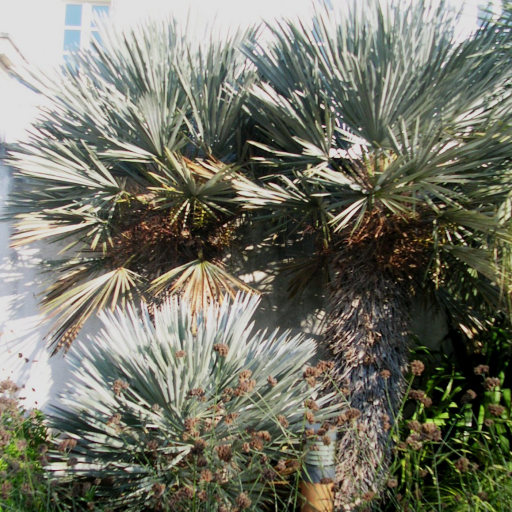
Plant Overview
Known as the Blue Needle Palm or Caranday Palm, Trithrinax campestris is the rugged aristocrat of the South American pampas. Emerging from the dry, sun-scorched landscapes of Argentina and Uruguay, this palm is prized for its architectural form and stunning "steely blue" foliage that shimmers under the midday sun. It is a plant that tells a story of survival, standing tall against both intense heat and surprising winter frosts.
🔍 How to Identify
- 🌿 Leaf Structure: Rigid, fan-shaped (palmate) fronds that are deeply divided into stiff, sword-like segments.
- 🎨 Metallic Hue: The foliage boasts a striking glaucous color, ranging from a soft silvery-grey to a metallic blue-green, covered in a waxy coating to prevent water loss.
- 🧶 Armored Trunk: The trunks are typically multi-stemmed and encased in a thick, woven "armor" of persistent leaf bases and dense, burlap-like brown fibers.
🏡 In Your Garden
- ☀️ Sun Worshiper: Unlike many tropical palms, this species thrives in full, intense sun and is exceptionally drought-tolerant. It actually prefers low humidity and plenty of airflow.
- 🏔️ Cold Hardiness: It is one of the toughest palms in the world, capable of surviving temperatures as low as -12°C (10°F), making it a favorite for Mediterranean-style landscapes in cooler climates.
- 🧱 The Taproot Rule: This palm develops a deep taproot early in life, which makes it "grumpy" about being moved. Always choose a permanent location with excellent drainage to avoid transplant shock.
⚠️ Safety & Toxicity
- 🗡️ Physical Hazard: This plant is not chemically toxic, but it is "armed and dangerous." The tips of the leaves are needle-sharp and can easily puncture skin or heavy clothing.
- 🐾 Pets & Children: High risk for mechanical injury. It should be planted well away from walkways, patios, or areas where children and pets play to avoid accidental stabbings.
✨ Fun Fact
The dense fibers covering the trunk are so incredibly strong and plentiful that local communities in South America have historically harvested them to weave durable hats, mats, and heavy-duty ropes that can withstand years of use!

Detailed Care Instructions
To grow Trithrinax campestris, also known as the blue needle palm, you can follow these steps:
- Climate Requirements: Trithrinax campestris is native to subtropical regions and is best suited for USDA hardiness zones 7 to 10. It thrives in full sun and can tolerate dry conditions, salty soil, and strong winds.
- Soil Selection: Choose well-draining soil with a mixture of sand, loam, and organic matter. Avoid heavy clay soils that may retain too much water, leading to root rot.
- Planting: Dig a hole twice as wide and as deep as the plant's root ball. Gently remove the plant from its container and place it in the hole with the top of the root ball level with the ground surface.
- Watering: Water the newly planted palm thoroughly and deeply to help establish its roots. After the initial watering, reduce the frequency but provide regular watering when the soil is dry, especially during the plant's establishment phase.
- Mulching: Apply a layer of mulch around the base of the palm, leaving a gap around the trunk to prevent moisture accumulation and the potential for rot. Mulch helps retain moisture and insulates the root zone.
- Fertilization: Trithrinax campestris generally doesn't require regular fertilization, as it is adapted to nutrient-poor soil. However, you can apply a slow-release fertilizer with palm-specific nutrients in spring to promote healthy growth.
- Pruning: Remove any dead or damaged fronds. Avoid excessive pruning, as the blue needle palm has a compact, symmetrical shape naturally. Pruning can be done to shape the plant or to remove yellowing or browning fronds.
- Protection: Protect the young palm from frosts during its first or second winter by covering it with a frost cloth. Once established, Trithrinax campestris can tolerate moderate frosts.
- Maintenance: Regularly monitor the plant for signs of pests or diseases. Common pests that may affect the blue needle palm include scale insects and mites. If necessary, treat the affected areas with appropriate pest control methods.
- Patience: Trithrinax campestris is a slow-growing palm, so be patient with its growth. Once established, it can withstand challenging conditions and provide you with a beautiful, low-maintenance palm tree.

Place in a bright room that is sun drenched almost all day. Or directly in a south-facing window.

To properly water this plant, it is recommended to let the soil dry out partially between watering. It is important not to overwater as it can cause root rot and damage the plant. When watering, ensure that the soil is thoroughly moistened but not waterlogged. The frequency of watering will depend on the climate and season, with more frequent watering needed in hotter and drier weather. It is recommended to water from the base of the plant rather than overhead to prevent fungal growth and ensure the water reaches the roots.
To fertilize this plant, use a balanced fertilizer with a ratio of 10-10-10 or 15-15-15. Apply it in early spring before new growth appears and again in mid-summer. Follow the package instructions for application rates. Water the plant thoroughly after applying the fertilizer to help it absorb the nutrients. Avoid fertilizing during the dormant winter season.
Trithrinax Campestris plant prefers well-draining soil with good aeration and moderate fertility. The soil should be sandy or loamy and have a neutral to slightly acidic pH. Adding organic matter such as compost or well-rotted manure can help improve soil structure and fertility. It is also important to avoid soil that is heavy or clay-based, as this can inhibit proper drainage and cause root rot. Additionally, the soil should be moist but not waterlogged, and should never be allowed to dry out completely.
To propagate this plant, first remove the mature seeds from the fruit that has fallen from the parent plant. Then soak the seeds in warm water for a few hours to soften the hard outer shell. Next, stratify the seeds by placing them in a container of moist, sterile soil and refrigerating for 2-3 months.
After stratification, plant the seeds in a well-draining soil mixture and water lightly. Keep the soil moist but not waterlogged, and place in a warm, bright area out of direct sunlight.
Germination may take several weeks or months, and the plant will grow slowly for the first year. Once it has established a strong root system, the plant can be gradually acclimated to brighter light and less frequent watering.
It's important to note that this plant is native to arid regions and prefers well-draining soil and limited water. Overwatering can lead to root rot and other issues.








