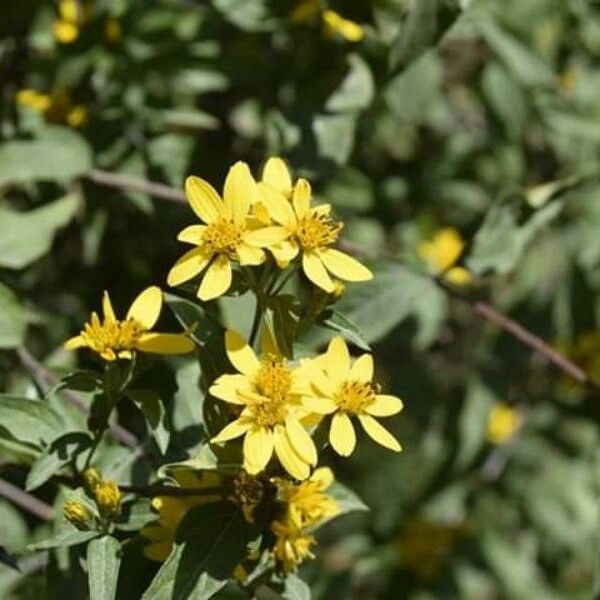
Plant Overview
Known affectionately as the Tropical Three-wing or "Hierba del Aire," this resilient shrub is a hidden gem of the American tropics and the southern United States. Its golden, tufted flowers resemble tiny bursts of sunshine, often blooming throughout the year in warmer climates. Historically, it has been a staple in traditional herbalism across Mexico and Central America, valued for its hardy nature and ability to thrive where other plants might wither.
🔍 How to Identify
- 🌼 Flower Structure: The bright yellow flower heads are unique; instead of broad petals, they are made up of "tubular" florets that look like shredded silk or tiny, delicate brushes.
- 🍃 Leaf Texture: The lance-shaped leaves are a vibrant, deep green with a slightly fuzzy or "tomentose" underside, which helps the plant retain moisture in the heat.
- 🌿 Growth Habit: It behaves as a semi-climbing or scrambling shrub. Without support, it forms a rounded mound, but if it finds a fence or a nearby tree, it can lean and "climb" up to 10 feet high.
🏡 In Your Garden
- ☀️ Heat Warrior: This plant is incredibly drought-tolerant and thrives in full sun to partial shade. It is a perfect candidate for xeriscaping or "low-water" gardens, as it rarely complains about a dry spell once established.
- 🦋 Wildlife Cafe: Because it can bloom late into the season, it serves as a critical nectar source for migrating butterflies and local bees when other floral options have disappeared for the winter.
⚠️ Safety & Toxicity
- 🐾 General Safety: Trixis inula is not listed as a toxic plant for domestic pets or humans. It is generally safe to handle and grow in residential areas.
- 🍵 Medicinal Note: While it has a long history in folk medicine for treating respiratory issues (the "Air" in Hierba del Aire), it should never be ingested as a home remedy. Always consult a professional before using wild plants medicinally.
✨ Fun Fact
- ✨ The name "Trixis" is derived from the Greek word for "threefold." This refers to the unique three-cleft shape of the outer floral petals—a tiny, geometric detail you can only see if you look very closely at the flower!

Detailed Care Instructions
To grow a Trixis Inula plant, follow these steps:
- Climate and soil requirements: Trixis Inula plants prefer tropical or subtropical climates. They can tolerate a wide range of soil types, but well-draining soil is important to prevent root rot. Choose a location that receives full sun.
- Propagation: Trixis Inula plants can be propagated from both seeds and cuttings. Seeds should be sown in spring, just below the soil surface. Keep the soil consistently moist until the seeds germinate, usually within 2-3 weeks. For cuttings, take 4-6 inch long stem cuttings from a healthy plant and remove the lower leaves. Dip the cut ends in rooting hormone and plant them in a pot filled with well-draining soil. Water the cutting regularly until it develops roots.
- Transplantation: Once the seedlings or rooted cuttings have developed a few true leaves and a strong root system, they can be transplanted into larger pots or directly in the garden. Space the plants at least 12-18 inches apart to provide adequate air circulation and room for growth.
- Watering and fertilizing: Trixis Inula plants require regular watering, especially during dry spells. Water deeply but allow the soil to dry slightly between waterings. Fertilize every 2-3 months with a balanced, slow-release fertilizer to promote healthy growth.
- Pruning: Trixis Inula plants benefit from occasional pruning to remove dead or damaged foliage and to maintain a compact shape. Prune after flowering to encourage new growth and a bushier appearance.
- Pests and diseases: Trixis Inula plants are generally resistant to pests and diseases. However, keep an eye out for aphids, mealybugs, or whiteflies, which can occasionally infest the plant. Treat any pest issues promptly using organic insecticides or insecticidal soap.
- Harvesting and propagation: Trixis Inula plants produce tiny, yellow flowers that are attractive to pollinators. You can let the flowers go to seed at the end of the season to collect them for future propagation. Simply allow the seed heads to dry on the plant, then collect the seeds by shaking them into a container.
By following these steps, you can successfully grow Trixis Inula plants and enjoy their beautiful flowers in your garden.

Place in a bright room that is sun drenched almost all day. Or directly in a south-facing window.

To water this plant, it is important to first check the soil moisture level by inserting a finger about one inch deep into the soil. If the soil feels dry to the touch, it is time to water the plant. Use a watering can or hose with a gentle spray nozzle to water the soil around the base of the plant until water begins to seep out of the drainage holes. It is essential not to overwater the plant as it can lead to root rot. Allow the soil to dry out slightly before watering again. The frequency of watering will depend on the environmental conditions, such as temperature and humidity, as well as the size of the plant and container. Keep an eye on the plant and adjust the watering schedule accordingly.
In terms of fertilizing this plant, it's important to remember that it needs a balanced and slow-release fertilizer. It can be given this type of fertilizer in the early spring, during mid-summer, and in the fall. It's recommended to use a 20-20-20 fertilizer or something similar. Be sure to follow the manufacturer's instructions for mixing and applying the fertilizer, and be careful not to over-fertilize as this can lead to burn and damage to the plant.
It is recommended to use a well-draining soil for this plant, as it does not tolerate waterlogged conditions. A sandy or loamy soil with a pH between 6.0 and 7.0 is ideal. This plant also prefers soil that is nutrient-rich, so amending with organic matter such as compost can be beneficial. It is important to avoid using heavy clay soils or soils with a high clay content, as they can retain too much moisture and lead to root rot.
To propagate this plant, first prepare a container with well-draining soil. Take a stem cutting that is several inches long, making sure it has several nodes or sections. Remove the lower leaves from the cutting and dip the cut end in rooting hormone powder. Plant the cutting in the prepared soil, making sure the soil is moist but not waterlogged. Cover the container with clear plastic to create a greenhouse effect and keep the cutting in a warm, brightly lit area. After a few weeks, roots should begin to form and the cutting can be gradually acclimated to normal growing conditions.








