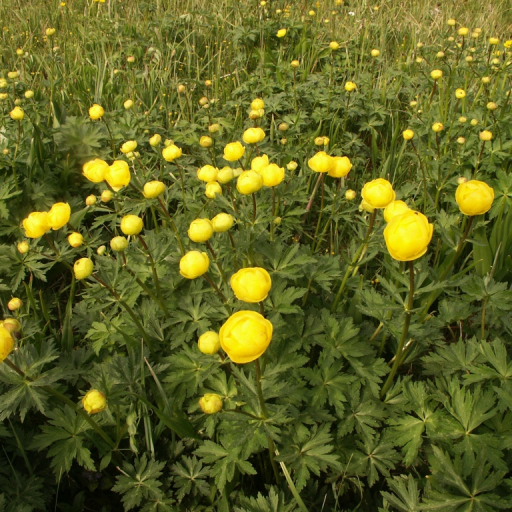
Plant Overview
The Globe Flower (Trollius europaeus) looks like a golden secret waiting to be told. Often called the "Fried Egg Plant" in some regions or the "Troll-flower" in Nordic folklore, its blooms appear as perfectly spherical, tightly packed buttercups that never quite seem to open. This mountain-dweller brings a splash of sunshine to the damp, shady corners of a garden where other flowers might struggle.
🔍 How to Identify
- 🌕 The Blooms: Large, globular flowers (3–5 cm) that stay curved inward, creating a hollow sphere. They range from pale primrose to vibrant lemon yellow.
- 🌿 The Foliage: Deeply lobed, dark green leaves that look almost like those of a delphinium or a buttercup, providing a lush, textured backdrop.
- 📏 The Stature: An upright, clump-forming perennial that typically reaches about 60 cm (2 feet) in height, with flowers held high on sturdy, leafless stems.
🏡 In Your Garden
- 💧 The Water Lover: Unlike many garden favorites that demand drainage, the Globe Flower has "wet feet." It thrives in heavy, clay-rich soil and is the perfect candidate for pond edges or bog gardens.
- ❄️ Cooler Climates: This plant is a true northerner; it hates intense summer heat and humidity. In warmer zones, it must be kept in partial shade to prevent the foliage from scorching and turning brown.
- 🛑 Don't Move Me: It possesses a deep, sensitive root system. Once you find a damp spot where it is happy, avoid transplanting it, as it can take a full season or more to recover from the shock.
⚠️ Safety & Toxicity
- 🚫 Toxic Sap: Like many members of the Buttercup family (Ranunculaceae), the Globe Flower contains protoanemonin. This chemical can cause a bitter taste and burning sensation if ingested.
- 🐾 Pets & Kids: The plant is generally avoided by deer and rabbits due to its acrid taste, but it is toxic to cats, dogs, and humans. Contact with the sap may also cause mild skin irritation for sensitive gardeners.
✨ Fun Fact
🪰 The Secret Partnership: Because the flower is so tightly closed, most bees can't get inside! It relies on a specific tiny fly (Chiastocheta) for pollination. The fly crawls through the narrow gaps in the petals to lay its eggs, and in exchange for a safe nursery, it ensures the plant produces seeds.

Detailed Care Instructions
| Lighting | Part Sun |
To grow Trollius Europaeus, also known as globeflowers or European trollius, follow these steps:
- Choose the right location: Trollius Europaeus prefers partial shade to full sun but prefers moist soil. Select a spot with well-draining soil that retains moisture.
- Prepare the soil: Till the soil and remove any weeds or rocks. Amend the soil with organic matter, such as compost or aged manure, to improve fertility and drainage.
- Sow seeds: Trollius Europaeus can be grown from seeds. Sow the seeds in early spring or fall, directly in the prepared soil. Space the seeds at least 12-18 inches apart.
- Mulch: Apply a layer of organic mulch, like straw or wood chips, around the plants. This helps retain moisture, prevent weeds, and insulate the soil.
- Watering: Keep the soil evenly moist, especially during dry spells or hot summers. Water deeply, but avoid overwatering or allowing the soil to become waterlogged.
- Fertilizing: Feed the plants with a balanced organic fertilizer in spring and early summer to promote healthy growth.
- Pruning: Cut back the foliage after the plant finishes blooming to encourage fresh growth and potential reblooming.
- Propagation: If desired, trollius plants can also be propagated by dividing the clumps in early spring or fall. Dig up the clump carefully, separate the sections, and plant them in prepared soil.
- Pests and diseases: Watch out for slugs and snails, which may feed on the foliage. Additionally, apply organic fungicides to prevent diseases like powdery mildew.
- Winter care: Trollius Europaeus is hardy in USDA zones 3-7. Mulch the plants heavily in late fall to protect the crown from freezing temperatures.
By following these guidelines, you can successfully grow Trollius Europaeus and enjoy its beautiful blooms in your garden.

Place in a bright room that is sun drenched almost all day. Or directly in a south-facing window.

To properly water this plant, you should ensure that the soil remains consistently moist but never waterlogged. Check the soil regularly and water when the top inch of soil feels dry to the touch. Use a watering can or hose with a gentle spray nozzle to water the base of the plant, being careful not to get water on the leaves or flowers. In hotter and drier climates, you may need to water this plant more frequently. During periods of heavy rain, you should ensure that the plant has good drainage to prevent waterlogging.
To fertilize this plant, use a balanced all-purpose fertilizer that has equal amounts of nitrogen, phosphorus, and potassium. Apply the fertilizer at the beginning of the growing season, as soon as new growth starts to emerge. Dissolve the fertilizer in water according to the package instructions and apply it to the soil around the base of the plant. Avoid getting the fertilizer on the foliage or flowers. Water the plant thoroughly after applying the fertilizer to help it absorb the nutrients. Repeat this fertilizing process once or twice during the growing season, but make sure to stop fertilizing in late summer to avoid promoting new growth that may not have enough time to harden off before winter.
The ideal soil for Trollius Europaeus is a well-draining, moist soil that is rich in organic matter. It prefers a slightly acidic to neutral soil pH between 6.0 and 7.0. A soil that is too sandy or too heavy may not be suitable for this plant. It is recommended to incorporate compost or well-rotted manure into the soil before planting. A layer of mulch around the base of the plant can also be beneficial in retaining moisture and preventing weeds. It is important to ensure the soil remains consistently moist, but not waterlogged, as this plant requires adequate water to thrive.
There are several methods to propagate this plant. One way is to collect mature seeds in late summer or early autumn and sow them in a well-draining soil mix that is kept moist and placed in a cool, shaded area. Another method is to take stem cuttings in late spring or early summer, and dip the cut ends in rooting hormone before planting in a moist soil mix.
Division is also a viable method of propagation, which involves digging up the entire plant, dividing the root mass into several sections, and replanting each section into its own container or into the ground. Divisions should be made in the fall or early spring, and each section should have at least one healthy stem and several roots.
Regardless of the method chosen, it is important to keep the soil moist and provide adequate light and temperature conditions for successful propagation.
Common pests of the globeflower include Spider mites, aphids, thrips, whiteflies. Make a habit of checking your globeflower frequently for pests so that any infestations can be caught and managed early.








