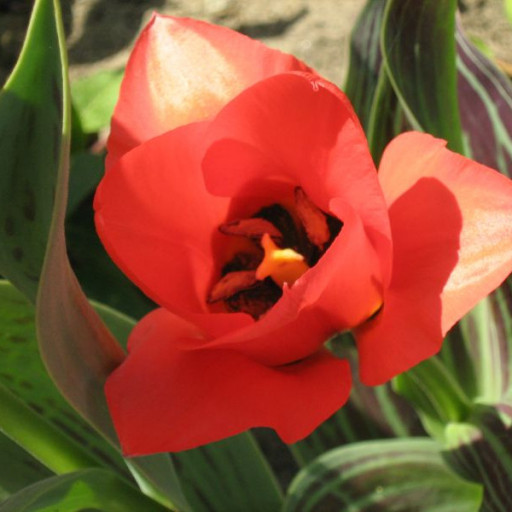
Plant Overview
Often hailed as the "Peacock Tulip" due to its remarkably patterned foliage, Tulipa greigii is a wild-at-heart species hailing from the rugged mountains of Central Asia. Unlike the tall, uniform tulips often seen in mass displays, these beauties are shorter, sturdier, and pack a visual punch even before their flowers emerge. They are a favorite for rock gardens because they bring a touch of untamed, prehistoric elegance to a home landscape.
🔍 How to Identify
- 🍃 The Foliage: The standout feature is the broad, wavy-edged leaves that are dramatically marked with bold, chocolatey-purple stripes or spots.
- 🌷 The Bloom: Large, chalice-shaped flowers that sit on short, thick stems, typically appearing in brilliant shades of scarlet, orange, or buttery yellow.
- 🖤 The Center: When the sun coaxes the petals wide open, they reveal a striking, dark "basal blotch" or "eye" at the very heart of the flower.
🏡 In Your Garden
- ☀️ Naturalizing Power: As a "botanical" tulip, this species is much more likely to return and multiply year after year compared to modern hybrids, provided the soil is well-drained and the bulbs are allowed to "bake" in the sun during their summer dormancy.
- 💨 Wind Resistance: Because of their low-growing habit and thick stems, they are virtually wind-proof, making them an excellent choice for exposed garden beds where taller tulips might snap or lean.
⚠️ Safety & Toxicity
- 🐾 Pet Safety: Like all members of the tulip family, Tulipa greigii contains alkaloid compounds that are toxic to dogs, cats, and horses; the bulbs contain the highest concentration of toxins.
- 🧤 Tulip Finger: Gardeners with sensitive skin may develop "Tulip Finger," an itchy allergic rash, after handling the bulbs, so wearing gloves during autumn planting is highly recommended.
✨ Fun Fact
🏛️ Imperial History: This plant was named in honor of Samuel Greig, a general in the Russian Imperial Navy who also served as the president of the Russian Horticultural Society in the late 1800s.

Detailed Care Instructions
To grow Tulipa Greigii plants, follow these steps:
- Choosing a suitable location: Tulipa Greigii plants prefer full sun to partial shade. Select a location in your garden with well-draining soil that receives at least 6 hours of direct sunlight each day.
- Planting time: Tulipa Greigii bulbs are typically planted in the fall, about 6-8 weeks before the first hard freeze. This gives them enough time to establish their roots before winter.
- Soil preparation: Ensure that the soil is well-draining and fertile. You can amend the soil with organic matter like compost to improve its quality. Remove any rocks or debris that may hinder bulb growth.
- Bulb planting: Dig a hole that is approximately 4-6 inches deep. Place the Tulipa Greigii bulb in the hole with the pointed end facing up and the flat end down. Space the bulbs about 6-8 inches apart to allow room for growth. Cover the bulb with soil and gently firm it down.
- Watering: After planting, water the bulbs thoroughly. Tulipa Greigii plants like moist but not waterlogged soil. Provide enough water to keep the soil evenly moist, especially during dry spells.
- Mulching: Apply a layer of organic mulch around the planted bulbs to help retain soil moisture and regulate soil temperature.
- Fertilizing: You can lightly fertilize your Tulipa Greigii plants with a balanced bulb fertilizer in early spring when you start to see growth. Follow the manufacturer's instructions for application rates.
- Maintenance: Tulipa Greigii plants do not require much maintenance. Remove any weeds that may compete with them for nutrients and space. Deadhead the spent flowers to redirect energy back into the bulb.
- Dormancy: Tulipa Greigii plants go dormant after blooming. Allow the foliage to die back naturally without cutting it off until it turns yellow and withers away. This allows the bulb to store energy for the next season.
- Dividing and propagating: After a few years, Tulipa Greigii bulbs can become crowded. Lift and divide them during the dormant season (late summer or early fall) to maintain their health and vigor. Replant the divided bulbs at the appropriate depth.
By following these steps, you can successfully grow Tulipa Greigii plants and enjoy their vibrant and colorful blooms.

Place in a bright room that is sun drenched almost all day. Or directly in a south-facing window.

Tulipa greigii plant requires regular watering to thrive. It is important to ensure that the soil is moist but not waterlogged. A good rule of thumb is to water the plant deeply once a week, making sure that the water reaches the roots. However, the frequency of watering may need to be adjusted based on the climate and the soil conditions.
When watering, it is important to avoid getting the foliage wet as this can lead to fungal diseases. Therefore, it is best to water at the base of the plant, using a watering can or a gentle hose attachment. Avoid using sprinklers or high-pressure jets, which can damage the delicate flowers and foliage.
During periods of drought or hot weather, it may be necessary to water more frequently to prevent the soil from drying out. However, be cautious not to overwater as this can lead to root rot and other problems. Always check the soil moisture level before watering to ensure that the plant actually needs water.
In summary, regular watering is important for the health and vitality of Tulipa greigii plant. Water deeply once a week, avoid getting the foliage wet, and adjust watering frequency based on the climate and soil conditions.
- Choose a fertilizer specifically formulated for bulbs.
- Apply the fertilizer in the fall, just before winter dormancy begins.
- Use a slow-release fertilizer to avoid burning the roots.
- Apply the fertilizer evenly across the soil, following the manufacturer's recommended dosage instructions.
- Water the fertilized soil well after application to ensure the nutrients reach the roots.
- Continue to water the soil periodically throughout the winter and early spring to activate the fertilizer and encourage growth.
- Avoid fertilizing during the growing season as this can harm the plant.
Tulipa Greigii plant prefers moist, well-draining soil. The soil should be slightly acidic to neutral with a pH range of 6.0-7.0. To provide the best growing conditions, it is recommended to use a loamy soil that is rich in organic matter. A soil that is too heavy or too sandy may not provide the ideal growing environment for this plant.
Additionally, Tulipa Greigii plant prefers to grow in full sun to partial shade. It requires about 6 hours of sunlight every day. Therefore, be sure to select a location that receives enough sunlight, and plant the bulbs in soil that is at least 6 inches deep.
Overall, it is essential to choose a soil type that will help prevent excess water retention while providing the plant with the necessary nutrients. Adequate drainage and overall composition of the soil are essential for the tulipa greigii plant to reach its full potential.
There are several methods you can use to propagate this plant. One way is to extract the bulb offsets that grow around the parent bulb. Wait until the bulbs mature and detach from the parent bulb, then gently pull them off. Replant these bulbs in well-draining soil and keep them moist until they start to grow.
Another propagation method is through seed. Wait for the flowers to fade and the seed pods to dry out. Collect the seeds and plant them in well-draining soil. Keep the soil moist until the seedlings emerge.
You can also propagate this plant through stem cuttings. Cut a stem from the parent plant that has at least one node. Plant the cutting in well-draining soil and keep it moist until it starts to grow roots.
No matter which method you choose, it is important to provide the plant with adequate sunlight, moisture, and nutrients to encourage healthy growth. Research specific care instructions for this particular variety to ensure successful propagation.
Common pests of the greig's tulip include Aphids, snails. Make a habit of checking your greig's tulip frequently for pests so that any infestations can be caught and managed early.








