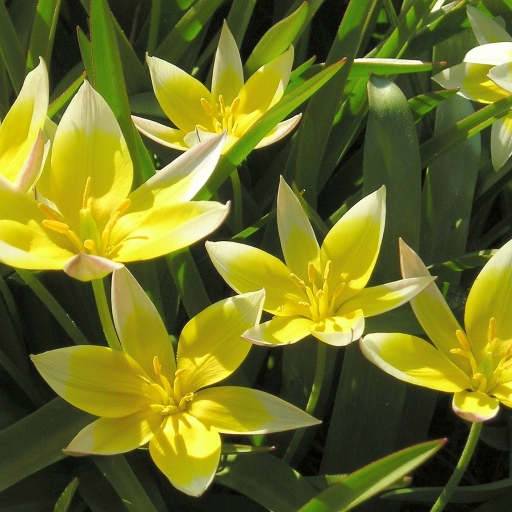
Plant Overview
Known as the "Urumieh Tulip" or the "Golden Star," this dainty wild species hails from the rocky, high-altitude slopes surrounding Lake Urmia in Iran. Unlike the stiff, oversized tulips found in florist bouquets, this botanical treasure stays low to the earth, creating a carpet of star-shaped blooms that look like tiny sunbursts. It is a favorite among rock garden enthusiasts for its "wild" look and its ability to naturalize and return year after year.
🔍 How to Identify
- 🌼 Petal Pattern: Features bright, buttery-yellow centers that fade to a clean white or cream at the tips, often giving it a "fried egg" appearance when fully open.
- 🍃 Leaf Structure: The foliage consists of narrow, strap-like green leaves that often have a slightly wavy edge and hug the ground in a prostrate rosette.
- 📏 Growth Habit: It is a dwarf species, rarely exceeding 4–6 inches in height, and notably produces multiple flowers from a single bulb rather than just one.
🏡 In Your Garden
- 🪨 Rock Garden Specialist: Because it originates from alpine scree, it thrives in gritty, fast-draining soil. It hates "wet feet," so avoid heavy clay areas where water sits.
- ☀️ The Sun Sensor: These flowers are highly phototropic. They will remain tightly closed like little spears on cloudy days and only unfurl into their star shape when they feel the direct warmth of the sun.
- ⏳ Longevity: Unlike "Dutch" hybrid tulips that often dwindle after one season, this botanical tulip is a perennial survivor that will slowly spread if left undisturbed.
⚠️ Safety & Toxicity
- 🐾 Toxic to Pets: Like all tulips, this plant contains tulipalin A and B. It is toxic to dogs, cats, and horses if ingested, with the highest concentration of toxins found in the bulb.
- 🧤 Skin Irritation: Gardeners with sensitive skin may develop "Tulip Finger," a mild rash or dermatitis, after handling the bulbs. It is best to wear gloves during autumn planting.
✨ Fun Fact
Tulipa urumiensis is a true "species tulip," meaning it exists in the wild exactly as you see it in gardens today. While modern hybrids are bred for size, this wild variety has spent thousands of years evolving to survive freezing mountain winters and scorching, dry summers without any human help.

Detailed Care Instructions
To grow Tulipa Urumiensis plants, follow these steps:
- Plant tulip bulbs in the fall before the ground freezes. Choose a location with well-drained soil and full sunlight.
- Dig a hole that is three times the height of the bulb and plant the bulb with the pointy end facing up.
- Space bulbs about 4-6 inches apart.
- Water the bulbs after planting and then only when the soil becomes dry. Tulipa Urumiensis plants prefer well-drained soil and do not like to sit in wet conditions.
- Fertilize the bulbs in the spring with a balanced fertilizer, following the instructions on the packaging.
- Allow the foliage to die back naturally after flowering. This allows the plant to store energy for the next year's bloom.
- Tulipa Urumiensis plants are perennial and will come back year after year if cared for properly.
- Protect the bulbs from rodents and other animals that may try to dig them up.
By following these steps, you can successfully grow Tulipa Urumiensis plants in your garden.

Place in a bright room that is sun drenched almost all day. Or directly in a south-facing window.

Tulipa Urumiensis plant should be watered regularly, but avoid over-watering as this can cause the roots to rot. It is best to water the plant at the base, near the soil, rather than directly on the leaves or flowers. Make sure the soil is well-draining to prevent water from pooling around the roots. Water the plant when the top inch of soil feels dry to the touch. During hot weather, the plant may require more frequent watering, but be cautious not to water too much. Additionally, it is important to avoid getting water on the foliage, as this can lead to disease outbreaks.
Fertilize Tulipa Urumiensis plant in early spring before new growth appears, using a balanced fertilizer with an NPK ratio of 10-10-10. Apply the fertilizer at half the recommended strength, following the instructions on the packaging. Mix the fertilizer into the soil around the base of the plant, being careful not to get any on the foliage. Water the plant well after fertilizing to help the nutrients penetrate the soil and reach the roots. Repeat the fertilization process once or twice more during the growing season, spacing out applications by 6-8 weeks. Avoid fertilizing in late summer or fall, as this can encourage new growth that may be damaged by frost.
Tulipa Urumiensis plants prefer well-draining soil that is rich in organic matter. A soil mix containing a combination of loam, sand, and organic compost is suitable for these plants. The pH of the soil should be slightly acidic to neutral. Avoid heavy clay soils as they can lead to waterlogging and cause root rot. It is recommended to amend the soil with perlite or coarse sand to improve drainage. Additionally, adding a slow-release fertilizer to the soil before planting can help provide essential nutrients for the growth of Tulipa Urumiensis plants.
Tulipa Urumiensis can be propagated through bulb offsets or seeds. To propagate through bulb offsets, gently remove the offsets from the parent bulb during the dormant season, making sure to include some roots with each offset. Plant the offsets in well-draining soil and keep them watered and in a sunny location. They should establish and grow into new plants within a few months.
To propagate through seeds, collect the seeds from the plant after the flowers have faded and the seed pods have dried. Sow the seeds in a well-draining potting mix at a depth of about twice the size of the seed. Keep the soil consistently moist and place the pot in a sunny location. The seeds should germinate within a few weeks to a few months, depending on the conditions. Transplant the seedlings into individual pots or into the garden once they have developed a few sets of leaves.
Propagation of Tulipa Urumiensis can be a rewarding process, as it allows you to create new plants and expand your collection of these beautiful flowers.
Common pests of the late tulip include Aphids, snails. Make a habit of checking your late tulip frequently for pests so that any infestations can be caught and managed early.








