Plant Overview
Known as the "Long-Leafed Bladderwort," this Brazilian beauty is a master of disguise. While it appears to be a lush, grassy plant with flowers that rival the finest orchids, it hides a predatory secret beneath the soil. Unlike its aquatic cousins that float in ponds, Utricularia longifolia is a terrestrial or lithophytic (rock-growing) carnivore that hunts microscopic soil organisms to survive in nutrient-poor environments.
🔍 How to Identify
- 🌿 The Foliage: Unlike the tiny, moss-like leaves of many bladderworts, this species produces long, strap-shaped, vibrant green leaves that can reach up to 12 inches in length.
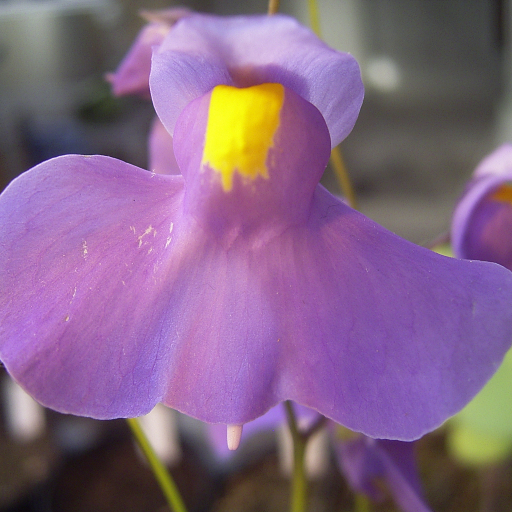
- 🌸 The Flowers: It produces stunning, large blooms on tall stalks. These flowers are typically a rich mauve or violet color with a distinct yellow "eye" or blotch on the lower petal, making them look remarkably like miniature orchids.
- 💧 The Traps: If you look at the roots, you will find tiny, translucent bladders. These are sophisticated vacuum traps that snap shut in milliseconds when triggered by tiny soil-dwelling organisms.
🏡 In Your Garden
- ☁️ Humidity & Water: This plant is a "bog-dweller" and loves high humidity. It should always sit in a tray of pure water (distilled, rainwater, or reverse osmosis), as minerals found in tap water will slowly "burn" its sensitive trapping system.
- 🌱 The Substrate: Never use standard potting soil. It thrives in nutrient-poor media like live sphagnum moss or a mix of peat moss and perlite. It loves to "creep," and will often send its leaves out of the drainage holes of its pot to explore.
⚠️ Safety & Toxicity
- 🟢 Non-Toxic: Utricularia longifolia is generally considered safe and non-toxic to humans, cats, and dogs.
- 🐜 Pest Control: While harmless to pets, it is a "foe" to tiny soil gnats and protozoa. It acts as a natural, underground pest control system for your indoor garden collection.
✨ Fun Fact
The suction traps of the Bladderwort are among the fastest-moving structures in the entire plant kingdom. They can suck in prey and reset the trap in less than 1/500th of a second—nearly 100 times faster than the snap of a Venus Flytrap!

Detailed Care Instructions
To grow Utricularia longifolia, also known as the "bladderwort" plant, you will need to follow these steps:
- Choose the right growing conditions: Utricularia longifolia is a carnivorous plant that naturally grows in wetland areas with full sun exposure. It thrives in temperature ranges of 70-90°F (21-32°C) during the day and a bit cooler at night.
- Prepare the planting container: Bladderworts are typically potted in shallow containers such as plastic trays or dishes. Ensure that the container has proper drainage to avoid waterlogging.
- Soil and water: Utricularia longifolia requires a mix of peat moss and sphagnum moss as the growing medium. Fill the pot with this mixture, leaving some space at the top. The soil should be kept constantly moist but not waterlogged. You can use distilled water or rainwater to prevent tap water chemicals from damaging the plant.
- Plant the seeds: Utricularia longifolia can be grown from either seeds or divisions of established plants. If you have seeds, sprinkle them lightly over the soil surface and press them gently. Avoid burying them too deeply.
- Provide adequate lighting: Place the pot in an area that receives bright, indirect sunlight for at least 6-8 hours a day. If growing indoors, consider using artificial grow lights to supplement the natural light.
- Maintain humidity: Bladderworts prefer high humidity levels, ideally around 60-80%. You can create a humid environment by misting the plant regularly or placing the pot on a tray filled with water and pebbles.
- Feeding: Utricularia longifolia is a carnivorous plant that obtains nutrients from insects and small organisms it catches in its bladder traps. However, it can also benefit from occasional supplemental feeding. You can use dried or live insects, such as fruit flies or small flies, to provide extra nutrients once in a while.
- Avoid overfeeding: While supplemental feeding can be beneficial, be cautious not to overfeed the plant. Too many nutrients can weaken the bladder traps and harm the plant.
- Pruning: Utricularia longifolia produces long, trailing stems. If you prefer a more compact shape, you can prune the plant by cutting back excessive growth. Pruning is best done during the growing season.
- Winter care: If you live in a region with freezing temperatures, Utricularia longifolia may require extra care during winter. Protect the plant by either moving it indoors to a bright, humid location or creating a frost-free environment with the help of a greenhouse or terrarium.
Remember that growing Utricularia longifolia can be a bit challenging due to its carnivorous nature, but with proper care and attention to its specific requirements, you can successfully cultivate this unique plant.

Place in a window with dappled sun or a spot in the middle of a room. Or directly in a window facing west or east.

Utricularia Longifolia is a carnivorous plant that thrives in moist soil conditions. In order to properly water this plant, you should avoid getting water on its leaves, as this can cause damage. Instead, water it at the base of the plant, in the soil, using a watering can or spray bottle. Make sure the soil is thoroughly saturated, but not waterlogged. Keep the soil consistently damp, but not too wet, in order to provide the plant with the necessary moisture it needs to grow. Additionally, this plant does best in bright, indirect light, so be sure to place it in an area with plenty of natural light.
Utricularia Longifolia, like many carnivorous plants, requires specific fertilization to thrive. Here are some instructions on how to fertilize:
- Use distilled water or rainwater to avoid mineral buildup that can harm the plant.
- Never use high-nitrogen fertilizers as they can damage the roots and leaves.
- Use a weak solution of fertilizer, typically a 1:10 or 1:20 dilution.
- Apply the fertilizer directly to the soil or use a foliar spray, but ensure it does not come into contact with the leaves or traps.
- Use fertilizer sparingly and no more than once or twice a month.
Remember, over-fertilization can be harmful to the plant, so it's better to err on the side of caution and withhold fertilizer if unsure.
Utricularia Longifolia plant prefers an acidic soil with a low nutrient content. It should be potted in a mixture of peat moss, perlite, and sand in equal parts to ensure proper drainage and aeration. The soil should be kept moist but not waterlogged, and it is important to avoid using hard water or tap water with high levels of dissolved minerals. Adding sphagnum moss to the soil mixture can also help retain moisture and maintain the desired level of acidity. Overall, the soil for Utricularia Longifolia plant should be well-draining, acidic, and low in nutrients.
To propagate this plant, it is important to first identify a healthy parent plant with strong roots. Using a sharp and sterile cutting tool, take a cutting of the plant about 2-3 inches in length with at least one node or leaf attached. Remove any lower leaves or stems that may be touching the soil.
Next, prepare a small pot or container with a well-draining soil mix, such as a mix of peat moss and perlite. Water the soil well and make a small hole in the center to accommodate the cutting. Dip the cut end of the stem in rooting hormone before planting it in the soil. Place the container in a warm, bright location with high humidity (such as a mini greenhouse or plastic bag over the pot) and mist the cutting daily to maintain moisture levels.
After a few weeks, the cutting should have developed new roots and can be gradually acclimated to lower humidity and brighter light conditions. Once the plant has established itself in the new pot, it can be gradually transitioned to its permanent location with proper care.
Common pests of the utricularia longifolia include Aphids. Make a habit of checking your utricularia longifolia frequently for pests so that any infestations can be caught and managed early.








