Plant Overview
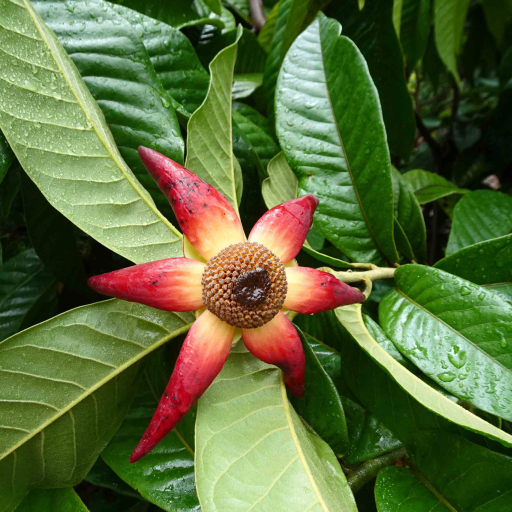
The Uvaria grandiflora, often celebrated as the Red Star Flower, is a show-stopping tropical climber known for its dramatic, velvety blooms. Native to the lush jungles of Southeast Asia, it behaves like a "scrambling" shrub, reaching out with its woody branches to find support as it climbs toward the light. In its native habitats, it is prized not just for its visual beauty but for its ability to transform a plain fence or trellis into a wall of deep crimson stars.
🔍 How to Identify
- 🌸 Velvety Blooms: The flowers are large and leathery, featuring six thick petals that range from deep maroon to bright burgundy, surrounding a contrasting ring of yellow stamens.
- 🍃 Leathery Foliage: Its leaves are oblong, dark green, and slightly fuzzy on the underside, providing a dense, lush backdrop that remains vibrant year-round in warm climates.
- 🍇 Unique Fruit Clusters: Following the bloom, it produces distinct fruit segments that look like small, elongated yellow sausages or grapes radiating from a central point.
🏡 In Your Garden
- 🧗 Support is Key: Because this plant is a "scrambler," it doesn't have tendrils to grip like a grape vine. It needs to be manually guided or leaned against a sturdy trellis, pergola, or fence to achieve its climbing potential.
- 💧 Tropical Humidity: It thrives in high humidity and well-draining soil. While it can tolerate brief dry spells once established, it prefers consistent moisture to keep its heavy foliage from drooping.
⚠️ Safety & Toxicity
- 🟢 General Safety: Uvaria grandiflora is generally considered non-toxic to the touch and is safe for most garden environments.
- 🐾 Pet Awareness: While not typically listed as a high-risk poison, the fruits and leaves are not for consumption. Keep an eye on curious pets, as ingesting the plant material can cause mild digestive upset or nausea.
✨ Fun Fact
The Uvaria grandiflora is a member of the Annonaceae family, making it a distant cousin of the delicious Soursop and Custard Apple! While its own fruit is edible in some regions, it is much more famous for the aromatic, spicy fragrance its flowers release during the evening hours.

Detailed Care Instructions
To grow Uvaria Grandiflora (also known as St. Thomas Tree or Moonbeam Tree), you can follow these steps:
- Climate and soil: Uvaria Grandiflora grows best in tropical or subtropical climates. It prefers well-draining soil that is rich in organic matter.
- Planting location: Choose a location that receives partial shade to full sun. It should have enough space for the plant to spread out when it grows.
- Propagation: Uvaria Grandiflora can be propagated from seeds or cuttings. If using seeds, soak them in warm water for 24 hours before planting. If using cuttings, take a 6-8 inch cutting from a healthy plant and plant it in well-draining potting mix.
- Planting in the ground: Dig a hole in the soil that is slightly larger than the root ball. Place the plant in the hole and fill it with soil, gently firming it around the base of the plant.
- Watering: Initially, water the plant deeply to promote root establishment. After that, water it regularly but allow the soil to dry partially between watering to prevent overwatering.
- Fertilizing: Uvaria Grandiflora benefits from regular fertilization. Use a balanced, slow-release fertilizer according to the instructions on the package.
- Pruning: Prune the plant lightly to maintain its shape and remove any dead or diseased branches. Pruning can be done after the flowering season.
- Pests and diseases: Keep an eye out for common pests like aphids or spider mites. Treat any infestations promptly using appropriate insecticides. Watch out for any signs of diseases, such as leaf spots or fungal infections, and take necessary measures to control them.
Remember to research specific care requirements for Uvaria Grandiflora in your particular growing region, as it may have specific needs based on the local climate and environment.

Place in a bright room that is sun drenched almost all day. Or directly in a south-facing window.

To properly water this plant, you should first ensure that the soil is dry to the touch before watering. When watering, give the plant a thorough soaking, allowing the water to fully penetrate the soil. Be sure to avoid getting water on the foliage as this can lead to disease problems. Allow the soil to dry out slightly before watering again, as overwatering can be detrimental to this plant's health. It is also important to provide good drainage to prevent waterlogging, and to avoid watering during the dormant period.
To fertilize this plant, use a balanced fertilizer with equal amounts of nitrogen, phosphorus, and potassium. Apply the fertilizer every two weeks during the growing season, but reduce the frequency to once a month during the winter months. Be sure to follow the manufacturer's instructions for the correct application rate and always water the plant before and after fertilizing to prevent fertilizer burn.
Uvaria Grandiflora plant prefers a well-draining soil with a balanced mix of organic matter, sand, and clay. This plant requires soil that is fertile and moisture-retentive. The pH level of the soil should be neutral or slightly acidic, ideally between 6.0 to 6.5. It is important to avoid soils that are clay-heavy or compacted, as it can increase the risk of waterlogging and poor aeration. A regular application of compost or organic fertilizer can help improve the soil quality, which can promote healthy growth and development of the Uvaria Grandiflora plant.
Uvaria Grandiflora is a plant that can be propagated through stem cuttings. To do this, select a healthy stem that is about 6-8 inches long and has at least 2 nodes. Cut the stem at a 45-degree angle using a sharp, sterile knife or scissors.
Remove the leaves from the bottom half of the cutting, leaving only a few leaves at the tip. Dip the cut end of the stem in rooting hormone powder and gently shake off any excess.
Prepare a potting mix of equal parts peat moss and perlite or sand. Fill a small pot with the potting mix and make a hole in the center. Insert the cutting into the hole and secure it in place with the potting mix, gently pressing down around the stem.
Water the cutting thoroughly and cover it with a clear plastic bag or plastic wrap to create a humid environment. Place the pot in a warm, bright location but away from direct sunlight.
Check the cutting regularly to ensure the soil stays moist and mist the leaves if necessary to maintain humidity. After a few weeks, gently tug on the stem to check for roots. Once roots have formed, you can remove the plastic covering and gradually transition the plant to its new environment.








