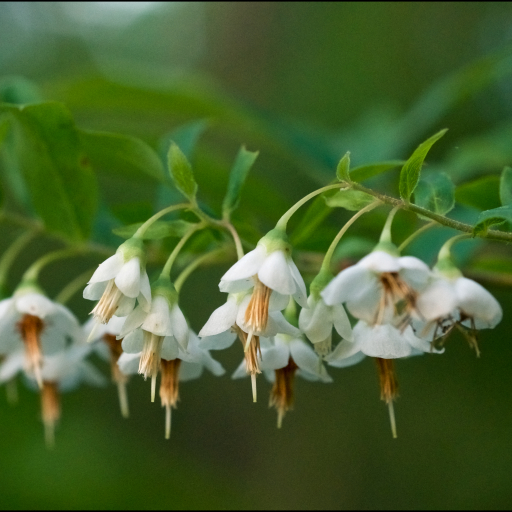
Plant Overview
Often known by its charming nickname "Deerberry," Vaccinium stamineum is a wild, airy shrub native to the eastern and central United States. Unlike its more famous cousin, the Highbush Blueberry, this plant offers a more delicate, ornamental look with its unique bell-shaped flowers and twisted, architectural branches. It is a cornerstone of North American woodland ecosystems, providing both beauty and a buffet for local wildlife.
🔍 How to Identify
- 🔔 Distinctive Blooms: The flowers are snowy white and bell-shaped, but they stand out because their long, yellow stamens hang far below the petals, looking like tiny chandeliers.
- 🍃 Two-Toned Foliage: The leaves are oval and smooth, but if you flip one over, you’ll notice a distinctively pale, almost whitish or glaucous underside.
- 🪵 Peeling Bark: Older stems develop a beautiful, shreddy texture with bark that peels away in thin, papery strips, ranging in color from gray to reddish-brown.
🏡 In Your Garden
- 🦋 Wildlife Magnet: This is a high-value plant for pollinators; the unique flower shape is perfectly designed for "buzz pollination" by native bees, while the berries feed songbirds and small mammals.
- 🏜️ Tough Under Pressure: While many blueberries demand constant moisture, the Deerberry is surprisingly drought-tolerant once established and thrives in the acidic, sandy, or rocky soils where other plants might struggle.
⚠️ Safety & Toxicity
- 🫐 Edibility: The berries are technically edible and safe for humans, though they are often much more tart or "mealy" than grocery store blueberries. They are best used in jams or pies where sugar can balance their tang.
- 🐾 Pet Safety: Like most members of the Vaccinium genus, this plant is generally considered non-toxic to dogs and cats, though heavy ingestion of any wild fruit can cause mild stomach upset.
✨ Fun Fact
The name "Deerberry" isn't just a folk name; it reflects the plant's biological reality! White-tailed deer are incredibly fond of browsing the foliage and twigs, often pruning the shrubs in the wild into dense, rounded mounds.

Detailed Care Instructions
To grow Vaccinium stamineum, also known as deerberry or tall huckleberry, follow these steps:
- Choose a suitable location: Vaccinium stamineum prefers full sun to partial shade. Pick a spot with well-drained soil that is rich in organic matter.
- Prepare the soil: Clear the area of any weeds or debris. Loosen the soil using a spade or garden fork, and mix in compost or aged manure to improve fertility and drainage.
- Plant the seedlings: Purchase Vaccinium stamineum seedlings from a reputable nursery or propagate them from seeds. Dig a hole large enough to accommodate the plant's root ball and place the seedling in the hole, ensuring it is at the same depth as it was in the container. Backfill with soil and gently firm it around the base of the plant.
- Water the seedlings: Give the newly planted Vaccinium stamineum seedlings a thorough watering to settle the soil. Afterward, water the plants regularly, keeping the soil consistently moist but not waterlogged.
- Mulch the soil: Apply a layer of organic mulch, such as wood chips or straw, around the base of the plant. This will help retain moisture, suppress weed growth, and regulate soil temperature.
- Fertilize sparingly: Vaccinium stamineum does not typically require heavy fertilization. However, you can apply a slow-release, balanced fertilizer in early spring, following the package instructions.
- Prune and shape: Vaccinium stamineum plants can be pruned after flowering to remove any dead or diseased branches and to shape the bush. This will promote airflow and maintain a healthy plant structure.
- Protect the plants: Cover the Vaccinium stamineum plants with bird netting or fencing to deter birds and other wildlife from consuming the berries.
- Harvest the berries: Vaccinium stamineum produces small, round, edible berries that turn a dark blue-black color when ripe. Harvest the berries once they are fully colored and pull easily from the stems.
By following these steps, you can successfully grow Vaccinium stamineum plants in your garden and enjoy the harvest of flavorful berries.

Place in a window with dappled sun or a spot in the middle of a room. Or directly in a window facing west or east.

To water this plant, you need to ensure that the plant's soil remains consistently moist but also well-drained. It is recommended to water the plant deeply, but not frequently, to prevent the roots from becoming waterlogged. The best time to water the plant is in the morning or evening when the sun is less intense to minimize evaporation.
Before watering, check the soil moisture level by inserting your finger about an inch deep into the soil. If it feels dry to the touch, it is time to water. Use a watering can or hose with a gentle spray nozzle to avoid disturbing the soil or damaging the plant's delicate roots.
Ensure that you water around the plant's base, avoiding wetting the leaves or flowers, as this can promote fungal growth. Also, avoid overwatering as this can lead to root rot and other diseases.
During hot weather or periods of drought, you may need to increase the frequency of watering to keep the plant healthy. It is also essential to monitor and adjust watering as needed based on weather conditions and the plant's growth and development.
To properly fertilize this plant, you should use an acid-specific fertilizer that contains nitrogen, phosphorus, and potassium. Apply the fertilizer in early spring before the new growth appears and then again after fruiting has finished in late summer. It is important to avoid over-fertilizing, as this can damage the delicate root system of the plant. Be sure to water thoroughly after each fertilization to help the nutrients reach the roots.
Vaccinium Stamineum is a plant that requires acidic soil with a pH range of 4.0 to 5.5. The ideal soil mix for this plant would be one that is made up of peat moss, sand, and well-draining loam soil. The peat moss will help to keep the soil acidic while also retaining moisture, which is important for this plant. The sand will aid in drainage to prevent waterlogging and the loam soil will provide the necessary nutrients for growth. Additionally, this plant prefers to grow in partial to full sunlight, so it is recommended to place it in a location that receives at least 4-6 hours of sunlight per day.
To propagate this plant, you must first take a cutting from a mature, healthy plant. The cutting should be about 4-6 inches long and contain several leaves. Remove the leaves from the lower 2 inches of the cutting and dip the cut end into rooting hormone. Plant the cutting into a pot filled with a mixture of peat moss and sand, and keep the soil moist but not waterlogged. Place the pot in a bright, indirect light and maintain a temperature of around 70°F. In about 4-6 weeks, roots should begin to develop and the cutting can be transplanted into a larger pot or into the ground.








