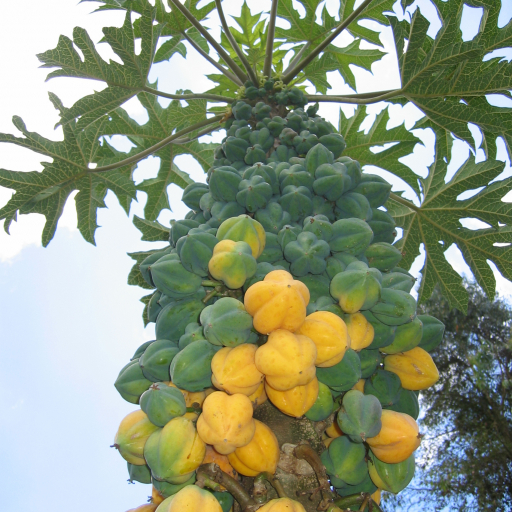
Plant Overview
Hailing from the misty slopes of the Andes Mountains, the Mountain Papaya (often called Papayuela) is the rugged, high-altitude cousin of the common tropical papaya. Unlike its heat-loving relative, this plant thrives in cooler, temperate climates where traditional papayas would shiver. It is cherished across South America not just for its fruit, but for its lush, umbrella-like canopy that adds an instant "cloud forest" aesthetic to any landscape.
🔍 How to Identify
- 🍃 The Foliage: Large, deeply lobed leaves that can grow up to 2 feet wide. The undersides are covered in fine, velvety hairs (hence the name pubescens).
- ⭐ The Fruit: Smaller than common papayas, these fruits are distinctly pentagonal (five-angled) and turn a brilliant golden-yellow when ripe.
- 🌳 The Trunk: A small, soft-wooded tree that displays prominent leaf scars, looking somewhat like a tropical totem pole.
🏡 In Your Garden
- ❄️ Cooler Temperaments: While most papayas crave sweltering heat, the Mountain Papaya prefers "eternal spring" conditions. It can even survive light, brief frosts once established, making it a favorite for Mediterranean climates.
- 💧 The Drainage Dilemma: This plant is notoriously sensitive to "wet feet." It requires extremely well-draining soil; if the roots sit in stagnant water for even a day, the plant may succumb to root rot.
- 🐝 Pollination Needs: Most varieties are dioecious, meaning you typically need both a male and a female plant to see those iconic yellow fruits.
⚠️ Safety & Toxicity
- 🐾 Pet Safety: The fruit itself is non-toxic, but like many members of its family, the plant contains a milky white latex.
- 🧪 Latex Warning: This latex contains papain, a powerful enzyme. If the stem or unripe fruit is nicked, the sap can cause skin irritation or "dermatitis" in sensitive individuals and pets.
- 🍽️ Edibility: While the fruit is fragrant and edible, it is quite acidic and is almost always eaten cooked in syrups or preserves rather than raw.
✨ Fun Fact
The Mountain Papaya is one of the "parents" of the famous Babaco (Champagne Fruit). Because the Mountain Papaya is so hardy, it was crossed with another species to create a seedless, cold-tolerant hybrid that is now grown commercially as far away as New Zealand!

Detailed Care Instructions
To grow Vasconcellea pubescens, commonly known as the babaco plant, follow these steps:
- Climate: Ensure that your climate is suitable for growing the plant. Babaco plants prefer a subtropical to tropical climate with temperatures between 60-80°F (15-27°C). They can tolerate light frost but are best grown in areas without freezing temperatures.
- Location: Choose a location that provides partial shade, ideally with protection from strong winds. The babaco plant can be grown both in pots and in the ground.
- Soil: Babaco plants prefer well-draining soil with good fertility. Use a mix of regular garden soil and organic compost or well-rotted manure to provide adequate nutrients.
- Planting: If planting in a pot, choose a container with good drainage holes. Dig a hole in the soil, slightly larger than the pot's size, and place the babaco plant at the same soil level as it was in the pot. If planting in the ground, dig a hole twice as wide and deep as the root ball. Fill it with soil and create a small mound around the base of the plant to prevent waterlogging.
- Watering: Babaco plants require regular watering to keep the soil consistently moist but not waterlogged. Water deeply once or twice a week, depending on the climate, and adjust the watering schedule accordingly.
- Fertilizing: Feed the plant with a balanced, slow-release fertilizer or a organic fertilizer rich in potassium and phosphorus. Apply the fertilizer according to the package instructions, typically every 2-3 months.
- Pruning: Babaco plants benefit from regular pruning to maintain shape and remove dead or damaged branches. Prune after harvesting the fruits or during early spring to stimulate new growth.
- Protecting from cold: If the temperature drops below freezing, protect the babaco plant by covering it with frost cloth or bringing it indoors if grown in a pot.
- Harvesting: Babaco fruits are ready to harvest when they turn yellow and slightly soften. Gently twist or cut the fruit from the plant, ensuring the stem is intact. Harvesting can take place around 10-12 months after planting, depending on growing conditions.
By following these guidelines, you should be able to successfully grow Vasconcellea pubescens, or babaco, in your garden or on your property.
The Vasconcellea Pubescens plant should be watered moderately, allowing the soil to dry slightly between watering. Over-watering can lead to root rot, while under-watering can cause the plant to wilt and dry out. It is important to use well-draining soil to prevent the roots from sitting in water. When watering, pour water evenly around the base of the plant to ensure that the root system receives adequate moisture. It is recommended to water early in the morning or late in the evening to avoid evaporation due to the heat of the day. Additionally, it is important to avoid getting water on the leaves of the plant, as this can lead to fungal infections.
To fertilize Vasconcellea Pubescens plant, mix a balanced fertilizer with equal parts of nitrogen, phosphorus, and potassium and apply it every three months. Water thoroughly after fertilizing to distribute the nutrients. Additionally, you can mix compost into the soil to improve overall plant health. Be sure not to over-fertilize, as this can cause nutrient burn and harm the plant.
The Vasconcellea Pubescens plant prefers well-draining soils that are rich in organic matter. The soil should be slightly acidic, with a pH range between 6.0 and 6.5. It is important to avoid heavy, water-logged soils as this can lead to root rot. Sandy loam to loamy soils with good drainage are ideal. When planting, it is recommended to mix the soil with compost or organic matter to improve soil fertility and structure. Additionally, adding some perlite or coarse sand to the soil will help improve drainage and prevent water-logging. Overall, the ideal soil for the Vasconcellea Pubescens plant should be well-draining, slightly acidic, rich in organic matter, and loose in texture.
To propagate this plant, you will need to take a cutting from a healthy and mature plant. Choose a stem that is at least 6 inches long and has a few leaves. Make a clean cut just below a leaf node using a sharp, clean pair of scissors or pruning shears.
Remove the leaves from the bottom half of the stem, leaving only the top leaves intact. This will help the stem focus its energy on growing new roots rather than maintaining foliage.
Prepare a pot with well-draining soil. You can use a commercial potting mix or make your own by mixing equal parts of perlite, vermiculite, and peat moss. Water the soil well and make a small hole in the center.
Dip the cut end of the stem into rooting hormone powder to encourage the growth of roots. Gently shake off any excess powder.
Insert the stem cutting into the hole you made in the soil and press the soil gently around it. Water the soil again to settle it around the stem.
Cover the pot with a clear plastic bag to create a mini greenhouse. This will help to retain moisture and create a humid environment, which is ideal for rooting.
Place the pot in a warm, bright location, but out of direct sunlight. Check the soil moisture regularly and water as needed to keep it moist but not waterlogged.
After a few weeks, the stem should start to produce roots. You can gently tug on the stem to check for resistance, indicating that it has rooted. Once the roots are established, you can remove the plastic bag and gradually acclimate the plant to normal growing conditions.








