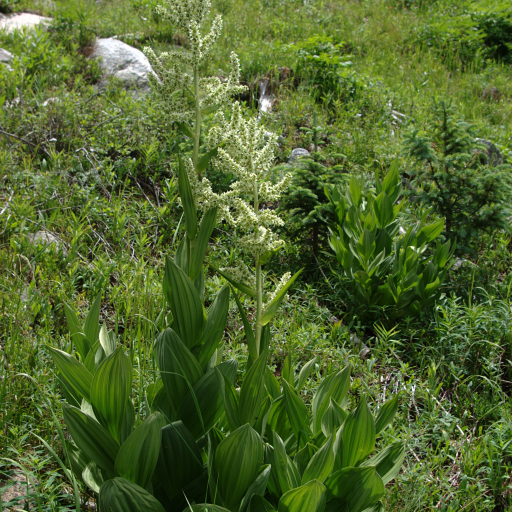
Plant Overview
Known commonly as the California Corn Lily or False Hellebore, this striking perennial is a master of disguise in the mountain meadows of the Western United States. Despite its name, it is neither a lily nor corn, but a member of the Melanthiaceae family. It towers over alpine wildflowers with a prehistoric elegance, often seen growing in massive, lush colonies near melting snowbanks.
🔍 How to Identify
- 🍃 The Foliage: The most striking feature is the large, bright green leaves that are deeply pleated, looking much like an accordion or a head of Veratrum "corn."
- 📐 Growth Habit: It grows remarkably tall, often reaching 3 to 7 feet, with a stout, unbranched stem that gives it a rugged, structural appearance.
- 🌸 The Bloom: In mid-to-late summer, it produces a massive, branching plume (panicle) of hundreds of tiny, star-shaped, creamy-white flowers with greenish centers.
🏡 In Your Garden & Nature
- ⛰️ Natural Habitat: You will rarely find this in a traditional backyard. It craves the "feet-wet, head-dry" conditions of subalpine meadows, seeps, and stream banks where the soil remains consistently moist.
- 🌱 Colonial Growth: It spreads via thick underground rhizomes. If you see one Corn Lily, you are likely looking at a massive underground network that has occupied that patch of earth for decades.
- 🧊 Cold Necessity: This plant is a true mountain dweller; it requires a significant winter dormancy period under snow to thrive and bloom.
⚠️ Safety & Toxicity
- 🚫 Status: EXTREMELY TOXIC. Every part of this plant—especially the roots—contains potent alkaloids that can be fatal if ingested.
- 🐾 Details: It is a major concern for livestock owners. If consumed by pregnant sheep or cows, it causes severe "cyclopian" birth defects (offspring born with a single eye). It is equally dangerous to humans and pets; never mistake the young shoots for wild ramps or asparagus.
✨ Fun Fact
👁️ The Cyclops Connection: The toxins in this plant led to a breakthrough in modern medicine. After scientists studied why lambs were being born with one eye after their mothers ate this plant, they discovered a compound called cyclopamine. This discovery revolutionized our understanding of stem cells and led to the development of new treatments for certain types of skin and brain cancer!

Detailed Care Instructions
| Humidity | Normal |
| Difficulty | Medium |
| Hibernation | Cold Period |
| Hardiness Zones | 8 - 10 |
growing Veratrum californicum, also known as California cornflower or California false hellebore, is relatively easy if you follow the right steps. Here is a guide on how you can grow this plant:
- Choose a suitable location: Veratrum californicum prefers partial shade to full sun and typically grows in moist, cool areas like woodlands or along streams. Make sure you choose a location with well-draining soil that regularly receives filtered sunlight.
- Prepare the soil: Prepare the soil by loosening it with a garden fork or tiller. Remove any weeds or rocks that may hinder the plant's growth. Enhance the soil's fertility by adding aged compost or well-decomposed manure, as Veratrum californicum prefers nutrient-rich soil.
- Sow the seeds: Before planting the seeds, it is recommended to stratify them. To do this, mix the seeds with moist sand or vermiculite and place the mixture in a plastic bag. Keep it in the refrigerator for about 60-90 days. After stratification, sow the seeds at a depth of approximately 1 inch (2.5 cm) in the prepared soil, spacing them around 2-3 feet (60-90 cm) apart.
- Watering: Keep the soil consistently moist throughout the growing season but avoid waterlogging. Overwatering can lead to root rot, so it's essential to maintain an appropriate balance.
- Mulch: Apply a layer of organic mulch around the base of the plants to help retain moisture and regulate soil temperature. This will also deter weed growth, preventing competition for resources.
- Maintenance: Veratrum californicum plants generally have low maintenance requirements. However, it is essential to keep an eye out for pests like slugs and snails, which can feed on the leaves. Applying organic slug control methods or setting up barriers can help protect the plants.
- Propagation: Apart from sowing seeds, Veratrum californicum can also be propagated through division. Once the plants are mature enough, usually after three to four years, you can carefully divide the rhizomes and replant them in the desired location.
- Harvesting: While Veratrum californicum can be grown for ornamental purposes, parts of the plant have historically been used for medicinal purposes. However, it's crucial to note that the plant is poisonous and only experienced individuals should handle it. Harvesting should only be done by professionals who are aware of the risks and proper usage of the plant.
Remember to always purchase Veratrum californicum seeds or divisions from reputable sources to ensure quality and avoid harvesting the plant from the wild, as it may be protected or endangered in some areas.

Place in a bright room that is sun drenched almost all day. Or directly in a south-facing window.

Veratrum Californicum is a perennial plant that requires proper watering to thrive. To water this plant, ensure that the soil is moist but not waterlogged. Water the plant deeply once a week during the growing season but reduce watering during the winter months. To avoid overwatering, make sure that the soil is well-draining and consider using a pot with drainage holes. Avoid watering the leaves or flowers, but instead, water the soil directly around the roots of the plant. Additionally, if the plant is growing in a pot, make sure to remove the excess water from the drainage tray after watering. By following these guidelines, you can provide the necessary level of moisture to help your Veratrum Californicum plant grow and flourish.
For best results, fertilize your plant in the spring before the growing season begins. Use a balanced fertilizer with a higher nitrogen content than phosphorus and potassium. Apply the fertilizer according to the package instructions, taking care not to over-fertilize. Water the plant thoroughly after fertilizing to help the nutrients reach the roots. Do not fertilize after the plant has started to flower or during the summer dormant period.
The ideal soil for this plant is an acidic to neutral loamy soil with good drainage and moisture retaining abilities. The soil should be rich in organic matter and nutrients. It should not be compacted or heavy and should have a slightly sandy texture. Additionally, this plant prefers soils with high levels of organic matter and humus. Prior to planting, the soil should be thoroughly prepared by removing any weeds, rocks or debris and mixing in compost or other organic matter. Additionally, the soil should be tested for pH levels and amended accordingly to ensure optimal conditions for growth.
To propagate this plant, you can start by collecting its seeds which are produced in the fall. You will need to remove the seeds from the pods and store them in a cool, dry place until you are ready to sow them in the spring.
In the spring, you can sow the seeds directly in the soil. The seeds should be sown at a depth of about ½ inch and spaced about 6 inches apart. Make sure to water the seeds regularly and keep them moist until they germinate.
You can also propagate this plant by dividing its rhizomes. You should do this in the fall or early spring, before the plant starts to produce new growth. To divide the rhizomes, you will need to carefully dig up the plant and separate the rhizomes into sections using a sharp knife. Each section should have at least one growing point. These sections can then be planted in new locations in the garden.
It is important to note that this plant is toxic and should not be consumed by humans or animals. Gloves should be worn when handling the plant to prevent skin contact.








