Plant Overview
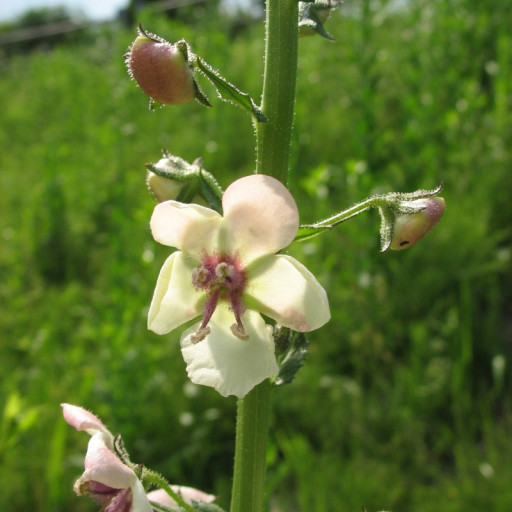
Often called the Moth Mullein, this elegant biennial is a wanderer from Eurasia that has charmed its way across North America. It gets its name from the delicate, fuzzy hairs at the center of its flowers, which look remarkably like the feathery antennae of a moth. While it is often found dancing along roadsides or in wild meadows, its tall, starry flower spikes make it a sophisticated addition to a "wildlife-style" cottage garden.
🔍 How to Identify
- 🌸 Star-Shaped Flowers: Features five-petaled blooms that are usually a buttery yellow or creamy white, often with a subtle purple tint on the underside.
- 🦋 Fuzzy Filaments: The most striking feature is the cluster of bright purple, woolly hairs in the center of the bloom, mimicking a moth’s fuzzy body.
- 🍃 Glossy Rosette: In its first year, it stays low as a rosette of dark green, crinkled leaves. In the second year, it shoots up a slender, smooth stem that can reach up to four feet tall.
🏡 In Your Garden
- 🌱 The Two-Year Cycle: Because it is a biennial, this plant spends its first year building a deep taproot and its second year flowering. If you want flowers every year, you'll need to allow it to self-seed or plant new starts two years in a row.
- ☀️ Pioneer Spirit: It thrives in "disturbed" or poor soil where more delicate flowers might fail. Because of that long taproot, it is exceptionally drought-tolerant but very difficult to transplant once it has settled in.
⚠️ Safety & Toxicity
- ✅ Generally Safe: Moth Mullein is not known to be toxic to humans, cats, or dogs, making it a safe choice for family gardens.
- 🧤 Mild Irritation: Some people find that the tiny hairs on the leaves or the sap can cause very minor skin redness. It is always a good idea to wear gloves if you are pulling or pruning a large patch.
✨ Fun Fact
The Century Sleeper: In one of the world's longest-running scientific experiments (started by William James Beal in 1879), Verbascum blattaria seeds were buried in bottles to test their longevity. Astonishingly, the seeds were still able to sprout after being buried for over 120 years!

Detailed Care Instructions
To grow Verbascum blattaria, also known as moth mullein, follow these steps:
- Choose a suitable planting location: Verbascum blattaria thrives in full sun and well-draining soil. It can tolerate various soil types, including sandy or rocky soil, but it prefers slightly alkaline or neutral soil.
- Prepare the soil: Before planting, remove any weeds or stones from the soil. Break up the soil to improve drainage and add organic matter such as compost or well-rotted manure to enrich it.
- Start seeds indoors (optional): You can start Verbascum blattaria indoors about 8 to 10 weeks before the last frost date. Plant seeds in seed trays or pots, and keep them in a warm and well-lit area. Keep the soil moist but not waterlogged. Transplant the seedlings outdoors once all danger of frost has passed.
- Direct sow seeds: Verbascum blattaria can also be sown directly outdoors in the garden in early spring or autumn. Scrape the soil surface lightly with a rake and sprinkle the seeds. Lightly press them into the soil but do not cover them, as they need light to germinate. Water gently to settle the seeds.
- Maintain moisture: Keep the soil consistently moist until the seeds germinate and seedlings are established. After that, Verbascum blattaria is somewhat drought-tolerant and does not require frequent watering. Water deeply but infrequently to encourage deep root growth.
- Provide support: As Verbascum blattaria grows, it may benefit from support to prevent the tall flower spikes from toppling over. Stake or cage the plants when they reach a height of around 1-2 feet.
- Mulch: Apply a layer of organic mulch, such as straw or wood chips, around the base of the plants. Mulching helps retain moisture, suppress weeds, and regulate soil temperature.
- Pruning: Deadhead spent flowers to encourage continuous blooming. In addition, cutting back the flower spikes after blooming can promote a second flush of flowers.
- Protect from pests and diseases: Verbascum blattaria is generally resistant to pests and diseases, but some gardeners may encounter issues with aphids or snails. Monitor the plants regularly and take appropriate measures if needed, such as using organic insecticides or physical barriers.
- Harvest seeds (optional): After the flowers fade, seed pods form. Allow the pods to fully ripen and dry on the plant before harvesting. Collect the seeds and store them in a cool and dry place for future sowing or sharing with others.
By following these steps, you can successfully grow Verbascum blattaria plants and enjoy their beautiful, moth-like flowers in your garden.

Place in a bright room that is sun drenched almost all day. Or directly in a south-facing window.

To water this particular plant, it is important to consider the environment in which it is grown. The plant prefers well-draining soil, so be careful not to over-water and drown the roots. It is also important to avoid overhead watering, as this can lead to the plant contracting fungal diseases. Instead, water at the base of the plant, allowing the water to soak into the soil. The plant should be watered at regular intervals, but the frequency of watering will depend on factors such as the humidity levels and temperature in its growing area. It is also important to monitor the soil moisture levels, and adjust watering accordingly. Lastly, it may be beneficial to mulch around the base of the plant to help retain moisture in the soil.
To fertilize this plant, use a balanced fertilizer with equal amounts of nitrogen, phosphorus, and potassium. Apply the fertilizer during the growing season, either in the spring or early summer. Follow the manufacturer's instructions regarding the amount of fertilizer to use. Water the plant thoroughly after fertilizing to help the nutrients penetrate the soil. Avoid over-fertilizing, as this can lead to excess growth or damage to the plant.
It is ideal to use well-draining soil with good aeration for this plant. The pH level of the soil should be slightly acidic to neutral. The soil should be rich in organic matter and should have a good water holding capacity. It is recommended to avoid heavy clay soil that retains too much moisture as this can cause root rot. Additionally, it is important to ensure that the soil is not too compacted, as this can inhibit root growth and cause stress to the plant. Ideally, the soil should be slightly loose and friable, allowing the roots to expand and uptake nutrients effectively.
One method to propagate this plant is through seed germination. Collect ripe seeds from the mature plant during the autumn season. Dry the seeds and store them in a cool, dry place until the spring season. Sow the seeds in well-draining soil in a sunny location. Water the soil regularly to ensure adequate moisture. Thin out the seedlings as they grow to allow proper spacing for optimal growth.
Another method of propagation is through stem cuttings. Take a stem cutting from a healthy, mature plant during the early summer season. The cutting should be about 4-6 inches long with a few leaves attached. Remove the lower leaves from the cutting and dip the cut end into rooting hormone. Place the cutting into well-draining soil and water it thoroughly. Keep the soil moist until the cutting establishes roots and new growth appears.
Finally, this plant can be propagated through division. Dig up the mature plant during the autumn season and separate the roots into smaller sections. Each section should have a few stems and roots attached. Plant each section in a well-draining soil in a sunny location. Water the soil thoroughly and keep it consistently moist until the plant establishes new growth.








