Plant Overview
Known as the "Velvet Giant" of the Balkans, Verbascum longifolium is a dramatic architectural wonder that commands attention in any landscape. Its massive, silvery-grey leaves feel like soft felt, earning it the reputation of "nature’s flannel" among hikers and gardeners alike. During its second year of growth, it transforms from a humble ground-hugging rosette into a towering golden spire that serves as a luminous lighthouse for local pollinators.
🔍 How to Identify
- ☁️ Foliage: The leaves are exceptionally long (hence the name longifolium), covered in a thick, woolly layer of silver-white hairs that give the plant a ghostly, frosted appearance.
- ⚱️ Growth Habit: It typically grows as a basal rosette in its first year, staying close to the ground, before shooting up a flower spike that can reach heights of 4 to 6 feet in its second year.
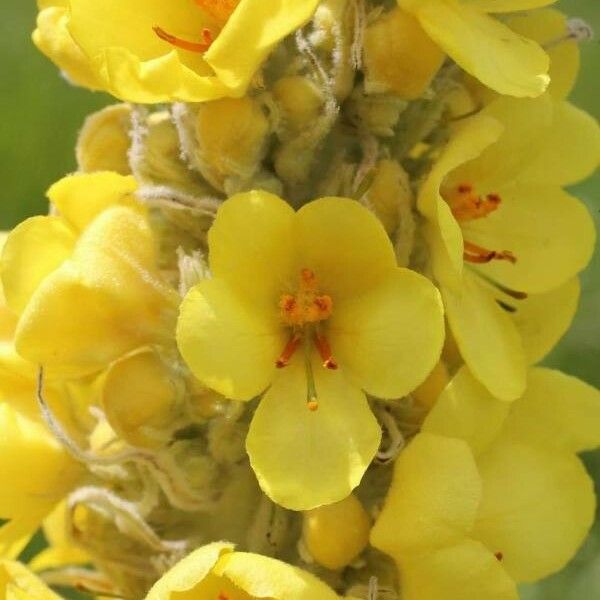
- 🌻 Flowers: The inflorescence is a dense, unbranched (or minimally branched) spike crowded with bright sulfur-yellow blossoms, each featuring orange-hairy stamens at the center.
🏡 In Your Garden
- ☀️ Sun & Drainage: This plant is a sun-worshiper that thrives in "neglected" spots. It has a deep taproot that hates being moved, so choose its home carefully—ideally in poor, rocky, or sandy soil where water never sits.
- 🦋 Pollinator Magnet: While humans love it for its height, bees and hoverflies view it as a high-rise buffet. It is a biennial, meaning it will die after flowering, so allow the seeds to drop naturally if you want a permanent colony in your garden.
⚠️ Safety & Toxicity
- 🌿 Status: Non-toxic but physically irritating.
- 👁️ Details: While not poisonous to pets or children, the fine, velvety hairs covering the leaves can act as a mechanical irritant. They may cause mild skin itching or eye irritation if handled roughly, so it is best to wear gloves during pruning.
✨ Fun Fact
In ancient times, the dried stalks of large Mullein species were dipped in suet or tallow and used as torches. They were often called "Hag’s Tapers" because of the eerie, long-lasting glow they provided during nighttime processions.

Detailed Care Instructions








