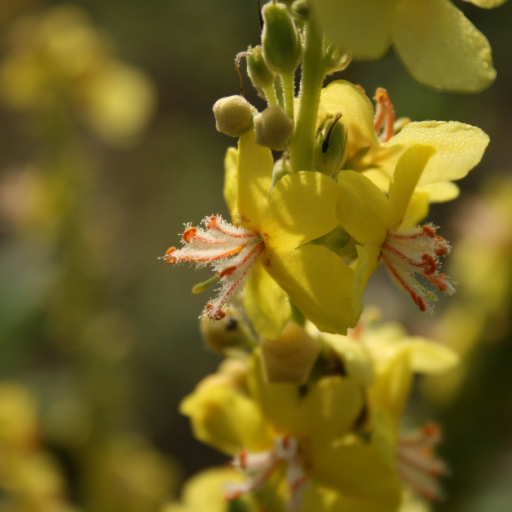
Plant Overview
Often towering like a silver candelabra over the summer garden, Verbascum speciosum, commonly known as the Showy Mullein, is a true architectural marvel. Native to Southeast Europe and Western Asia, this biennial starts its life as a soft, velvety rosette before launching a massive, branched floral display in its second year. It is a favorite for gardeners who want high-impact drama and a touch of "wild" elegance without the need for constant maintenance.
🔍 How to Identify
- 🍃 Foliage: Large, lance-shaped leaves that are densely covered in thick, silvery-grey woolly hairs, giving them a felt-like texture.
- 🌼 Flowers: Bright yellow, five-petaled blossoms that appear in clusters along many-branched terminal spikes (panicles).
- 📏 Stature: A massive vertical presence, often reaching 6 feet (2 meters) in height, with a distinct "candelabra" branching habit compared to the single-spike common mullein.
🏡 In Your Garden
- ☀️ Sun & Soil: This plant is a pioneer species that thrives in full sun and well-draining, even poor or rocky soil; it hates "wet feet" and will rot in heavy clay.
- 🦋 Pollinator Hub: Its golden flowers are a magnet for bees and hoverflies, while the fuzzy leaves provide nesting material for certain types of solitary bees.
- 🌱 Long-term Guest: Because it is a biennial, it dies after flowering, but it produces thousands of seeds that can remain dormant in the soil for decades, waiting for the right moment to sprout.
⚠️ Safety & Toxicity
- 🧴 Skin Irritation: While not toxic, the tiny "woolly" hairs on the leaves can cause mechanical skin irritation or a mild rash for those with sensitive skin.
- 🐟 Aquatic Warning: The seeds contain saponins, which were historically used to stun fish; keep this plant away from the edges of koi ponds or sensitive waterways.
- 🐾 Pet Safety: It is generally considered non-toxic to dogs and cats, but ingesting large amounts of the rough foliage may cause mild stomach upset.
✨ Fun Fact
In historical folklore, the dried, tall stalks of Mullein were often dipped in fat or wax and used as torches, leading to one of its oldest nicknames: "Hag's Taper."

Detailed Care Instructions
To grow Verbascum speciosum, also known as Showy Mullein, you can follow these steps:
- Choose the right location: Verbascum speciosum prefers to grow in full sun to partial shade. Make sure the chosen spot receives at least six hours of direct sunlight daily.
- Soil preparation: The plant prefers well-draining soil that is slightly acidic to slightly alkaline. Amend the soil with organic matter, such as compost, to improve its fertility and drainage.
- Sowing seeds: You can either start the plant from seeds or purchase young plants from a nursery. If starting from seeds, sow them directly into the garden in early spring after the last frost or start them indoors 8-10 weeks before the last frost date. Sow seeds at a depth of 1/8 inch in well-draining soil. Keep the soil evenly moist until seedlings emerge.
- Transplanting: If starting seeds indoors, transplant young seedlings into the garden when they have developed their second or third set of true leaves. Transplant them into well-prepared soil, spacing them about 2-3 feet apart.
- Watering: Verbascum speciosum prefers moderate moisture levels. Water the plant deeply, allowing the soil to dry slightly between waterings. Avoid overwatering, as it may cause root rot.
- Mulching: Applying a layer of organic mulch around the plant helps to conserve moisture, suppress weed growth, and maintain a consistent soil temperature. Mulch with materials such as wood chips or straw, keeping it several inches away from the stem to prevent rot.
- Maintenance: Keep an eye out for pests like aphids or snails, and take appropriate measures to control them. Deadhead spent flowers to encourage further blooming and prevent self-seeding.
- Winter care: Verbascum speciosum is perennial in zones 5-9. In colder regions, apply a layer of mulch around the base of the plant to protect it from freezing temperatures.
By following these steps, you should be able to successfully grow Verbascum speciosum. Remember to research any specific growing requirements for your particular region or climate.

Place in a bright room that is sun drenched almost all day. Or directly in a south-facing window.

To water this plant properly, you should first ensure that the soil in which it is growing is well-draining. This is important because the plant can be prone to root rot if the soil stays waterlogged for too long. Once you have confirmed that the soil is well-draining, you should water the plant deeply but infrequently. This means that you should water it thoroughly enough that the water reaches the roots, but you should not water it too often. In general, you should aim to water this plant once a week, but you may need to adjust the frequency depending on the weather and the specific growing conditions. Additionally, it is important to avoid getting water on the leaves of the plant, as this can lead to fungal infections and other issues. Instead, water the plant at the base and try to avoid getting water on the foliage. Overall, proper watering is essential for helping this plant thrive and grow to its full potential.
To fertilize this plant, first ensure that the soil is moist. Then, choose a balanced fertilizer with equal amounts of nitrogen, phosphorus, and potassium. Follow the instructions on the fertilizer package for the correct amount to use. Apply the fertilizer evenly over the soil around the plant, being careful not to get any on the leaves or stem. Water the plant lightly after applying the fertilizer to help it absorb the nutrients. Repeat this process every four to six weeks during the growing season.
Verbascum Speciosum plant prefers well-draining soil that is slightly acidic with a pH of around 6.0 to 7.0. The soil should be rich in organic matter and nutrients, as the plant requires a lot of nutrients to grow well. A mixture of sand, loamy soil, and organic matter is ideal for this plant. The soil should be moist, but not waterlogged, as standing water can cause root rot. The plant prefers full sun to partial shade and can tolerate drought conditions. Regular watering is required during the growing season to keep the plant healthy and thriving.
Verbascum Speciosum is a plant that can be propagated in several ways. One method is to collect the seeds from the plant in the fall. Once the seeds have ripened, they can be carefully collected and stored in a cool, dry place until the spring.
Another way to propagate Verbascum Speciosum is by root division. This process involves digging up the parent plant and dividing its roots into smaller sections. Each section can then be replanted to grow into a new individual.
Finally, Verbascum Speciosum can also be propagated through stem cuttings. To do this, take a stem cutting from the parent plant and remove the lower leaves. Dip the cut end of the stem in rooting hormone and place it in moist soil or potting mix. Keep the cutting in a warm, moist area until it takes root and starts to grow.








