Plant Overview
Often called "Great Mullein," "Velvet Plant," or "Quaker’s Bonnet," the Verbascum is a statuesque biennial that looks like it stepped straight out of a medieval herbalist’s garden. Known for its incredibly soft, silver-green leaves that feel like thick flannel, it has been used for centuries for everything from warding off evil spirits to lighting the pathways of Ancient Rome.
🔍 How to Identify
- 🍃 Felted Foliage: The leaves are large, ovate, and covered in a dense layer of silver-white hairs, giving them a distinct "velvet" or "wool" texture that is unmistakable to the touch.
- 🏰 Towering Spire: In its second year, the plant sends up a dramatic, unbranched flower spike that can reach heights of 6 to 8 feet, standing like a fuzzy sentinel in the landscape.
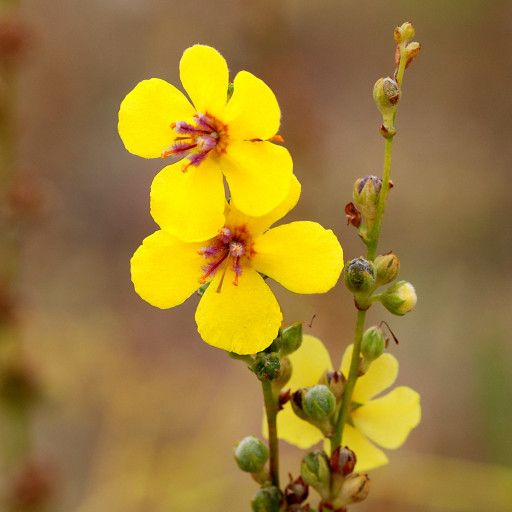
- 🌼 Sunny Blooms: Small, five-petaled yellow flowers cluster tightly along the top of the stalk, blooming in a slow, upward progression throughout the summer.
🏡 In Your Garden
- 🏜️ Pioneer Spirit: This plant is a specialist in "bad" environments. It thrives in poor, rocky, or disturbed soil where other plants struggle, making it a hero for xeriscaping or gravel gardens.
- ⏳ The Long Game: As a biennial, it spends its first year as a low-growing rosette of fuzzy leaves. Be patient; the spectacular flower spike only appears in its second and final year of life.
- ⚓ Deep Taproot: It develops a long, sturdy taproot very quickly to find water deep underground. Because of this, it hates being transplanted—once you've tucked it into the soil, try not to move it.
⚠️ Safety & Toxicity
- 🧤 Mild Irritant: While not chemically poisonous to humans, the tiny, hooked hairs on the leaves can cause "mechanical irritation." This can result in itchy skin or a scratchy throat if the leaves are handled or ingested by curious pets.
- 🐟 Seed Warning: The seeds contain small amounts of saponins and rotenone. Historically, these were used to stun fish in still water, so avoid planting them directly overhanging a koi pond or aquarium.
✨ Fun Fact
Ancient Romans nicknamed this plant "Hag’s Taper." They would harvest the dried, woody flower stalks, dip them in tallow (animal fat), and light them to use as long-burning torches for outdoor processions and funerals.

Detailed Care Instructions
To grow Verbascum plant, follow these steps:
- Start with the right soil: Verbascum plants prefer well-draining soil that is slightly acidic to neutral. Amend heavy clay or sandy soil with organic matter like compost to improve drainage and provide nutrients.
- Choose a suitable location: Verbascum plants thrive in full sun, so select a spot in your garden that receives at least 6-8 hours of direct sunlight daily. Ensure the area has good air circulation to prevent diseases.
- Sow seeds or purchase seedlings: Verbascum plants can be started indoors from seeds or purchased as young seedlings from a nursery. Sow seeds in early spring or late fall, barely covering them with soil. Transplant seedlings outdoors after the last frost date in your area.
- Water appropriately: Initially, water Verbascum plants regularly to establish a strong root system. Once established, these plants are quite drought-tolerant. Water deeply but infrequently, allowing the soil to dry out slightly between waterings.
- Mulch around the plants: Apply a layer of organic mulch around the base of the plants to conserve moisture, suppress weeds, and provide insulation to the soil.
- Fertilize sparingly: Verbascum plants typically do not require much fertilization. Apply a balanced slow-release fertilizer in early spring or top-dress the soil with compost for added nutrients.
- Prune for maintenance: Remove spent flower spikes to encourage continuous blooming and prevent self-seeding. In fall, trim the plant back to its basal leaves to prepare it for winter dormancy.
- Protect from pests and diseases: Verbascum plants are relatively deer-resistant, but they may attract aphids and slugs. Monitor for pests and treat them accordingly. Ensure good airflow to prevent fungal diseases like powdery mildew by spacing plants adequately.
By following these guidelines, you can successfully grow Verbascum plants in your garden.

Place in a bright room that is sun drenched almost all day. Or directly in a south-facing window.

To water this plant, make sure to allow the soil to dry slightly in between watering sessions. When watering, make sure to thoroughly soak the soil, ensuring that the water reaches the roots of the plant. Avoid getting the foliage wet, as this can lead to disease or damage to the plant. If the plant is in a container, make sure to pour water slowly and evenly to prevent water from running out the bottom too quickly. When watering, avoid using cold water, as this can shock the plant. Instead, use room temperature water. In general, this plant prefers well-drained soil and does not tolerate waterlogged conditions well, so make sure to avoid overwatering.
To fertilize this plant, use a balanced 10-10-10 fertilizer once a month during its growing season. Apply the fertilizer to the soil around the base of the plant and water it in thoroughly. Be careful not to get any fertilizer on the leaves or stem, as this could burn the plant. Additionally, make sure the plant is well-watered before and after fertilizing to avoid root damage.
Verbascum plants thrive in well-draining soil that is loose and rich in nutrients. The soil should have a pH level between 6.0 and 7.5. A mix of sandy loam and compost is ideal for Verbascum plants. Adding organic matter such as peat moss, aged manure or compost can improve the soil texture and fertility. It is important to ensure that the soil is not too compacted, as Verbascum plants need good soil aeration for healthy root growth. Overly wet soil can cause root rot, so ensure the soil is well-draining. Verbascum plants prefer full sun but can also tolerate some shade.
This plant can be propagated through seed or vegetative methods. To propagate through seed, collect the matured seed pods on the plant when they have turned brown and begin to split open. Remove the seeds and sow them directly into the soil or in seed-starting trays. Place the trays or pots in a sunny location and keep the soil moist. Seedlings should emerge in 2-4 weeks.
To propagate vegetatively, use softwood stem cuttings in the summer when the plant is actively growing. Cut a 3-4 inch section of new growth just below a node. Remove the leaves from the lower half of the stem and dip the cut end in rooting hormone. Plant the cutting in a well-draining potting mix and place it in a shaded location until roots develop. Once the plant has rooted, it can be transplanted into a larger pot or outside in the garden.







