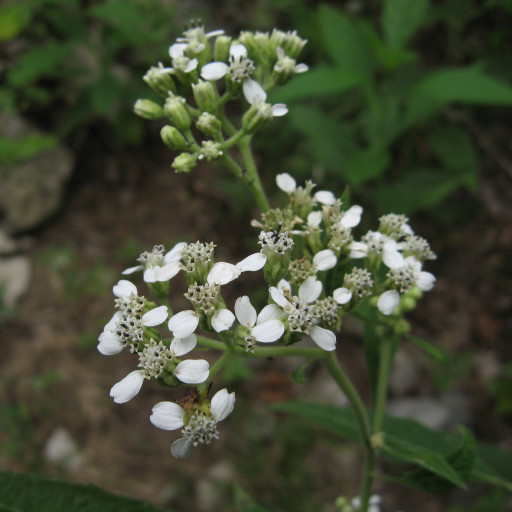
Plant Overview
Often called "Frostweed" or "White Crownbeard," this statuesque native plant is a late-season hero for pollinators. It earns its chilling nickname from a magical winter phenomenon where ice crystals erupt from its stem during the first hard freeze. Found across the eastern and central United States, it adds a wild, structural elegance to woodland edges and shaded gardens.
🔍 How to Identify
- 🌼 Flowering Heads: Dense, white, flat-topped clusters appear in late summer and autumn, providing a critical nectar source for migrating Monarch butterflies.
- 🦋 Winged Stems: Look closely at the central stalk; it features distinctive leafy "wings" or fleshy ridges running vertically along its length.
- 🍃 Leaf Structure: The dark green leaves are broad, serrated, and rough to the touch, often reaching up to 6 inches in length and alternating along the stem.
🏡 In Your Garden
- 🌳 Woodland Preference: Unlike many heavy bloomers, Frostweed thrives in the dappled light of the forest edge or under large canopy trees, making it a perfect solution for those tricky, shady garden corners.
- 🌱 Natural Spreader: It has a vigorous taproot and can spread via rhizomes to form lush colonies; it’s best used in "wilder" areas of the landscape where it has room to roam and stabilize the soil.
⚠️ Safety & Toxicity
- ✅ Low Toxicity: Verbesina virginica is generally considered non-toxic to humans, dogs, and cats.
- 🧤 Skin Sensitivity: The leaves and stems are covered in fine hairs that can feel coarse or scratchy. Sensitive individuals may experience mild skin irritation when handling the plant, so gloves are recommended for heavy pruning.
✨ Fun Fact
When the first hard freeze hits, the sap inside the stem expands and bursts through the "wings," freezing instantly into delicate, ribbon-like "ice flowers." These translucent curls look like white cotton candy or sea shells clinging to the base of the plant!

Detailed Care Instructions
To successfully grow Verbesina Virginica, also known as white crownbeard or frostweed, follow these steps:
- Choose the right location: Select a spot in your garden that receives full sun to partial shade. The plant can tolerate a wide range of soil types but prefers moist, well-draining soil.
- Prepare the soil: Before planting, loosen the soil and remove any weeds or grass. Add compost or organic matter to improve drainage and nutrient content.
- Planting: Dig a hole that is slightly larger than the rootball of the Verbesina Virginica plant. Place the plant in the hole, ensuring that the top of the rootball is level with or slightly above the soil surface. Backfill the hole and gently firm the soil around the plant to secure it.
- Watering: Water the newly planted Verbesina Virginica thoroughly to settle the soil around the roots. Afterward, water regularly to keep the soil consistently moist but not waterlogged. During dry periods, provide deep, infrequent waterings to encourage deep root growth.
- Mulching: Apply a layer of organic mulch, such as bark chips or straw, around the base of the plant to help retain moisture and suppress weeds. Keep the mulch a few inches away from the stem to avoid excessive moisture on the plant.
- Fertilizing: Verbesina Virginica typically doesn't require heavy fertilization, especially if the soil is already nutrient-rich. However, you can apply a balanced, slow-release fertilizer in the spring to promote healthy growth.
- Maintenance: Regularly check for any pest or disease issues. Remove any damaged or dead foliage to maintain a tidy appearance and prevent the spread of diseases. Monitor the moisture levels in the soil and adjust watering accordingly.
- Propagation: Verbesina Virginica can be propagated through seeds, cuttings, or division. Collect seeds in the fall and plant them in pots or seed trays filled with well-draining soil. For cuttings, take stem cuttings in spring or early summer and root them in a mixture of perlite and peat moss. Division can be done in early spring when the plant is still dormant.
- Winter care: Verbesina Virginica is hardy in USDA zones 6-9 and should tolerate cold temperatures. However, it can benefit from a layer of mulch over the root zone for added protection during extremely cold winters.
By following these steps, you should be able to successfully grow Verbesina Virginica and enjoy its showy white flowers and attractive foliage.

Place in a window with dappled sun or a spot in the middle of a room. Or directly in a window facing west or east.

To water this plant, you should check the soil moisture level by gently touching the top layer with your finger. If it feels dry, water the plant deeply until the water seeps out of the bottom of the pot or the soil feels moist to the touch. Avoid overwatering, as this plant prefers well-draining soil with some dry periods between waterings. It is best to water in the morning or early evening to prevent evaporation. Additionally, avoid getting water on the leaves to prevent fungal growth.
The plant should be fertilized with a balanced, slow-release fertilizer in the early spring before new growth appears. Use a granular or water-soluble fertilizer with equal amounts of nitrogen, phosphorus, and potassium. Apply the fertilizer at a rate of 1/4 to 1/2 pound per 100 square feet of planting bed. Water the plant deeply after fertilizing to distribute the fertilizer evenly throughout the soil. Repeat the fertilization once or twice during the growing season to encourage healthy growth and robust blooms.
The ideal soil for the Verbesina Virginica plant is a rich, well-draining soil that is slightly acidic in nature. It should be free from any rocks or other debris that may impede root growth. Additionally, it is important that the soil is kept moist but not waterlogged, as the plant is susceptible to root rot. Organic matter such as compost or peat moss can be worked into the soil prior to planting to improve soil quality. Fertilizing the plant regularly with a balanced fertilizer can also help to ensure healthy growth.
To propagate this plant, you can collect its seeds after the flowers have finished blooming. Wait until the seeds have fully developed and turned a brownish-black color. Then, collect them and allow them to dry fully.
Next, prepare a pot with a well-draining soil mixture and plant the seeds about ¼ inch deep. Water the soil regularly to keep it moist, but avoid soaking it.
The seeds should germinate in about 2-3 weeks. Once the seedlings have grown to be about 2 inches tall, you can transplant them into their own pots or into a larger garden bed.
If you prefer to propagate the plant through cuttings, take a stem cutting from a healthy plant and trim away any leaves from the lower part of the stem. Dip the cut end in rooting hormone and plant it in moist potting soil. Keep the soil moist and warm, and roots should develop within a few weeks.








