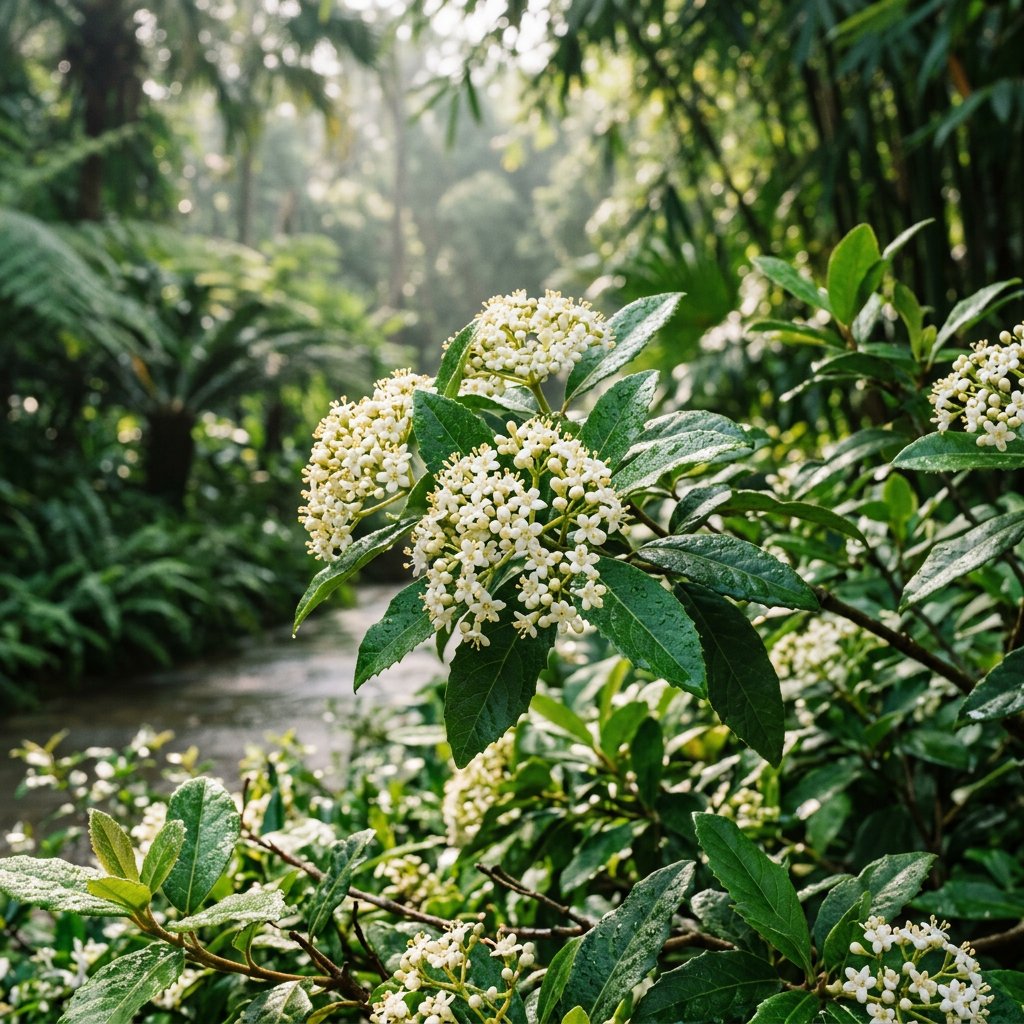
Plant Overview
Meet the "Sweet Viburnum," a landscape superstar known for its intoxicating spring perfume and lush, evergreen presence. Often nicknamed the "Living Fence," this vigorous shrub is a favorite for homeowners who want to trade their wooden pickets for a wall of shiny, emerald leaves. It’s a plant that appeals to both the eyes and the nose, turning any backyard into a private, scented sanctuary.
🔍 How to Identify
- 🍃 Glossy Foliage: The leaves are large, leathery, and oval-shaped with a high-shine finish that looks almost polished. They grow in an "opposite" pattern, meaning they emerge in pairs directly across from one another on the stem.
- 🌸 Fragrant Clusters: In late spring, the plant is covered in small, creamy-white flowers grouped in conical clusters (panicles). Their scent is heavy, sweet, and can often be smelled from across the garden.
- 🍒 Changing Berries: After the flowers fade, tiny berries appear. They transition through a beautiful color palette, starting green, turning a bright "lipstick" red, and finally maturing to a deep blue-black.
🏡 In Your Garden
- 🧱 Privacy Specialist: Due to its incredibly fast growth rate and dense branching, this is the ultimate choice for a natural privacy screen. It can easily reach 15 to 20 feet if left unpruned, effectively blocking out noise and neighbors.
- ✂️ The Pruning Trade-off: While it handles heavy shearing very well, pruning it into a tight, formal box-shape often removes the flower buds. If you want those fragrant blooms, it's best to prune it right after it finishes flowering in the spring.
- ☀️ Sun Seeker: It is quite versatile but performs best in full sun. In deep shade, the growth becomes "leggy" or thin, and it may lose that signature dense, hedge-like quality.
⚠️ Safety & Toxicity
- 🐾 Mildly Toxic: The leaves and berries contain polyphenols and saponins. If ingested by dogs, cats, or horses, it can cause mild gastrointestinal distress, including drooling or vomiting.
- 👶 Child Safety: While the berries look tempting to children, they are generally considered unpalatable and mildly toxic. It is best to admire them visually rather than as a snack.
✨ Fun Fact
👃 The "Most" Fragrant: The species name odoratissimum is the Latin superlative for "fragrant." It literally translates to "the most fragrant," a bold scientific claim that the plant backs up every time it blooms!

Detailed Care Instructions
| Soil Ph | 5.5 To 6.6, But Also Tolerates Slightly Alkaline Soil |
| Humidity | Normal |
| Lighting | Part Sun |
| Toxicity | Non-Toxic To Humans And Animals |
| Soil Type | Rich, Moist, Well-Drained Soil |
| Difficulty | Medium |
| Plant Type | Deciduous Shrub |
| Mature Size | Up To 20 Feet Tall And 15 Feet Wide |
| Native Area | Temperate Regions Of Northern Hemisphere |
| Sun Exposure | Full Sun To Partial Shade |
| Hardiness Zones | 2-9 |
To successfully grow Viburnum odoratissimum, also known as sweet viburnum or sweet viburnum tree, you can follow these steps:
- Select a suitable location: Viburnum odoratissimum prefers full sun to partial shade, but it can tolerate some shade. Choose a well-drained area with rich soil.
- Prepare the soil: Before planting, amend the soil with organic matter, such as compost or well-rotted manure, to enhance drainage and fertility. Dig a hole that is wider and deeper than the root ball.
- Planting: Place the Viburnum odoratissimum plant in the prepared hole, making sure the top of the root ball is level with or slightly above the soil surface. Backfill the hole with soil, gently firming it around the roots.
- Watering: After planting, give the plant a thorough watering. Water regularly, especially during dry spells, to keep the soil evenly moist but not waterlogged. Established plants are moderately drought-tolerant.
- Fertilizing: Apply a slow-release balanced fertilizer in early spring to promote healthy growth. Follow the manufacturer's instructions for application rates.
- Mulching: Apply a layer of organic mulch around the base of the plant to suppress weeds, conserve moisture, and insulate the roots. Keep the mulch a few inches away from the trunk to prevent rot.
- Pruning: Prune Viburnum odoratissimum in late winter or early spring to remove any dead, damaged, or crossing branches. This will help maintain its shape and promote healthy growth. Light pruning throughout the year can also be done to shape the plant.
- Pests and diseases: Viburnum odoratissimum is generally resistant to pests and diseases. However, keep an eye out for aphids, mealybugs, or scale insects. Promptly treat any infestations with organic pest controls if necessary.
- Cold protection: In colder regions, provide winter protection by wrapping the plant with burlap or covering it with frost blankets during harsh winters. Mulching around the base can also help insulate the roots.
- Propagation: Viburnum odoratissimum can be propagated from seeds, cuttings, or layering. Seeds typically take longer to produce plants, while cuttings or layering methods provide faster results.
Remember that success in growing Viburnum odoratissimum also depends on your specific climate and environmental conditions. Regular care, watering, and monitoring for any specific issues will help ensure the plant's healthy growth.

Place in a bright room that is sun drenched almost all day. Or directly in a south-facing window.

1. Determine the watering schedule: Viburnum Odoratissimum needs regular watering but not too often. Soil should be kept slightly moist, but not waterlogged. The frequency of watering depends on the weather, humidity, and soil type. During hot and dry weather, water more often. In cooler seasons, watering can be reduced.
2. Check the soil moisture: Before watering, check soil moisture with a finger or moisture meter. If the top 2 inches of soil are dry, it’s time to water. If the soil is still moist, wait a day or two before checking again.
3. Water deeply: When watering viburnums, it is necessary to give them a thorough soaking. Watering deeply means that the soil should be saturated down to where the plant roots are located. The amount of water to use will depend on the size and age of the plant, as well as the soil type.
4. Water at the base: When watering viburnum, avoid getting water on the foliage. Water at the base of the plant, or close enough to the base to be absorbed by the root system, using a hose, watering can, or drip irrigation system.
5. Mulch: Applying a layer of mulch around the base of the plant helps to retain moisture and regulate the soil temperature. Keep the mulch level low, about 2-3 inches, to avoid trapping moisture against the bark.
6. However, be careful not to over-water the plant, as it may lead to root rot and other fungal diseases.
- Choose a balanced fertilizer with equal amounts of nitrogen, phosphorus, and potassium.
- Apply the fertilizer in early spring before new growth appears.
- Use a granular fertilizer and sprinkle it around the base of the plant.
- Water the plant thoroughly after fertilizing.
- Repeat fertilization in mid-summer if desired.
- Do not over-fertilize, as this can lead to excessive growth and weak stems.
- Follow the manufacturer's instructions for application rates on the fertilizer bag.
Viburnum Odoratissimum plant prefers a well-draining soil that is fertile and rich in organic matter. It can grow in slightly acidic to neutral soil with a pH range of 5.5-7.5. The ideal soil for this plant should have good water-holding capacity while also allowing excess water to drain away. Clay soils should be amended with sand to improve drainage, while sandy soils should be enriched with organic matter to improve moisture retention. It is recommended to use a soil mix that is specifically formulated for shrubs and trees to provide the necessary nutrients and drainage. Additionally, adding a layer of organic mulch around the plant can help retain moisture and improve soil health.
To propagate this plant, start by taking a healthy cutting from a mature plant. The cutting should have at least three leaf nodes and be around six inches long.
Once you have your cutting, remove the bottom leaves and dip the cut end in a rooting hormone powder. Plant the cutting in a well-draining soil mix and water it thoroughly.
Cover the cutting with a plastic bag or container to create a humid environment. Place the plant in a shady spot, away from direct sunlight.
Check the soil often and keep it moist but not waterlogged. After a few weeks, you should see new growth on your cutting, which means it has rooted.
Once the roots have developed, you can transplant the new plant into a larger pot or into your garden. With proper care, your new Viburnum plant will grow into a healthy, mature plant.
Common pests of the sweet arrowwood include Aphids, larvae. Make a habit of checking your sweet arrowwood frequently for pests so that any infestations can be caught and managed early.








