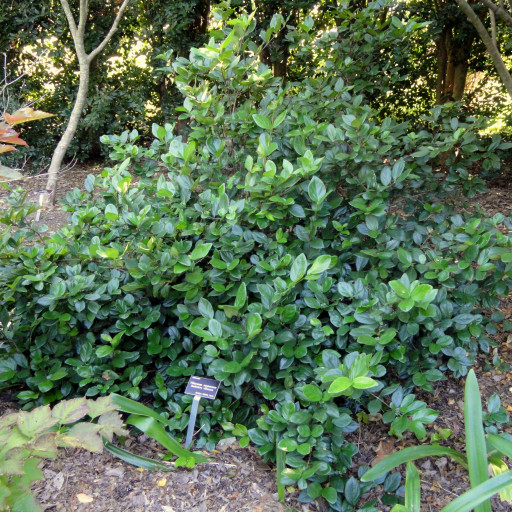
Plant Overview
Commonly known as the Sandankwa Viburnum, this Japanese native is a sturdy, evergreen "workhorse" for the home landscape. Originating from the Ryukyu Islands, it is cherished for its dense, leathery foliage that provides year-round privacy. While many shrubs hide away in the winter, the Sandankwa steps into the spotlight with delicate, rose-tinted white flowers that emit a uniquely spicy, sweet fragrance.
🔍 How to Identify
- 🍃 The Foliage: The leaves are thick, leathery, and dark green, usually measuring 2 to 4 inches long. They have a slightly "toothy" or serrated edge and a rough texture that feels a bit like fine sandpaper.
- 🌸 The Blooms: Small, tubular flowers appear in dense, hanging clusters (cymes). They are primarily creamy white but often show a distinct waxy, pinkish blush before fully opening.
- 🍒 The Berries: Following the bloom, the plant produces small, round fruits. These berries transition from a bright, eye-catching red to a deep, glossy black as they ripen in the autumn.
🏡 In Your Garden
- 🧱 The Living Wall: Because of its dense branching habit and rapid growth, it is most often used as a formal hedge or a "foundation plant" to hide the base of houses or fences.
- 🌗 The Shade Solution: Unlike many flowering shrubs that demand full sun to thrive, the Sandankwa is remarkably shade-tolerant. It’s a perfect choice for those tricky corners of the yard that receive dappled light or afternoon shadows.
- ✂️ Pruning Nuance: This plant is very forgiving of shears. However, to keep it looking its best, it should be pruned immediately after it finishes flowering in the spring so you don't accidentally cut off next year's flower buds.
⚠️ Safety & Toxicity
- 🐾 Status: Generally considered low-toxicity, but not edible.
- 👶 Details: While not listed as a majorly poisonous plant, the berries can cause mild stomach upset, nausea, or vomiting if ingested in large quantities by children or pets. It is best treated as an ornamental-only species.
✨ Fun Fact
The scent of the Sandankwa Viburnum is a polarizing delight! While many find its spicy aroma reminiscent of expensive perfume, some gardeners claim it smells exactly like "fine tobacco" or "old-fashioned soap," earning it a reputation as one of the most uniquely fragrant plants in the Viburnum family.

Detailed Care Instructions
To grow Viburnum Suspensum plants, follow these steps:
- Choose a suitable location: Viburnum Suspensum prefers full sun or partial shade, so select a spot that receives at least six hours of sunlight daily. The soil should be well-draining and fertile.
- Prepare the soil: Before planting, loosen the soil in the chosen area with a garden fork or tiller. Mix in compost or organic matter to improve drainage and add nutrients.
- Dig a hole: Dig a hole twice as wide and as deep as the root ball of the plant. Place the removed soil in a wheelbarrow or on a tarp to mix with compost for backfilling.
- Plant the Viburnum Suspensum: Gently remove the plant from its container and loosen the roots if they are tightly bound. Place the plant in the hole, ensuring that the top of the root ball is level with or slightly above the soil surface. Backfill the hole with the soil mixture, gently firming the soil around the base of the plant.
- Water thoroughly: After planting, water the Viburnum Suspensum thoroughly to settle the soil around the roots. Keep the soil consistently moist but not soggy during the first growing season.
- Mulch and stake if necessary: Apply a 2-3 inch layer of organic mulch around the plant to help retain soil moisture and suppress weeds. If your Viburnum Suspensum is top-heavy or prone to leaning, use a stake or plant support to provide stability until it becomes established.
- Prune as needed: Viburnum Suspensum can be pruned to maintain shape and size. You can prune it lightly throughout the year or perform a more extensive pruning during the dormant season. Remove dead or damaged branches and shape the plant to your preference.
- Fertilize: Feed Viburnum Suspensum with a slow-release, balanced fertilizer in early spring and again in mid-summer to promote healthy growth and flowering.
- Monitor for pests and diseases: Keep an eye out for common pests, such as aphids or scales, and promptly address any issues. Viburnum Suspensum is generally resistant to diseases but may occasionally be affected by powdery mildew or root rot if the soil is overly wet.
Regularly care for your Viburnum Suspensum plant by watering, mulching, fertilizing, and pruning to enjoy its vibrant foliage and fragrant flowers.

Place in a window with dappled sun or a spot in the middle of a room. Or directly in a window facing west or east.

When providing water for Viburnum Suspensum plants, it is essential to ensure that the moisture level remains consistent. The best way to do this is to water these plants deeply, but infrequently. One should aim to saturate the soil around the plant's root zone, but avoid overwatering, as this can lead to root rot.
During the initial establishment phase, Viburnum Suspensum plants may require more frequent watering until their roots are well-established and able to absorb moisture efficiently. However, after this period, one can adjust the watering schedule to suit the plant's needs.
To water, one should use a watering can or garden hose with a gentle flow setting. Aim to water the base of the plant rather than the foliage, as wet leaves can encourage fungal growth. It is also important to avoid splashing water onto the plant's leaves, as this can cause leaf scorch in full sun exposure.
The frequency of watering will depend on various factors, including the plant's location, the time of year, and the weather conditions. One should monitor the soil regularly and water only when the top one to two inches of soil feel dry to the touch.
In conclusion, the key to watering Viburnum Suspensum plants is to ensure a consistent moisture level, avoid overwatering, and water deeply but infrequently.
To fertilize this plant, apply a balanced fertilizer with a 10-10-10 ratio in early spring, right before new growth emerges. Apply the fertilizer according to the recommended dosage on the package. Spread the fertilizer evenly around the base of the plant, taking care not to get any fertilizer on the leaves or stems. Water the plant thoroughly after applying the fertilizer to help the nutrients penetrate the soil. For best results, repeat the fertilization process every 4-6 weeks during the growing season, stopping about 2 months before the first expected frost.
The ideal soil for the Viburnum Suspensum plant is a well-draining soil that is rich in organic matter. It should have a pH level between 5.5 and 7.5. The soil texture should be sandy loam or loam, which will provide the plant with good drainage and air circulation. The soil should be evenly moist, but not waterlogged, as the Viburnum Suspensum plant is sensitive to waterlogging and root rot. The soil should be amended with organic matter such as compost or aged manure to improve its fertility. This will provide the plant with the essential nutrients it needs for healthy growth. Additionally, the soil should be tested regularly to ensure that it has the proper pH balance and nutrient levels. This will help prevent nutrient deficiencies and ensure optimal plant health.
To propagate this plant, first select a healthy branch from the main plant and cut it to a length of about 6-8 inches. Remove any leaves or foliage from the lower half of the stem.
Prepare a pot with well-draining soil and make a hole in the center with a pencil. Dip the cut end of the stem into rooting hormone and gently insert it into the hole in the soil.
Water the cutting thoroughly and cover the pot with a plastic bag or plastic wrap to create a greenhouse effect. Place the pot in a bright spot with indirect sunlight, but avoid direct sunlight as it can burn the cutting.
Check the soil regularly and water when it feels dry to the touch. Mist the cutting with water to keep the humidity high inside the plastic bag. After a few weeks, the cutting should start to grow roots.
Once the plant has established roots, remove the plastic bag and gradually expose it to more sunlight. After a few more weeks, the plant should be ready to be transplanted into a larger pot or outdoors into the garden.
Common pests of the viburnum include Aphids, larvae. Make a habit of checking your viburnum frequently for pests so that any infestations can be caught and managed early.








