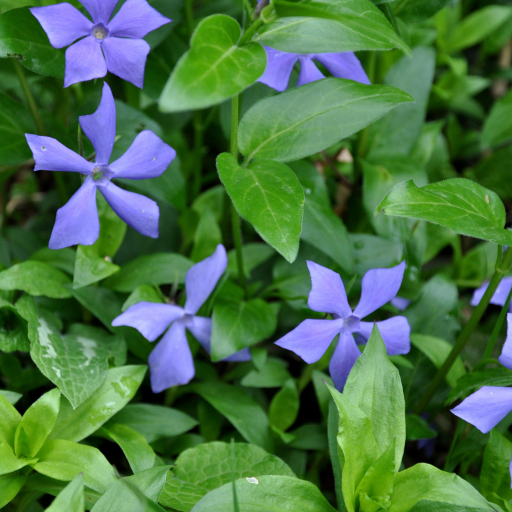
Plant Overview
Often called the "Wild Blue Star" or Herbaceous Periwinkle, this low-growing gem is the more delicate, deciduous cousin of the common evergreen periwinkles. Native to the sun-drenched grasslands of Eastern Europe and the Middle East, it creates a graceful, trailing carpet of violet-blue flowers. Unlike its aggressive relatives, this species is a polite garden guest that retreats underground during the winter, making it perfect for seasonal transitions.
🔍 How to Identify
- 🌸 The Pinwheel Blooms: The flowers are a striking violet-blue, featuring five distinct petals that look like a tiny spinning propeller or star.
- 🍃 Narrow Foliage: Unlike the round, leathery leaves of other periwinkles, these leaves are slender, lance-shaped, and have slightly fuzzy or "ciliate" edges.
- 🌱 Arching Stems: It produces long, thin stems that arch toward the ground. While it spreads, it does not form the thick, woody mats associated with invasive groundcovers.
🏡 In Your Garden
- ☀️ Sun-Loving Nature: While most periwinkles prefer deep shade, Vinca herbacea thrives in rocky, sunny spots. It is exceptionally drought-tolerant once established, thanks to its origins in the dry steppes.
- 💤 The Winter Vanish: Because it is "herbaceous," the entire plant dies back to the ground in late autumn. Gardeners should place a small marker where it is planted to avoid accidentally digging it up during early spring cleaning.
⚠️ Safety & Toxicity
- 🚫 Status: Toxic to ingest.
- 🐾 Details: Like all members of the Apocynaceae family, this plant contains vinca alkaloids. If eaten by pets or children, it can cause vomiting, diarrhea, and low blood pressure. It is best placed in areas where curious pets won't snack on the foliage.
✨ Fun Fact
The genus name Vinca is derived from the Latin word vincire, which means "to bind" or "to fetter." This refers to the long, flexible stems that were traditionally woven together to create garlands and wreaths in ancient times.

Detailed Care Instructions
To grow Vinca Herbacea plant, follow these guidelines:
- Choose the right location: Vinca Herbacea plants prefer partial shade to full shade conditions. Select an area in your garden that receives dappled sunlight or is shaded for most of the day.
- Soil preparation: Ensure that the soil is well-draining and rich in organic matter. Amend the soil with compost or well-rotted manure before planting.
- Planting: Start by sowing the seeds indoors in early spring or sow them directly in the garden after the last frost. Sow the seeds at a depth of about ¼ inch and keep the soil consistently moist.
- Watering: Vinca Herbacea plants require regular watering, especially during dry periods. Keep the soil evenly moist, but avoid overwatering, as it can lead to root rot. Mulching around the plants can help retain soil moisture.
- Fertilization: Apply a slow-release fertilizer or organic compost around the base of the plants in early spring. This will provide the necessary nutrients for healthy growth.
- Pruning: Vinca Herbacea plants benefit from regular pruning to encourage bushier growth and promote flower production. Pinch back the stems when they are young to encourage branching.
- Pests and diseases: Monitor your plants regularly for any signs of pests or diseases. Vinca Herbacea plants are generally resistant to most common garden pests, but occasionally, they can be affected by aphids or leaf spot. Treat any issues promptly with organic pest control methods.
- Winter care: Vinca Herbacea is a perennial plant, but it may require protection during harsh winters. Consider adding a thick layer of mulch around the base of the plant to insulate the roots and protect them from freezing temperatures.
- Propagation: Vinca Herbacea plants can be propagated through division or by taking stem cuttings. Dividing the plant every few years will help rejuvenate it and prevent overcrowding.
With proper care and attention, your Vinca Herbacea plant should grow well and thrive. Enjoy its beautiful blooms and attractive foliage in your garden.

Place in a bright room that is sun drenched almost all day. Or directly in a south-facing window.

To water this particular plant, it is important to keep the soil evenly moist but not waterlogged. It is recommended to water deeply but infrequently, allowing the top layer of soil to dry out between waterings. Overwatering can lead to root rot and other diseases, while under-watering can cause the plant to wilt and suffer from stress. It is also important to avoid getting water on the leaves, as this can contribute to fungal problems. A good way to water this plant is to use a watering can or hose with a soft spray nozzle, directing the water towards the base of the plant. During periods of high heat or drought, the plant may require extra water to maintain its health and vigor.
For optimal growth, apply a balanced fertilizer with equal parts nitrogen, phosphorus, and potassium to the soil around the plant's base during the active growing season. Avoid over-fertilization, which can cause leaf burn and stunted growth. The plant may benefit from a light feeding every four to six weeks during the growing season. Additionally, consider using organic fertilizers, such as compost or well-rotted manure, to enrich the soil over time.
Vinca Herbacea requires well-draining soil with moderate fertility. The soil should be slightly acidic with a pH between 6.0 to 7.5. It is best to use soil that is rich in organic matter and has good aeration. The ideal soil type is sandy loam or loamy soil. It is important to avoid using heavy clay soil or soil that is too dry as it can cause root rot and other diseases. Adding perlite or sand can help improve soil drainage. Additionally, it is recommended to add some slow-release fertilizer or compost to the soil before planting.
Vinca herbacea is a type of plant that can be propagated through vegetative means. One way to propagate this plant is through stem cuttings. To do this, take a healthy stem cutting from the parent plant, making sure it is around five to six inches long. Remove the lower leaves of the cutting and dip the cut end in rooting hormone powder. Then, plant the cutting in a well-draining soil mixture, making sure the soil is moist but not waterlogged. Place the container in bright, indirect light and keep the soil moist. In a few weeks, the cutting should form roots and new growth.
Another way to propagate Vinca herbacea is through division. This method involves separating a clump of the parent plant into smaller sections, each with its own roots and stems. To do this, carefully remove the parent plant from its container and gently separate the clumps with a sharp, sterile knife. Once divided, plant each section in a container with well-draining soil and bright, indirect light.
Propagation can also be done through layering. This involves bending a low-growing stem of the parent plant to the ground and partially burying it in soil, leaving the tip exposed. Over time, roots will form where the stem is buried, and the new plant can be separated from the parent plant and transplanted.








