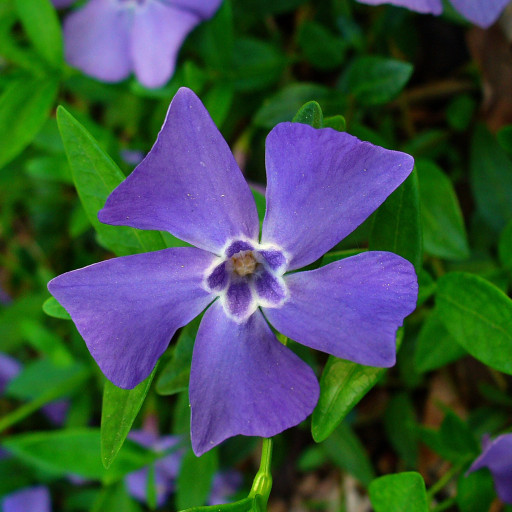
Plant Overview
Commonly known as the Lesser Periwinkle or Creeping Myrtle, this charming evergreen ground cover has blanketed European forest floors for centuries. In medieval times, it was tucked into wedding bouquets for luck, yet in Italy, it was known as the "flower of death" because it was often placed on the graves of children. Today, it is a gardener’s best friend for those tricky, shaded spots where nothing else seems to survive.
🔍 How to Identify
- 🌿 Glossy Foliage: The leaves are small, oval-shaped, and have a leathery, dark green finish that remains vibrant even through the winter months.
- 🌸 Pinwheel Blooms: It produces delicate, five-petaled flowers in a distinct "periwinkle" blue or violet. The petals are uniquely squared off at the tips, creating a propeller-like appearance.
- 🌱 Trailing Stems: The plant spreads via long, arching runners that root at the nodes. It creates a dense, low-growing carpet that rarely rises more than 6 inches off the ground.
🏡 In Your Garden
- ☁️ The Shade Specialist: This is the ultimate solution for "dry shade"—the difficult areas under large trees where grass refuses to grow. It thrives in low light and helps prevent soil erosion on slopes.
- 🚜 Spreading Nature: While it is a beautiful ground cover, it is a vigorous grower. In some regions of North America, it is considered invasive because it can smother native wildflowers. It is best planted in contained garden beds or areas where its wandering spirit won't disturb local ecosystems.
⚠️ Safety & Toxicity
- 🐾 Toxic to Pets: Vinca minor contains vinca alkaloids. If ingested by dogs, cats, or horses, it can cause symptoms ranging from vomiting and diarrhea to more serious issues like tremors or low blood pressure.
- 👶 Human Caution: While not usually life-threatening to humans, the plant can cause stomach upset if eaten and skin irritation (dermatitis) in sensitive individuals. It is wise to wear gloves when pruning large patches.
✨ Fun Fact
The word "Periwinkle" comes from the Latin vincire, which means "to bind" or "to fetter." This refers to the plant’s incredibly tough, flexible stems that were historically used to weave sturdy garlands and wreaths that wouldn't break apart.

Detailed Care Instructions
| Color | Blue, Lavender, Purple, White |
| Soil Ph | Acid, Neutral, And Alkaline |
| Humidity | Normal |
| Lighting | Part Sun |
| Soil Type | Normal, Sandy, Or Clay |
| Bloom Time | May, June |
| Difficulty | Easy |
| Plant Type | Evergreen Perennial |
| Mature Size | 3 To 6 Inches Tall With Trailing Vines That Get 18 Inches Long |
| Native Area | Central And Southern Europe |
| Temperature | 24°C - 28°C |
| Sun Exposure | Partial Sun To Full Shade |
| Hardiness Zones | 4 Through 8 |
To help grow a Vinca Minor plant, here are a few steps you can follow:
- Choose the right location: Vinca Minor is a shade-loving plant, so ensure you plant it in a spot that gets partial to full shade. Avoid direct sunlight.
- Prepare the soil: Vinca Minor prefers well-draining soil. Prepare the soil by removing any weeds or grass, loosen it up to improve drainage, and amend with organic matter like compost or peat moss.
- Planting: Dig a hole slightly larger than the root ball of the plant. Place the plant in the hole, ensuring the crown (where the stem meets the roots) is level with the soil surface. Backfill the hole with soil and gently firm it.
- Watering: After planting, water the plant thoroughly to help settle the soil. Vinca Minor likes moist but not waterlogged soil, so water regularly but avoid overwatering.
- Mulching: Apply a layer of organic mulch around the plant to help retain moisture, suppress weed growth, and keep the soil temperature stable.
- Pruning: To encourage dense and bushy growth, consider trimming back the Vinca Minor plants after they finish flowering. This can be done by cutting back the stems by about a third.
- Fertilization: Vinca Minor typically doesn't require much fertilizer. However, you can apply a balanced slow-release fertilizer in the spring to provide some nutrients.
- Maintenance: Check and remove any weeds that may compete with the plant for nutrients. Monitor for pests or diseases and take appropriate action if necessary.
Following these steps should help you successfully grow a Vinca Minor plant.

Place in a window with dappled sun or a spot in the middle of a room. Or directly in a window facing west or east.

To water this plant, it is important to first check the soil to ensure that it is dry to the touch. The plant should receive a deep watering, allowing the water to soak into the soil. It is recommended to use a watering can or hose with a gentle flow to avoid damaging the plant. The watering should be repeated when the soil begins to dry out again. It is important to avoid getting water on the leaves, as this can lead to disease and damage.
The fertilizer should be applied to the soil around the base of the plant in the early spring, just as new growth begins to emerge. Use a balanced fertilizer with an NPK ratio of 10-10-10 or 20-20-20. Follow the instructions on the label for application rates. Water the plant thoroughly after fertilizing to help the nutrients penetrate the soil and reach the roots. Fertilize again in mid-summer if necessary. Avoid fertilizing Vinca Minor too late in the season, as this can encourage new growth that is susceptible to frost damage.
The best soil to use with a particular plant species depends on its specific requirements for optimal growth. For Vinca Minor plant, it is recommended to use well-draining soil that is rich in organic matter. The soil should be moist but not waterlogged, and it should be slightly acidic to neutral, with a pH range of 6.0 to 7.5.
To ensure good drainage, you can mix in some sand, perlite, or vermiculite with the soil. Additionally, adding compost or aged manure to the soil will provide important nutrients and improve soil structure.
Before planting, it is also a good idea to amend the soil with a slow-release fertilizer that contains nitrogen, phosphorus, and potassium. This will help the plant grow healthy and promote robust blooms.
Overall, the soil for Vinca Minor plant should be well-aerated, moist, and nutrient-rich, with good drainage properties to prevent waterlogging.
Vinca Minor is a trailing perennial plant that is commonly propagated by rooting stem cuttings. To propagate Vinca Minor, select a healthy mother plant and take 3-4 inch stem cuttings with at least 2-3 nodes. Remove the lower leaves from the stem and dip the cut end into a rooting hormone powder. Plant the cuttings into a moist, sandy soil mixture and keep them in a warm and bright location. Water the cuttings regularly to ensure the soil stays moist but not waterlogged. After a few weeks, roots should start to form and new growth will appear on the stem. Once the cuttings have established roots, they can be transplanted into their permanent location in the garden. It is important to note that Vinca Minor can be an invasive plant, so propagation should be done with caution and in areas where it will not become a problem.
Common pests of the common periwinkle include Scale insect, mealybugs, spider mites, aphids, whiteflies. Make a habit of checking your common periwinkle frequently for pests so that any infestations can be caught and managed early.








