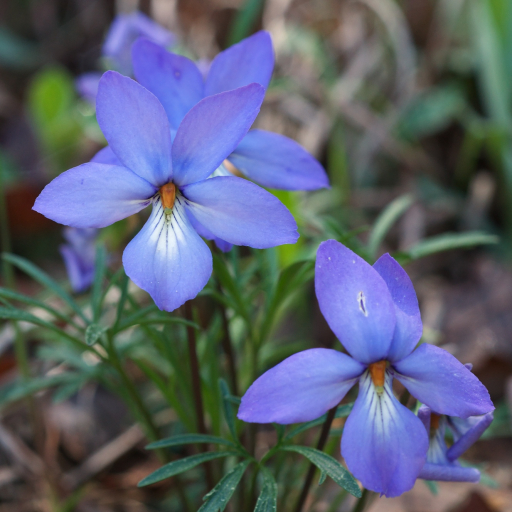
Plant Overview
Known as the Birdfoot Violet, this charming North American perennial is often called the "Queen of the Violets" for its exceptionally large and vivid blooms. Unlike the common violets that might invade your lawn, Viola pedata is a refined, slow-growing beauty found in sandy prairies and rocky slopes. Its name is a direct tribute to its unique foliage, which fans out in a shape remarkably similar to a bird’s claw.
🔍 How to Identify
- 👣 Avian Foliage: The leaves are deeply divided into three to five narrow, finger-like lobes. This "birdfoot" shape is a key identifier that sets it apart from the heart-shaped leaves of most other violets.
- 🎨 Bicolor Blooms: While some are solid lilac, the most prized variety features two upper petals of deep, velvety royal purple and three lower petals of a soft, pale lavender.
- 🧡 The Golden Eye: In the center of the flower, you’ll find a prominent, bright orange "beak" formed by the stamens, which stands out against the petal colors.
🏡 In Your Garden
- ⏳ Drainage is Essential: This plant is a "specialist." It thrives in lean, sandy, or gravelly soil. It has a vertical rhizome and will quickly rot if forced to sit in heavy, wet clay or rich, moisture-retentive garden soil.
- ☀️ Sun Seeker: Unlike its shade-loving cousins, the Birdfoot Violet craves sunshine. It is happiest in full sun to very light dappled shade, mimicking its natural habitat of open pine barrens and rocky glades.
⚠️ Safety & Toxicity
- ✅ Safe for All: Viola pedata is non-toxic to humans, cats, and dogs. In fact, many wild violets are historically known for being edible.
- 🌱 Handle with Care: While safe to touch, it is sensitive to transplanting. Because it grows from a thick, vertical rootstock rather than spreading by runners, moving an established plant can be fatal to its delicate root system.
✨ Fun Fact
- 🐜 The Ant Express: This violet relies on "Myrmecochory"—seed dispersal by ants! Each seed has a tiny, protein-rich attachment called an elaiosome. Ants carry the seeds back to their underground nests to eat the treat, effectively planting the seeds in a protected, nutrient-rich environment.

Detailed Care Instructions
To grow Viola Pedata, also known as the bird's-foot violet, you can follow these steps:
- Choose the right location: Viola Pedata prefers sandy or well-draining soil that is slightly acidic. It thrives in full sun to partial shade. Choose a spot in your garden that receives at least 4-6 hours of direct sunlight daily.
- Prepare the soil: Before planting, remove any weeds or grass from the area. Loosen the soil using a garden fork or tiller. If the soil is heavy or clayey, amend it with organic matter like compost to improve drainage.
- Sow seeds or plant seedlings: Viola Pedata can be grown from seeds or seedlings. If using seeds, scatter them on the prepared soil and lightly press them into the soil surface. Water gently to avoid displacing the seeds. If using seedlings, dig holes slightly larger than the root ball and place each seedling into a hole. Space the plants 6-8 inches apart to allow room for growth.
- Watering: Keep the soil moist but not waterlogged. Water the plants deeply whenever the top inch of soil feels dry to the touch. Mulching around the plants can help retain moisture and suppress weed growth.
- Fertilizing: Viola Pedata generally does not require heavy fertilization. You can apply a balanced, slow-release fertilizer once in early spring. Follow the instructions on the fertilizer packaging for proper application rates.
- Controlling pests and diseases: Viola Pedata is relatively resistant to pests and diseases. However, keep an eye out for slugs, snails, and aphids. If detected, you can manually remove them or use appropriate organic pest control methods.
- Pruning: Pruning is not necessary for Viola Pedata. However, you can remove spent flowers as they fade to encourage more blooms and promote a tidy appearance.
- Overwintering: Viola Pedata is a perennial plant and can tolerate cold winters. Mulch around the plants with straw or leaves in late fall to provide insulation and protect the roots from freezing temperatures.
By following these steps, you can grow Viola Pedata successfully in your garden. Enjoy the beautiful flowers and the delightful fragrance they bring.

Place in a window with dappled sun or a spot in the middle of a room. Or directly in a window facing west or east.

Viola Pedata is a plant that requires regular watering to maintain its health and growth. It is important to consistently monitor the moisture level of the soil to avoid over or under-watering. The soil should be kept consistently moist, but not waterlogged, as this can lead to root rot and other plant diseases.
One effective way to water Viola Pedata is to water deeply, allowing the water to penetrate down to the roots. This can be achieved by using a watering can or hose with a soft spray nozzle. It is best to water the plant in the morning or evening, when the temperatures are cooler and the water is less likely to evaporate quickly.
It is important to avoid getting water on the leaves of the plant, as this can encourage the growth of fungal diseases. Instead, aim to water at the base of the plant, directing the water towards the soil.
In periods of dry weather or during the plant’s active growing season, it is important to increase the frequency of watering. It is also important to provide good drainage for the plant, as standing water can lead to root damage.
In summary, to effectively water Viola Pedata, you should monitor the moisture level of the soil, water deeply and avoid getting water on the leaves, increase watering frequency in dry weather, and provide good drainage.
- Choose a balanced, slow-release fertilizer with equal amounts of nitrogen, phosphorus, and potassium.
- Apply the fertilizer during the growing season, preferably in early spring or late fall.
- Follow the recommended dosage on the fertilizer packaging, and apply evenly around the base of the plant.
- Water the plant immediately after fertilizing to help the nutrients reach the root system.
- Avoid fertilizing during the dormant season, as this can cause excessive growth and weaken the plant.
- Consider supplementing with organic fertilizers, such as compost or manure, to improve soil fertility and promote healthy growth.
Viola Pedata prefers a specific type of soil, typically characterized by its pH and nutrient composition. The soil should have a slightly acidic to neutral pH range, between 5.5 and 7.0. The texture of the soil should be well-draining, allowing excess water to drain away quickly to prevent root rot.
The plant prefers moist soil that is rich in organic matter, such as compost or leaf litter. This type of soil composition provides essential nutrients for healthy plant growth.
It is important to avoid heavy, clay soils since Viola Pedata requires a more porous soil for proper root growth. Adding sand or perlite to the soil mixture can improve the soil’s texture and drainage.
Finally, regular soil testing can help maintain balanced soil pH and nutrient levels, ensuring optimal plant health and growth.
Viola Pedata is propagated through asexual means such as division or stem cuttings. To propagate through division, carefully dig up the mature clump during early spring or late fall. Separate the clump into several smaller sections, ensuring each section has a healthy root system and foliage. Replant the sections into new containers or directly into the ground.
To propagate Viola Pedata through stem cuttings, choose a healthy mature stem with several leaves and cut it just below the node using a pair of clean, sharp scissors. Remove the lower leaves and any flowers or buds. Dip the cut end into rooting hormone and plant it in a pot filled with damp, well-draining potting soil.
Place the pot in a bright, but indirect, light and keep the soil consistently moist. Within a few weeks, new roots should develop, and new growth should appear. Once the new plant has established a healthy root system, it can be transplanted into a larger pot or directly into the ground.








