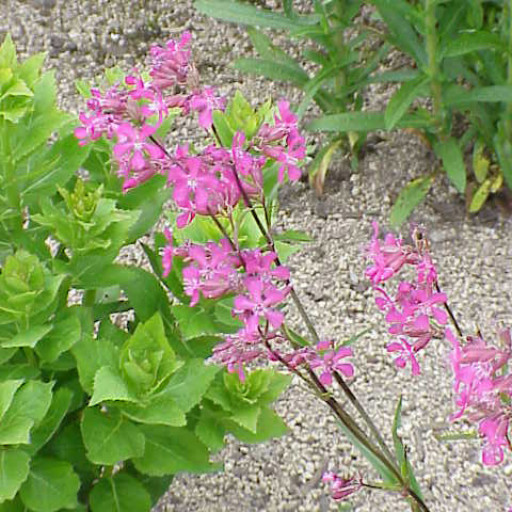
Plant Overview
Known widely as the Sticky Catchfly, Viscaria vulgaris is a striking perennial that looks like it stepped straight out of a wildflower meadow. It is famous for its "sticky" secret—a dark, resinous glue found on its stems that acts as a natural barrier against crawling insects. In the language of flowers, it has historically symbolized a "snare" or "invitation to dance," thanks to its vibrant magenta blooms and adhesive personality.
🔍 How to Identify
- 🌸 Vibrant Blooms: It features dense clusters of five-petaled, trumpet-shaped flowers in a shocking shade of reddish-purple or hot pink.
- 🍯 The Sticky Zones: Look for dark, brownish-black sticky patches on the stems just below the leaf joints. These feel tacky to the touch, almost like unhardened sap.
- 🌿 Folliage Shape: The plant forms a neat basal rosette of narrow, dark green, lance-shaped leaves, with upright flowering stems reaching up to 20-30 inches tall.
🏡 In Your Garden
- 🪨 The Rock Star: Because it naturally thrives in rocky crevices and dry meadows, it is the perfect candidate for rock gardens or "well-drained" spots where other plants might struggle with thirst.
- 🦋 Pollinator Magnet: While it "catches" small crawling ants that try to steal nectar, it is a favorite for long-tongued insects like butterflies and bumblebees who can reach the nectar while hovering safely.
- ☀️ Sun Seeker: This plant is a true sun-worshipper. It rarely thrives in deep shade and needs bright light to produce that signature neon flower color.
⚠️ Safety & Toxicity
- ✅ Safe for All: Viscaria vulgaris is generally considered non-toxic to humans, dogs, and cats. It is a safe choice for family gardens and pet-friendly landscapes.
- 🧤 Skin Sensitivity: While not poisonous, the sticky resin on the stems can be a bit messy or mildly irritating to those with very sensitive skin if handled extensively during pruning.
✨ Fun Fact
The Sticky Catchfly is a secret weapon for gardeners! It contains high levels of brassinosteroids, which are natural plant hormones. Research has shown that extracts from this plant can actually help neighboring plants grow faster and become more resistant to diseases.

Detailed Care Instructions

Place in a bright room that is sun drenched almost all day. Or directly in a south-facing window.

The plant in question prefers to be watered regularly during its growing season and less frequently during its dormant season. It is best to water it at the base of the plant rather than overhead, as wet foliage can lead to diseases. The soil should be moist but not waterlogged, and it is important to avoid letting the soil dry out completely. When watering, it is recommended to use room-temperature water to prevent shocking the plant. It is also important to make sure any excess water is able to drain away, as standing water can lead to root rot.
Viscaria Vulgaris grows best in a well-draining soil that is rich in organic matter. The soil should be slightly acidic to neutral with a pH range of 6.0-7.5. It is important to avoid using heavy clay soils, as they do not allow for proper drainage and can lead to root rot.
A good soil mix for Viscaria Vulgaris should consist of a blend of garden soil, compost, perlite and sand. The garden soil should have good drainage properties and be free from pests and diseases. Compost should be added to improve the soil structure and provide essential nutrients. Perlite and sand should be used to increase the porosity of the soil, which will provide good aeration and drainage.
When planting Viscaria Vulgaris, it is important to create a planting hole that is about twice the size of the plant's root ball. The plant should be placed in the hole and backfilled with the soil mix, ensuring that the plant is at the same level as it was in its original container. The soil should be gently tamped down around the plant and watered thoroughly to ensure good root establishment.








