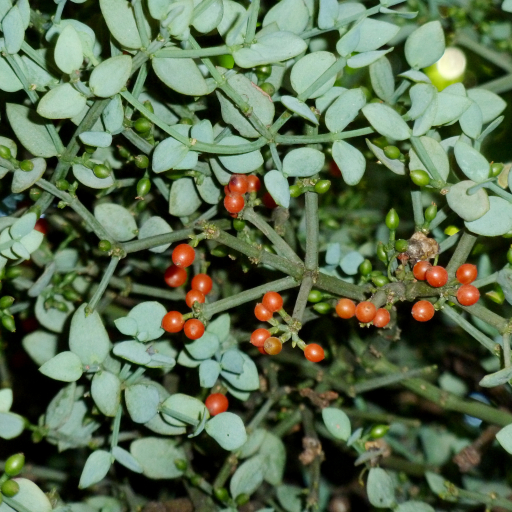
Plant Overview
Often called the Round-leaved Mistletoe, this fascinating African native is a "hemiparasite." Unlike typical plants, it doesn't grow in the ground but hitches a ride high up on the branches of trees like Acacias and Hawthorns. While it steals water and minerals from its host, it remains a "partial" parasite because its thick, green leaves still produce energy through photosynthesis.
🔍 How to Identify
- 🍃 The Leaves: As the name rotundifolium suggests, the leaves are thick, leathery, and distinctly round or oval. They usually grow in pairs and have a dull, olive-green hue.
- 🍒 The Fruit: It produces small, fleshy berries that turn a brilliant, translucent red or orange when ripe. These are the plant's primary "lures" for local wildlife.
- 🌿 The Structure: It grows as a brittle, woody shrublet that forms a dense, tangled ball directly attached to the bark of a host tree. You won't find any visible roots leading to the soil.
🏡 In Your Garden
- 🐦 A Wildlife Magnet: If this mistletoe appears in your garden, expect a flurry of bird activity! Species like the Tinkerbird and Cape White-eye are obsessed with the berries. They are the plant’s primary "gardeners," spreading seeds from branch to branch.
- 🌳 Host Impact: While it is a parasite, it rarely kills a healthy tree. However, it can be a sign of a stressed host or can cause "dieback" on specific branches. It is best managed by pruning if it begins to overwhelm a small ornamental tree, as it "taps" directly into the tree's water supply.
⚠️ Safety & Toxicity
- 🚫 Status: TOXIC. While the berries are a feast for birds, they are not safe for human consumption.
- 🐾 Details: The plant contains viscotoxins. Ingesting the berries or leaves can cause blurred vision, stomach cramps, and a slowed heart rate in humans. Keep curious toddlers and pets away from any fallen berries, as they are highly attractive but dangerous.
✨ Fun Fact
- ✨ Biological Superglue: The seeds are coated in a substance called viscin, which is one of nature's strongest biological glues. When a bird "deposits" a seed onto a branch, the glue hardens almost instantly, ensuring the seed doesn't fall to the ground where it would surely die.

Detailed Care Instructions

Place in a window with dappled sun or a spot in the middle of a room. Or directly in a window facing west or east.

Some plants require more regular watering than others, which should be done every few days. It's critical to maintain the soil moist all of the time. The water requirements of the same plant placed in pots with varying sizes will differ. Because the water in the smaller pot evaporates faster than the water in the larger pot, it will require more watering. Regardless of pot size, the surface should constantly be maintained moist.








